
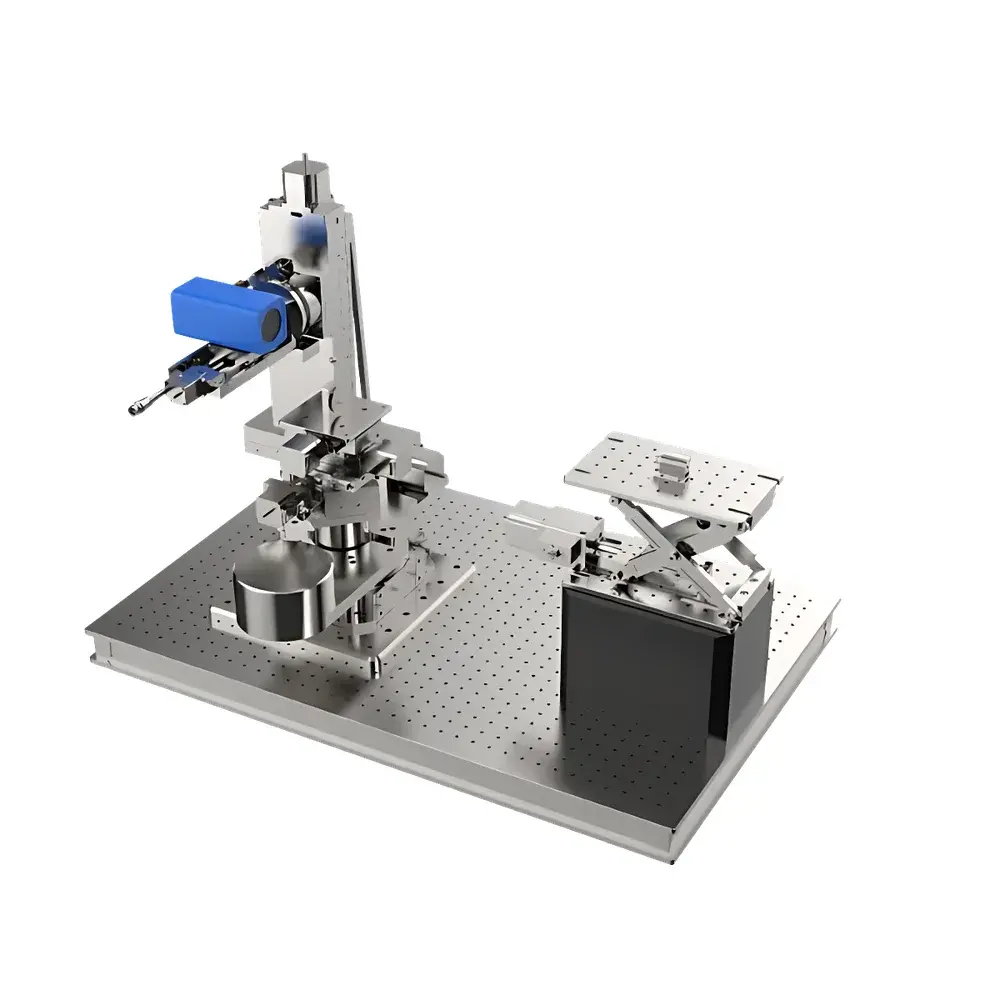
GKInst LaScater 1.0 Laser Small-Angle Scattering (SAS) Instrument
| Brand | GKInst |
|---|---|
| Model | LaScater 1.0 |
| Origin | Anhui, China |
| Instrument Type | Integrated SAS System |
| Laser Wavelength Range | 390–780 nm |
| Laser Power | 1–100 W (continuously adjustable) |
| Power Stability | < 1% RMS |
| Beam Divergence | < 0.015° |
| Sample Stage Travel (X/Y) | ±75 mm |
| Z-Travel | ±10 mm |
| Positioning Accuracy | 1 µm |
| Angular Axes (β/γ) | ±7.5°, Resolution: 0.001° |
| Rotational Axis (α) | 360°, Resolution: 0.001° |
| Detector | CCD/CMOS hybrid sensor |
| Pixel Size | 10 µm × 10 µm |
| SNR | >40 dB |
| Peak Quantum Efficiency | 0.65 A/W |
| Frame Rate (high-speed mode) | up to 60 fps |
| Cooling | Peltier-based thermoelectric cooling for low-noise acquisition |
Overview
The GKInst LaScater 1.0 is a benchtop laser-based small-angle scattering (SAS) instrument engineered for quantitative structural characterization of nanoscale and sub-micron heterogeneities in soft matter, colloids, polymers, catalysts, and biological macromolecules. Operating on the fundamental principle of elastic light scattering at angles typically between 0.01° and 5°, the system measures angular intensity distributions (I(q)) to extract structural parameters including particle size distribution, radius of gyration (Rg), surface fractal dimension, and interfacial roughness—without requiring crystalline order or sample destruction. Unlike X-ray or neutron SAS systems, the LaScater 1.0 leverages tunable visible-wavelength lasers (390–780 nm), enabling rapid, ambient-condition measurements with high signal-to-noise ratio and minimal radiation safety constraints. Its modular optical architecture supports both static and quasi-static acquisition modes, making it suitable for routine quality control as well as advanced research into dynamic structural evolution under controlled environmental stimuli.
Key Features
- Multi-wavelength laser source with continuous power adjustment (1–100 W) and exceptional stability (<1% RMS), facilitating wavelength-dependent contrast optimization for complex matrices.
- High-precision multi-axis sample stage with linear (X/Y/Z) and rotational (α/β/γ) degrees of freedom, offering sub-micron positioning accuracy (1 µm) and angular resolution down to 0.001°—critical for precise alignment and anisotropic scattering analysis.
- Dual-mode detector system integrating high-sensitivity cooled CCD and high-speed CMOS sensors, each optimized for specific experimental regimes: low-light static measurements or time-resolved kinetics at up to 60 fps.
- Modular in situ cell compatibility—including tensile stages, cryo-heating stages (–150°C to +300°C), and gradient flow cells—enabling real-time structural monitoring during mechanical deformation, thermal cycling, or chemical reaction.
- Automated azimuthal scanning protocol: motorized detector translation combined with software-driven data stitching yields full 2D q-space maps without manual repositioning or interpolation artifacts.
Sample Compatibility & Compliance
The LaScater 1.0 accommodates solid films, powders, gels, emulsions, aerosols, and liquid dispersions in standard quartz cuvettes, capillaries, or custom vacuum-tight cells. Sample volume requirements range from 10 µL (microfluidic configuration) to bulk slabs (up to 50 mm × 50 mm). All optical and mechanical components comply with IEC 61000-6-3 (EMC emission standards) and IEC 60825-1:2014 (laser safety Class 4 compliance with interlocked enclosure). The system architecture supports audit-ready operation per GLP and GMP frameworks: full electronic logbook, user-access-level controls, and timestamped metadata embedding for every acquired dataset—fully compatible with FDA 21 CFR Part 11–compliant LIMS integration when deployed with optional validation packages.
Software & Data Management
LaScater Control Suite v3.2 provides unified acquisition, real-time visualization, and model-assisted reduction workflows. Raw 2D scattering images undergo automatic background subtraction, polarization correction, and radial/azimuthal integration using validated algorithms aligned with ISO 21382:2020 (small-angle scattering data reduction). Built-in Guinier, Porod, and polydisperse sphere fitting modules enable immediate Rg, d-spacing, and polydispersity index estimation. All processed data export to standardized formats (ASCII, HDF5, NeXus) and integrate natively with third-party platforms such as SasView, IGOR Pro, and MATLAB. Audit trails record operator ID, parameter sets, calibration timestamps, and version-controlled processing scripts—ensuring full traceability for regulatory submissions.
Applications
- Environmental science: Quantification of atmospheric particulate morphology (e.g., soot aggregates, secondary organic aerosols) and hygroscopic growth behavior under variable RH conditions.
- Pharmaceutical development: Monitoring self-assembly kinetics of lipid nanoparticles (LNPs), protein aggregation pathways, and excipient-induced colloidal stability shifts.
- Heterogeneous catalysis: In situ tracking of metal nanoparticle sintering, support pore restructuring, and coke deposition dynamics during thermal aging or reactive gas exposure.
- Advanced materials: Characterization of block copolymer microphase separation, polymer blend miscibility, and nanocomposite filler dispersion homogeneity.
- Academic research: Teaching laboratory implementation of scattering theory, structure–property correlation studies, and method validation against SAXS/SANS reference datasets.
FAQ
What sample preparation protocols are recommended for optimal SAS data quality?
Standard protocols include filtration (0.1 µm syringe filters), degassing under vacuum, and concentration optimization to avoid multiple scattering—detailed SOPs are provided in the instrument’s Application Notes Library.
Can the LaScater 1.0 be calibrated against NIST-traceable standards?
Yes—certified polystyrene latex spheres (NIST SRM 1963, SRM 2800) and silver behenate (d-spacing = 58.38 Å) are supported for absolute q-scale and intensity calibration; calibration routines are embedded in the software.
Is remote operation and data access supported?
The system includes secure TLS-encrypted web interface (HTTPS) for real-time monitoring, queue-based acquisition scheduling, and encrypted cloud sync via optional GKCloud Gateway module.
Does the instrument support time-resolved measurements?
Yes—triggered acquisition mode synchronizes detector readout with external stimuli (e.g., stepper motor position, temperature ramp, pump flow rate) with sub-millisecond timing resolution.
What maintenance intervals are specified for long-term operational reliability?
Laser diode output verification and optical alignment checks are recommended every 6 months; detector quantum efficiency mapping and stage backlash calibration are scheduled annually—service logs are auto-generated and exportable.





