
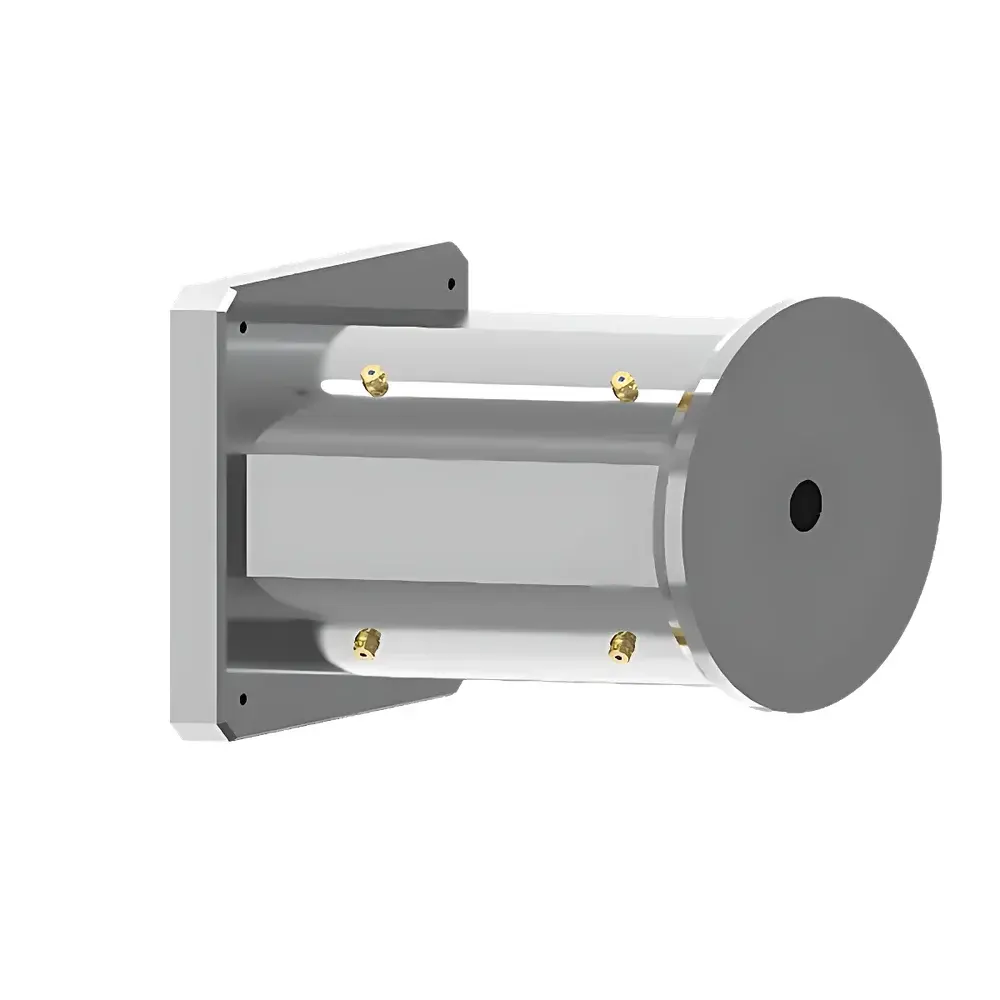
GKINST X-Ray Reflective Mirror
| Brand | GKINST |
|---|---|
| Origin | Anhui, China |
| Manufacturer Type | Authorized Distributor |
| Product Category | Domestic |
| Model | X-Ray Reflective Mirror |
| Pricing | Available Upon Request |
| Focal Length | 110 mm |
| Optimized Energies | 8.0 keV (Cu Kα), 17.24 keV (Mo Kα) |
| Output Beam Divergence | ΔΦ ≤ 0.4 mrad |
| Reflectivity | ≥ 65% (integrated, at optimized energy) |
| Dimensions (L × W × H) | 100 mm × 40 mm × 30 mm (custom sizes available) |
Overview
The GKINST X-Ray Reflective Mirror is a precision optical component engineered for high-performance beam conditioning in laboratory-scale X-ray diffraction (XRD) and small-angle X-ray scattering (SAXS) systems. Unlike conventional refractive or absorptive optics, this mirror operates on the principle of total external reflection at grazing incidence—leveraging the low real part of the complex refractive index of materials in the X-ray regime. At incident angles below the critical angle (typically < 0.5° for Cu Kα), X-rays undergo specular reflection with minimal absorption, enabling efficient beam focusing, collimation, or harmonic rejection without introducing significant wavefront distortion. Designed for integration into synchrotron beamlines, rotating-anode sources, or microfocus sealed-tube generators, the mirror delivers stable, reproducible optical performance under vacuum or helium-purged environments typical of high-resolution X-ray instrumentation.
Key Features
- Ultra-precision substrate fabrication: Monocrystalline silicon or fused silica substrates machined to user-specified dimensions, surface figure (λ/10 PV or better), and RMS roughness (< 0.3 nm) via deterministic polishing and interferometric metrology.
- Tailored multilayer or single-layer coating architecture: Custom-designed Ni/C, Pt/C, or W/B4C coatings deposited by magnetron sputtering or ion-beam deposition; layer thickness, interface grading, and stoichiometry optimized for peak reflectivity, bandwidth, and angular acceptance at target X-ray energies.
- High thermal stability and mechanical rigidity: Low-expansion substrate material combined with stress-balanced thin-film stacks ensures long-term alignment retention under thermal load from intense X-ray beams.
- Grazing-incidence geometry support: Compatible with standard kinematic mounts (e.g., six-axis goniometers) and vacuum-compatible flanges (CF-40/CF-63); optional motorized pitch/roll adjustment for in situ optimization.
- Traceable calibration documentation: Each unit supplied with interferometric surface map, reflectivity curve (measured at BL12B, NSRL or equivalent facility), and coating composition report.
Sample Compatibility & Compliance
This reflective optic is compatible with standard X-ray source configurations operating in the 5–25 keV range, including Cu Kα (8.04 keV), Mo Kα (17.48 keV), and Ag Kα (22.16 keV). It meets the dimensional and surface quality requirements specified in ISO 10110-7 (optical elements — surface form tolerances) and ASTM E915-21 (standard test method for residual stress by X-ray diffraction). While not a standalone analytical instrument, its use supports compliance with GLP and GMP workflows when integrated into validated XRD/SAXS platforms—particularly where beam purity, intensity stability, and angular resolution are critical for phase identification, crystallite size analysis, or nanostructure characterization per ISO 21390, ISO 18556, and USP .
Software & Data Management
The GKINST X-Ray Reflective Mirror functions as a passive optical element and does not incorporate embedded electronics or firmware. However, its performance parameters—including focal length, optimal incidence angle, and reflectivity vs. energy curves—are fully compatible with industry-standard optical simulation tools such as SHADOW, XOP, or SRW. Users may import provided surface error maps and coating optical constants (n, k) into ray-tracing models to predict beamline throughput, spot size, and background suppression. Reflectivity data files (ASCII format) and mounting interface drawings (STEP/IGES) are delivered with each unit to facilitate integration into LabVIEW, EPICS, or Tango-based control architectures. Audit trails for coating process logs and metrology reports are retained for 10 years per internal QA policy, supporting regulatory review during FDA 21 CFR Part 11–compliant system validation.
Applications
- Monochromatic beam conditioning in powder XRD systems for improved signal-to-noise ratio and reduced parasitic scattering.
- Primary optics in SAXS beamlines to define incident beam divergence and suppress higher-order harmonics from monochromators.
- Focusing element in micro-XRD setups requiring sub-100 µm beam spots for spatially resolved phase mapping.
- Harmonic rejection in time-resolved experiments using polychromatic sources coupled with fast detectors.
- Reference optic in metrology labs calibrating X-ray wavefront sensors or testing adaptive optics for next-generation light sources.
FAQ
What is the maximum heat load this mirror can withstand?
Thermal loading capacity depends on beam size, power density, and cooling configuration. Under typical lab-source conditions (≤ 2 kW rotating anode, 0.5 mm × 0.5 mm beam, 0.3° incidence), no active cooling is required. For synchrotron applications, water-cooled mounts are recommended and available upon request.
Can you supply mirrors with custom focal lengths outside the standard 110 mm?
Yes. Substrate curvature is adjustable during grinding/polishing; focal lengths from 50 mm to 500 mm are routinely manufactured with maintained surface figure fidelity.
Do you provide coating durability data under prolonged X-ray exposure?
Accelerated aging tests show no measurable degradation in reflectivity after >109 photons/mm² at 8 keV (Cu Kα), consistent with literature on Ni/C bilayers under UHV conditions.
Is vacuum compatibility certified?
All substrates and coatings are processed and tested under <1×10⁻⁶ mbar; outgassing rates comply with ECSS-Q-ST-70-02C for space-qualified optics.
How is angular alignment verified prior to shipment?
Each mirror undergoes full-aperture slope error measurement using a long-trace profiler (LTP) and is aligned to within ±2 arcsec of nominal incidence angle using a He–Ne laser autocollimator traceable to NIST standards.



