
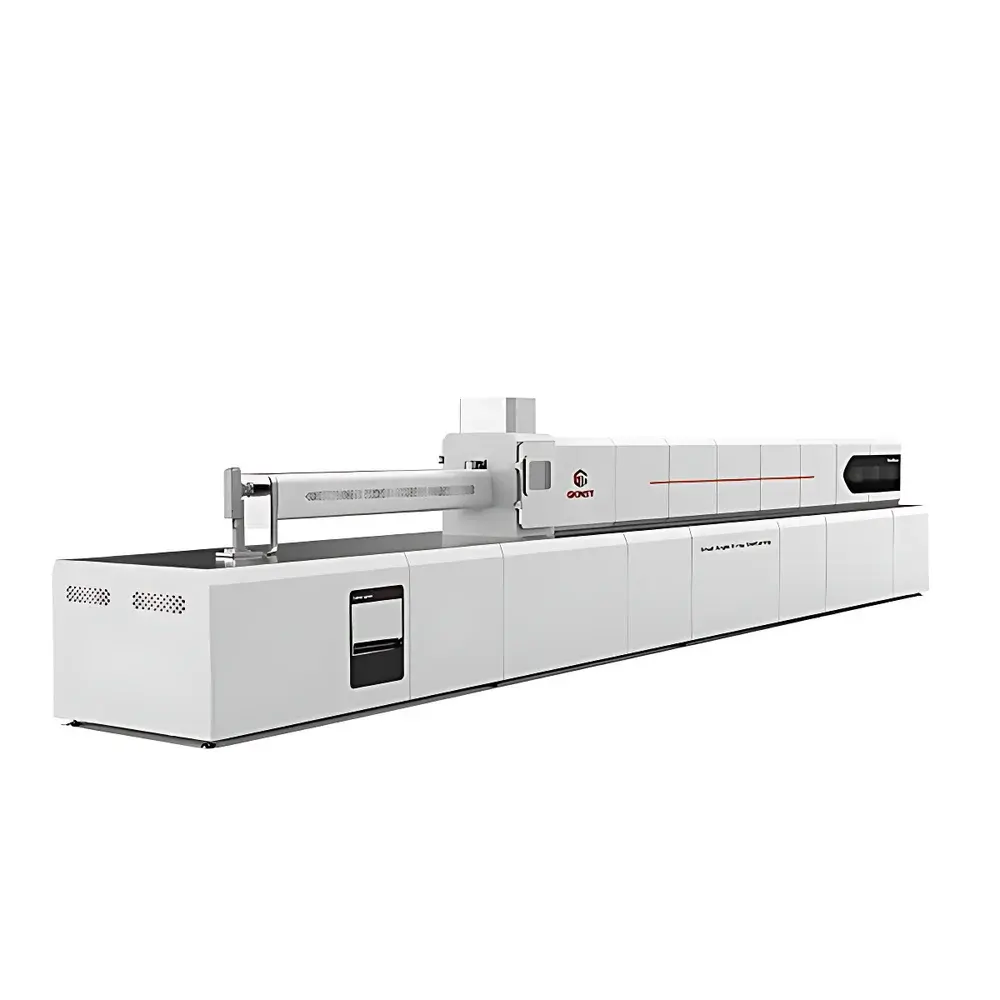
GKInst SAXSFocus Series Small-Angle X-ray Scattering (SAXS) System
| Brand | GKInst |
|---|---|
| Origin | Anhui, China |
| Manufacturer Type | Authorized Distributor |
| Origin Category | Domestic |
| Model | SAXSFocus |
| Price Range | USD 420,000 – 1,120,000 |
| Instrument Type | Small-Angle X-ray Scattering (SAXS) System |
| Measurement Dynamic Range | 32-bit, 1 × 10⁷ photons/s/pixel |
Overview
The GKInst SAXSFocus Series is a high-performance, laboratory-based small-angle X-ray scattering (SAXS) system engineered for quantitative structural characterization across length scales from ~0.1 nm to >100 nm. Operating on the fundamental principle of elastic X-ray scattering from electron density fluctuations in matter, the SAXSFocus enables rigorous determination of nanoscale morphology—including particle size distribution, shape anisotropy, internal porosity, domain spacing in block copolymers, and interfacial roughness—without requiring crystalline order. Its design integrates a microfocus sealed-tube X-ray source with automated dual-target capability (Cu standard; optional Mo, Ag, Ga, or In), coupled with a multilayer focusing mirror and precision collimation optics that eliminate parasitic scattering and deliver high brilliance with minimal beam divergence. The vacuum-compatible scattering chamber and motorized detector translation stage (SD = 30–6000 mm) ensure optimal q-range coverage (0.007–50 nm⁻¹) and high signal-to-noise ratio across both ultra-small-angle (USAXS) and conventional SAXS regimes.
Key Features
- Microfocus X-ray source with automatic dual-target switching (Cu/Mo/Ag/Ga/In) and liquid-metal Ga/In target options for tunable wavelength selection and enhanced flux at specific energies.
- Optimized X-ray optics: Multilayer focusing mirror + high-precision zero-scatter collimation system enabling real-time, continuous, and motorized beam spot size adjustment without manual intervention.
- Modular, high-throughput sample handling: Interchangeable auto-samplers supporting powder (40/60-position), capillary (30-position), solid (30-position), and gel (15-position) formats—all compatible with robotic integration and unattended operation.
- Multi-axis goniometric sample stage: XYZ translation (±75 mm, 1 µm resolution); Omega and Ry rotation (±5°, 0.001° angular resolution); Phi rotation (330°, 0.001° resolution) for precise orientation control and reciprocal-space mapping.
- Ultra-low-noise 2D silicon pixel array detector: Single-photon counting architecture with zero dead time, no readout noise or dark current; 75 µm × 75 µm pixel pitch; true 32-bit dynamic range for simultaneous capture of weak and intense scattering features.
- Vacuum scattering chamber with fully motorized detector rail: Enables stable long-exposure measurements and eliminates air scatter artifacts—critical for low-q data fidelity and accurate Porod analysis.
Sample Compatibility & Compliance
The SAXSFocus accommodates a broad spectrum of sample forms—powders, solutions, gels, thin films, fibers, and bulk solids—and supports in situ and operando experimentation via dedicated environmental stages for temperature-controlled (−180°C to +800°C), tensile, humidity, and gradient-field conditions. All hardware and software modules comply with ISO/IEC 17025 requirements for testing laboratories, and the system architecture supports audit-trail-enabled operation per FDA 21 CFR Part 11 when deployed in regulated GMP/GLP environments. Data integrity is ensured through timestamped metadata embedding, electronic signature support, and non-modifiable raw data archiving. The system meets electromagnetic compatibility (EMC) standards IEC 61326-1 and safety standards IEC 61010-1 for Class I laboratory equipment.
Software & Data Management
GKInst SAXSControl Suite provides full automation of instrument alignment, sample positioning, exposure sequencing, and detector calibration. Batch acquisition workflows support scheduled multi-sample runs with adaptive exposure optimization. Raw 2D scattering images are processed using SAXSAnalysis Pro—a validated toolkit implementing standard reduction pipelines (radial averaging, background subtraction, absolute intensity calibration, desmearing) and advanced modeling modules including form factor fitting (spheres, cylinders, core-shell), structure factor analysis (hard-sphere, polydisperse), and inverse Fourier transform for real-space pair distance distribution functions (P(r)). All processing steps are scriptable via Python API and exportable in standardized formats (NXcanSAS, HDF5) for cross-platform interoperability with third-party tools such as ATSAS, Scatter, or SasView. Audit logs record every parameter change, user action, and calibration event for full traceability.
Applications
The SAXSFocus serves as a primary structural probe in academic and industrial R&D labs across diverse domains: polymer science (morphology evolution during annealing or solvent casting), semiconductor nanofabrication (quantitative metrology of quantum dot ensembles and porous Si templates), energy materials (pore network characterization in battery separators and MOF frameworks), biopharmaceutical development (conformational stability of monoclonal antibodies and virus-like particles), catalysis (metal nanoparticle dispersion and support interface analysis), food science (fat crystal network topology and protein aggregation kinetics), and advanced composites (nanofiller dispersion homogeneity and interphase thickness quantification). Its ability to resolve hierarchical structures—from atomic-scale density variations to micron-scale phase segregation—makes it indispensable for structure–property relationship studies where diffraction-limited techniques fall short.
FAQ
What X-ray wavelengths are supported by the SAXSFocus system?
The system ships with a Cu Kα source (λ = 0.15418 nm) as standard; optional targets include Mo (λ = 0.07107 nm), Ag (λ = 0.05608 nm), Ga (λ = 0.1439 nm), and In (λ = 0.1274 nm), all switchable under vacuum without breaking beamline integrity.
Is the detector capable of time-resolved SAXS measurements?
Yes—the single-photon-counting detector supports frame rates up to 1 kHz (depending on ROI size and SD distance), enabling kinetic studies of structural transitions with millisecond temporal resolution.
Can the system be integrated into existing lab automation infrastructure?
The SAXSFocus provides full OPC UA and RESTful API interfaces, allowing seamless integration with LIMS, MES, and robotic sample-handling platforms compliant with ASTM E2658 and ISO/IEC 17025 digital workflow standards.
What level of q-resolution can be achieved at maximum SD distance?
At SD = 6000 mm and using a 1.5 mm beamstop, the minimum measurable q is 0.001 nm⁻¹, corresponding to a real-space correlation length of ~6.3 nm—sufficient for characterizing large micelles, vesicles, and hierarchical mesophases.
Does GKInst provide application-specific method development support?
Yes—GKInst offers on-site and remote application consulting, including custom model implementation, SOP development, and personnel training aligned with ISO/IEC 17025 competency requirements.



