
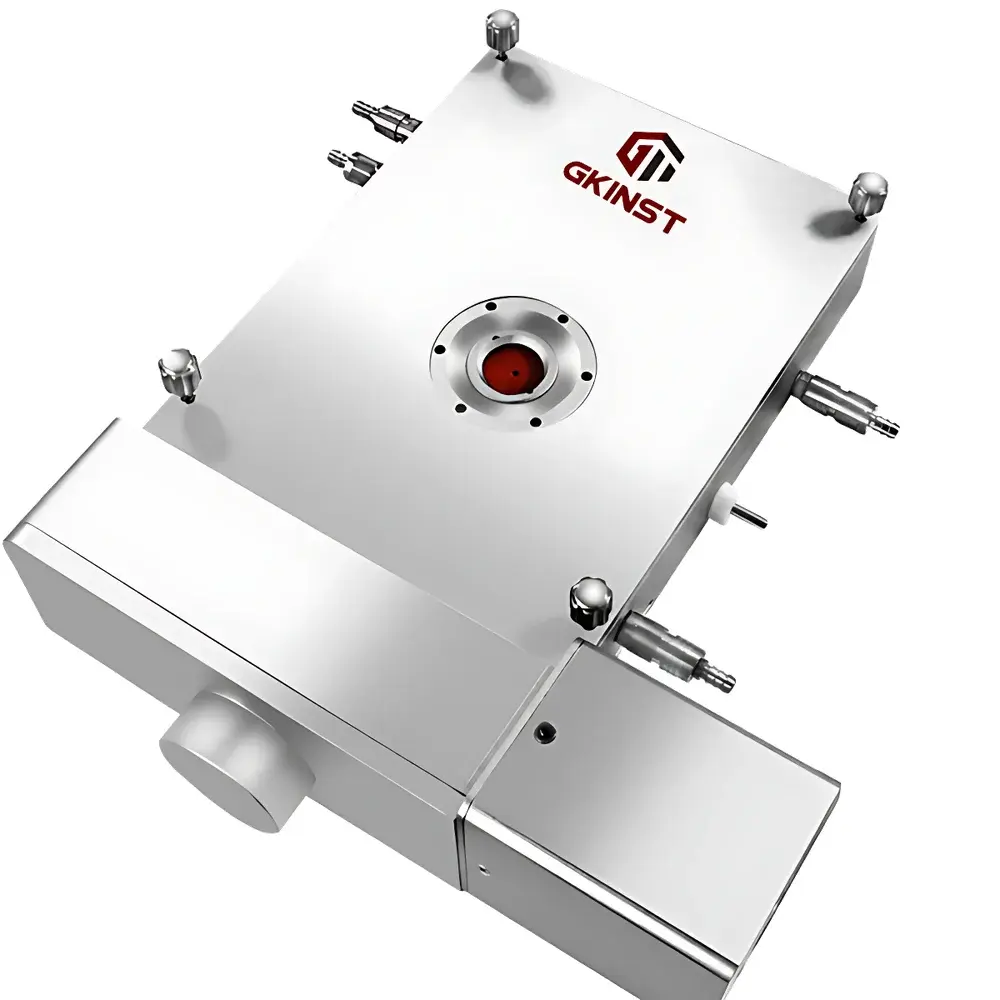
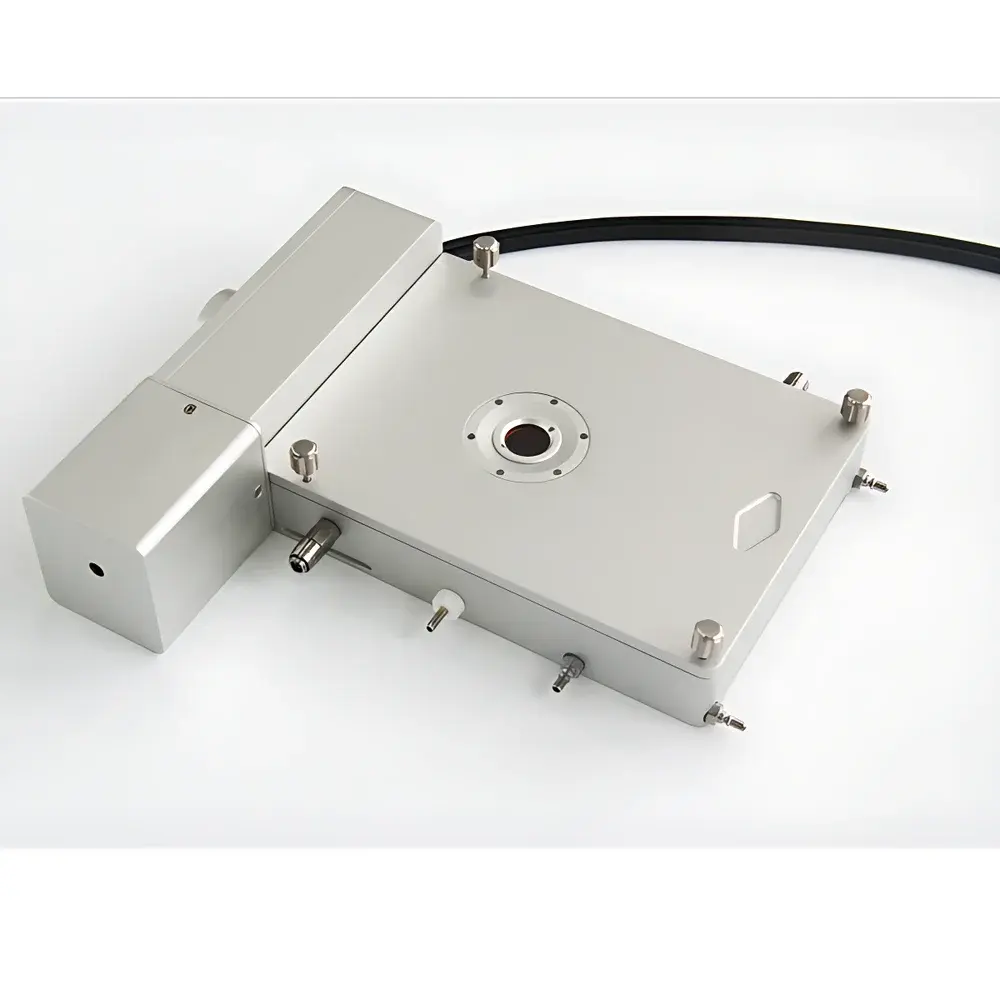
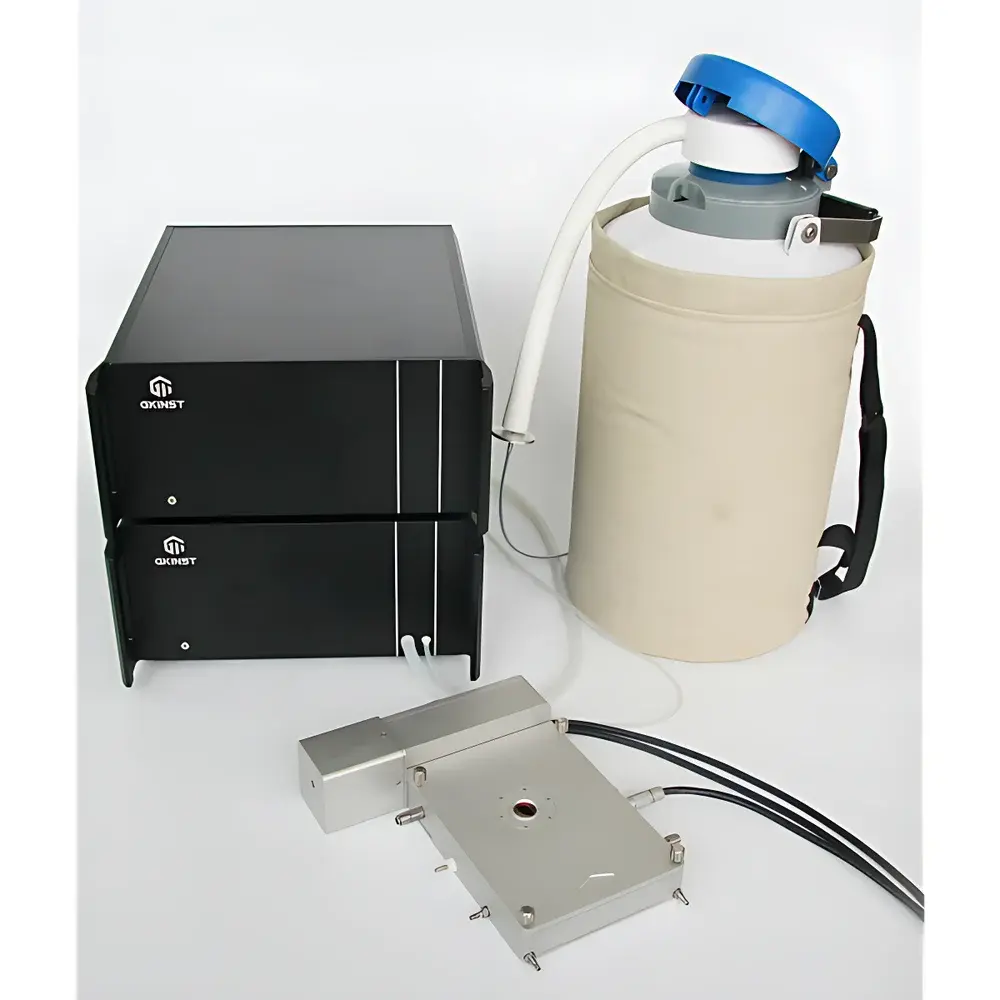
GKinst TST350V Optical Heating-Cooling Tensile Stage
| Brand | GKinst |
|---|---|
| Model | GK-TST350V |
| Force Range | 0–500 N / 0–200 N / 0–20 N |
| Force Resolution | 0.01 N |
| Max. Extension | 80 mm |
| Displacement Resolution | 0.01 mm |
| Displacement Speed | 1–1000 µm/s |
| Force Control Modes | Constant Velocity, Constant Force, Position Hold, Jog, Cyclic Loading |
| Vacuum Compatibility | Customizable for Ultra-High Vacuum (≤1×10⁻⁵ Pa) |
| Temperature Range | –195 °C to +350 °C |
| Origin | Anhui, China |
Overview
The GKinst TST350V Optical Heating-Cooling Tensile Stage is a precision in situ mechanical testing platform engineered for synchrotron X-ray diffraction (XRD), laboratory-based X-ray scattering (SAXS/WAXS), and optical microscopy systems. It integrates high-fidelity uniaxial tensile actuation with programmable thermal control and sub-micron motion resolution—enabling real-time, quantitative observation of structural evolution during thermomechanical loading. The stage operates on a dual-actuator architecture: a high-resolution piezoelectric or stepper-driven displacement system coupled with a calibrated load cell array, ensuring traceable force feedback across three selectable ranges (20 N, 200 N, 500 N). Its compact, low-scatter design minimizes beam obstruction and maintains optical/X-ray path integrity—critical for experiments requiring simultaneous imaging and diffraction at beamlines or in benchtop X-ray chambers.
Key Features
- Multi-range force sensing (0–20 N / 0–200 N / 0–500 N) with 0.01 N resolution, calibrated per ISO 376 and traceable to national metrology institutes
- Linear displacement accuracy of ±0.01 mm over 80 mm stroke, supported by closed-loop position feedback and thermal drift compensation
- Programmable displacement speed from 1 µm/s (quasi-static creep) to 1000 µm/s (dynamic loading), with smooth acceleration/deceleration profiles
- Integrated cryo-heating module enabling continuous operation from –195 °C (liquid nitrogen cooling) to +350 °C, with ±0.5 °C temperature stability at steady state
- Ultra-high vacuum (UHV)-compatible construction using non-outgassing materials (e.g., stainless steel 316L, ceramic insulators, metal-sealed feedthroughs); optional bake-out to 150 °C
- Modular mounting interface (M6 tapped holes, kinematic alignment pins) for seamless integration into goniometers, sample holders, and custom vacuum chambers
Sample Compatibility & Compliance
The TST350V accommodates standard tensile specimens (dog-bone, film strips, fiber bundles) with widths up to 15 mm and thicknesses ≤3 mm. Sample clamping employs pneumatically assisted or manual micrometer-driven jaws with replaceable serrated inserts to prevent slippage under cyclic loading. All electrical and thermal interfaces comply with IEC 61000-6-3 (EMC emission limits) and IEC 61010-1 (safety requirements for laboratory equipment). When operated in regulated environments (e.g., GLP-compliant labs or FDA-audited R&D facilities), the stage supports audit-ready data logging—including timestamped force/displacement/temperature triplets—with optional 21 CFR Part 11-compliant software add-ons for electronic signatures and change control.
Software & Data Management
Control is executed via GKinst’s TensileLab™ v4.x software suite (Windows 10/11), offering scriptable experiment sequencing, real-time parameter overlay on live camera feeds, and synchronized trigger output for external detectors (e.g., Pilatus, Eiger, sCMOS cameras). Raw data streams (force, displacement, temperature, encoder counts) are saved in HDF5 format with embedded metadata (sample ID, operator, calibration certificate IDs, environmental conditions). Export modules support ASTM E8/E21-compliant stress-strain report generation and direct import into MATLAB, Python (via h5py), or OriginLab for advanced modeling (e.g., viscoelastic fitting, phase-field simulation input).
Applications
- In situ synchrotron SAXS/WAXS studies of polymer crystallinity evolution during cold-drawing or thermal annealing
- Real-time tracking of crack initiation and interfacial delamination in flexible OLED substrates under thermal cycling
- Quantitative analysis of martensitic transformation kinetics in shape-memory alloys under constrained heating/cooling
- Mechanochemical coupling in battery electrode films (e.g., Si anodes) during lithiation-induced swelling
- Creep-recovery behavior of hydrogels and biopolymer networks across physiological temperature gradients
FAQ
Can the TST350V be used inside a synchrotron hutch without interfering with X-ray detection?
Yes—the stage body uses low-Z materials (aluminum alloy housing, titanium load path), and all internal cabling is shielded and routed away from the primary beam path. Beam attenuation is <0.3% at 12 keV.
Is third-party software integration (e.g., Bluesky, EPICS) supported?
Yes—GKinst provides documented TCP/IP and shared memory APIs, along with example drivers for Bluesky plans and EPICS IOC deployment.
What vacuum feedthrough options are available for electrical and thermal signals?
Standard configurations include 12-channel D-sub vacuum feedthroughs (for load cell, RTD, and motor signals) and coaxial RF feedthroughs for high-speed encoder lines; custom multi-pin ceramic variants are available upon request.
Does the system include NIST-traceable calibration certificates?
Each unit ships with factory calibration reports for force (per ISO 376 Class 0.5), displacement (laser interferometer verified), and temperature (calibrated Pt100 RTD), all traceable to NIM (China) or NIST-equivalent standards.
Related Products





