
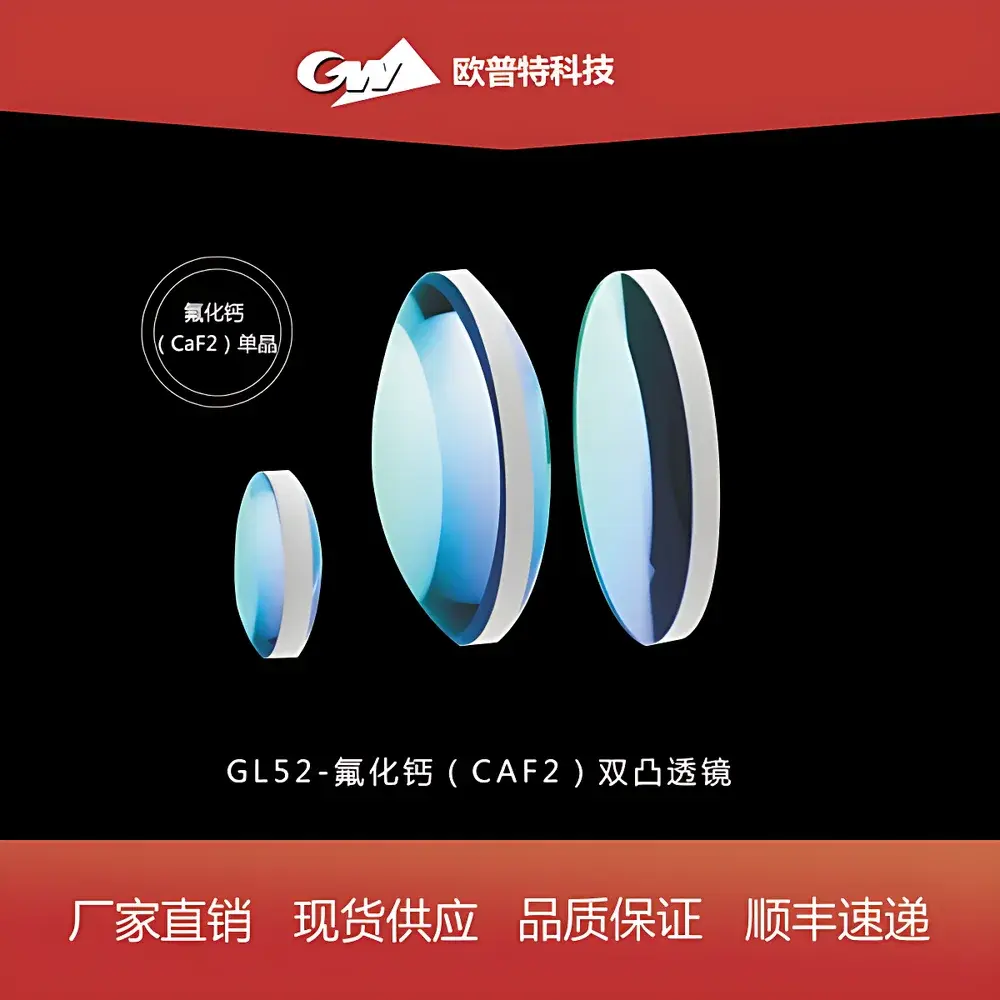
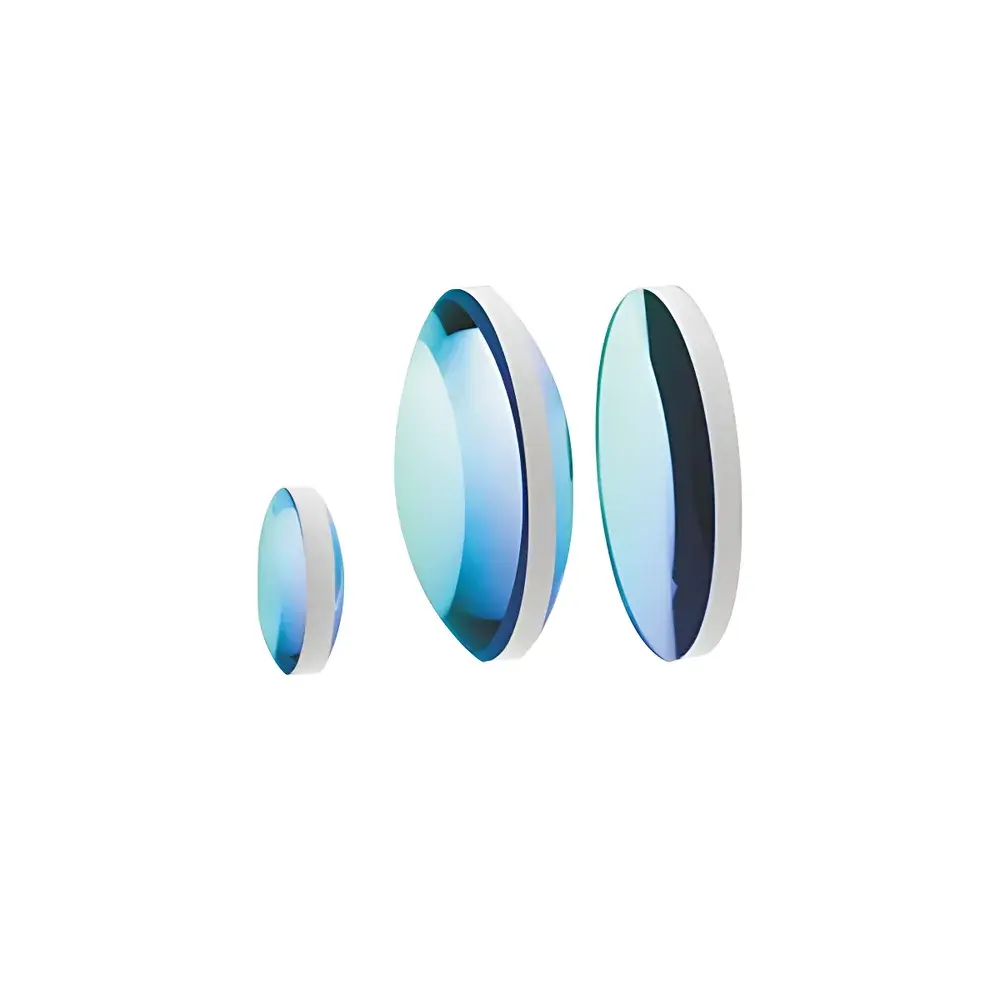
GL52 Calcium Fluoride (CaF₂) Double-Convex Lens – Uncoated & IR Anti-Reflective Coated (3–5 μm)
| Origin | Beijing, China |
|---|---|
| Manufacturer Type | Distributor |
| Regional Origin | Domestic (China) |
| Model | GL52 |
| Price Range | USD 70–140 (per unit) |
| Component Category | Optical Element |
Overview
The GL52 series comprises precision-polished calcium fluoride (CaF₂) double-convex lenses engineered for demanding infrared (IR) optical applications within the 3–5 μm spectral band. Fabricated from high-purity, synthetic CaF₂ crystal—selected for its exceptional transmission (>92% per surface, uncoated), low refractive index dispersion, and negligible fluorescence in the mid-wave infrared (MWIR)—these lenses serve as critical beam-shaping and focusing elements in thermal imaging systems, gas sensing platforms (e.g., CO, NO, CH₄ detection), FTIR spectrometers, and laser delivery setups operating with quantum cascade lasers (QCLs) or optical parametric oscillators (OPOs). Unlike fused silica or BK7 optics, CaF₂ maintains structural stability and low absorption across cryogenic to elevated temperatures (−196 °C to +200 °C), making it suitable for vacuum-compatible and thermally cycling environments. Each lens is manufactured to λ/4 surface flatness (per ISO 10110-5), ≤20–10 scratch-dig specification, and centered to <3 arcmin, ensuring minimal wavefront distortion and high Strehl ratio performance.
Key Features
- Substrate material: High-grade synthetic calcium fluoride (CaF₂), certified for MWIR homogeneity and low birefringence (Δn < 5 × 10⁻⁶)
- Optical design: Double-convex (DCX) geometry optimized for minimal spherical aberration at finite conjugates; all radii calculated using paraxial ray tracing and verified via interferometric testing
- Coating options: Standard uncoated version available; optional single-layer MgF₂-based IR1 anti-reflective coating deposited via ion-assisted e-beam evaporation, achieving average reflectance <0.8% per surface across 3.0–5.0 μm (RMS)
- Mechanical robustness: Edge thickness tolerance ±0.1 mm; clear aperture ≥90% of diameter; chamfered edges (0.2 mm × 45°) to prevent chipping during mounting
- Traceability: Each lens carries a unique part number (e.g., GL52-025-100-IR1) and batch ID aligned with ISO 9001-certified quality records; inspection reports include transmitted wavefront error (TWE) maps and spectral transmittance curves
Sample Compatibility & Compliance
These CaF₂ lenses are compatible with standard kinematic mounts (e.g., Thorlabs SM1-threaded lens tubes, Edmund Optics RMS adapters) and vacuum-compatible lens holders (CF-35 or KF-25 flanges with Viton or metal gaskets). The material exhibits no outgassing above 10⁻¹⁰ mbar·L/s per cm² (per ASTM E595), satisfying NASA low-outgassing requirements for space-qualified payloads. While not inherently compliant with FDA or IEC 61000-4 standards (as passive optical components), documentation supports integration into systems adhering to ISO 13485 (medical devices), MIL-STD-810G (environmental ruggedness), and EU RoHS Directive 2011/65/EU (hazardous substance restrictions). Certificates of Conformance (CoC) and material test reports (MTRs) are provided upon request.
Software & Data Management
No embedded firmware or proprietary software is associated with these passive optical components. However, full optical prescription data—including radius of curvature, center thickness, focal length (EFL), back focal length (BFL), and effective focal length (EFFL)—is supplied in Zemax .zmx and CODE V .seq formats for system-level modeling. Spectral transmittance datasets (3–12 μm, 0.1 μm step) and coating performance curves (R vs. λ at 0° and 10° AOI) are delivered in CSV and MATLAB .mat formats. All digital assets are archived under controlled revision control (Rev. B, Q4 2024), traceable to NIST-traceable spectrophotometer calibrations (PerkinElmer Lambda 950 with integrating sphere).
Applications
- Collimation and focusing of MWIR laser beams in industrial process monitoring (e.g., furnace temperature profiling, combustion analysis)
- Objective and relay lenses in cooled InSb or HgCdTe detector modules for defense-grade thermal sights and missile seekers
- Sample compartment optics in portable FTIR analyzers for environmental VOC monitoring and pharmaceutical raw-material ID
- Beam conditioning in quantum cascade laser absorption spectroscopy (QCLAS) systems targeting greenhouse gas quantification
- Windows and condenser optics in vacuum UV-IR hybrid ellipsometers where CaF₂’s wide-band transparency (120 nm–8 μm) enables multi-spectral calibration
FAQ
Is the IR1 coating durable enough for cleaning with acetone or IPA?
Yes—the MgF₂-based IR1 AR layer is ion-assisted and adheres strongly to CaF₂; routine cleaning with spectroscopic-grade isopropanol (IPA) and lint-free polyester wipes is approved. Acetone is discouraged due to potential substrate stress cracking at prolonged exposure.
Can these lenses be used below 200 K without risk of fracture?
Yes—CaF₂ has a low coefficient of thermal expansion (18.9 × 10⁻⁶ /K) and high fracture toughness (~0.9 MPa·m¹ᐟ²); thermal cycling from 4 K to 300 K has been validated per ASTM F1353 without degradation.
Do you provide custom focal lengths or non-standard diameters?
Yes—custom geometries (including plano-convex, meniscus, or aspheric variants) and diameters up to Ø100 mm are available under NDA; lead time is 6–8 weeks with metrology report included.
What is the maximum power density these lenses can handle at 4.5 μm CW operation?
For uncoated lenses: ≤5 kW/cm² (10.6 μm reference scaled per Beer–Lambert absorption coefficient); for IR1-coated versions: ≤3.2 kW/cm² due to localized thermal load at coating interfaces—pulse operation requires separate LIDT validation.
Are Zemax files provided for all standard part numbers?
Yes—Zemax .zmx files with realistic surface irregularity models (based on measured interferograms) and bulk absorption coefficients (α = 0.003 cm⁻¹ @ 4.2 μm) are included with every order.





