
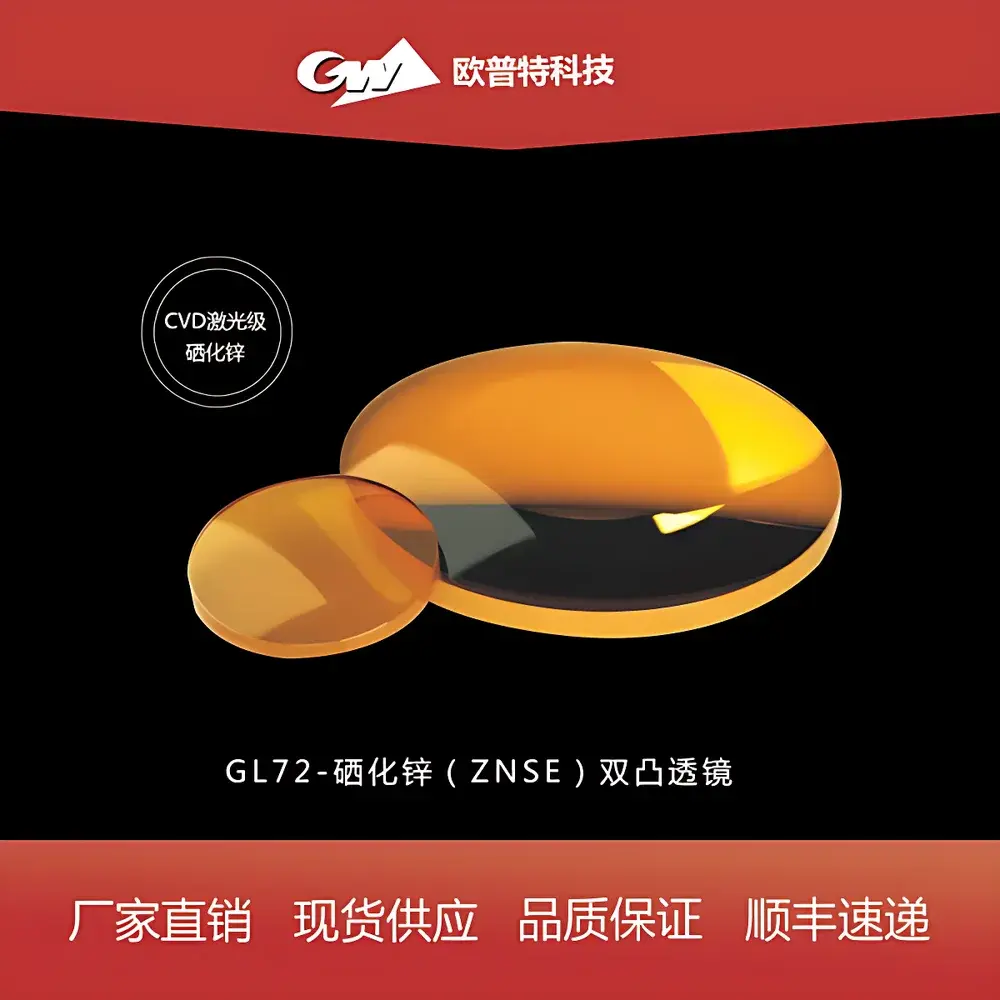
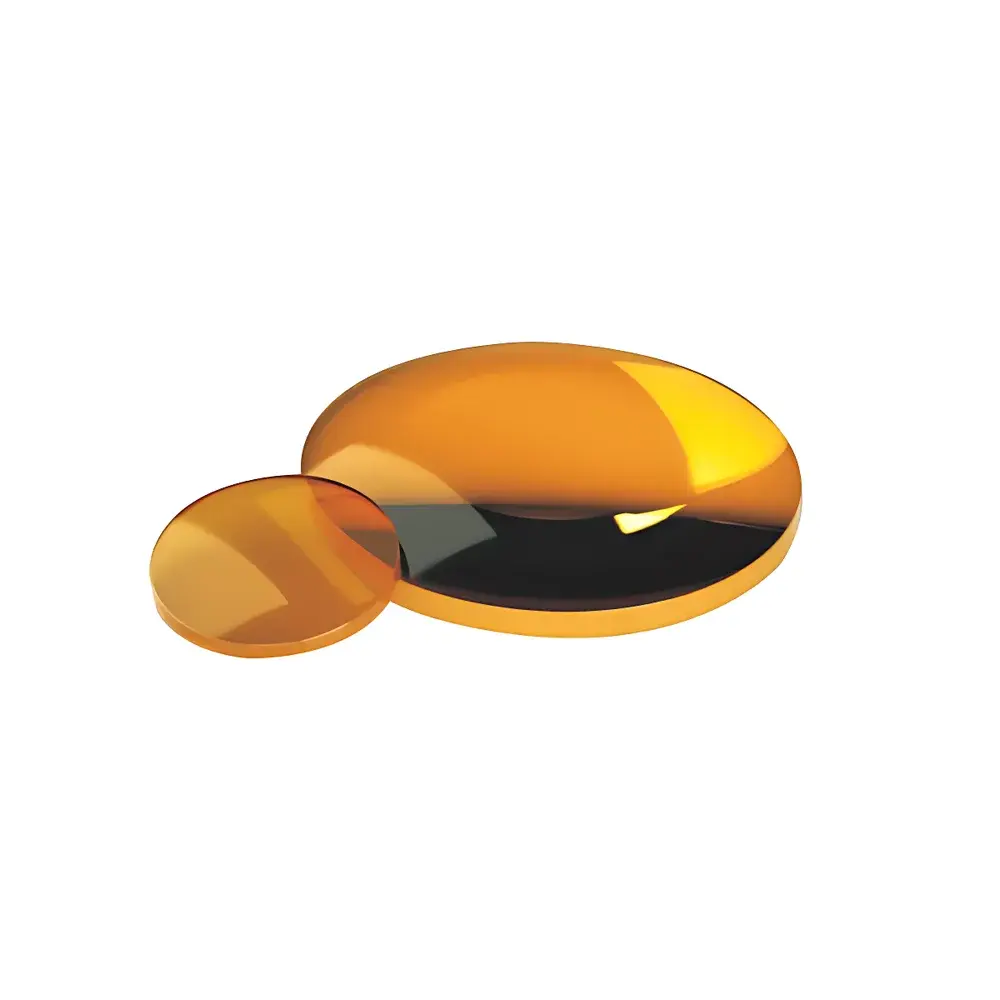
GL72 Zinc Selenide (ZnSe) Biconvex Lens, Uncoated with Optional IR2 Broadband Anti-Reflection Coating for 8–12 µm
| Origin | Beijing, China |
|---|---|
| Manufacturer Type | Authorized Distributor |
| Regional Origin | Domestic (PRC) |
| Model | GL72 |
| Price Range | USD 70–140 |
| Component Category | Optical Element |
| Material | Zinc Selenide (ZnSe) |
| Coating Option | IR2 Broadband AR Coating (Rₐᵥg < 1.5% @ 8–12 µm) |
| Design | Precision-Polished Biconvex Geometry |
| Compliance | ISO 10110-1, ISO 10110-7, MIL-PRF-13830B Scratch-Dig |
Overview
The GL72 series comprises high-purity, precision-ground and polished zinc selenide (ZnSe) biconvex lenses engineered specifically for mid-wave to long-wave infrared (MWIR–LWIR) optical systems operating in the 8–12 µm spectral band. ZnSe is a crystalline II–VI semiconductor material with exceptional transmission (>70% bulk transmission) across 0.5–20 µm, low absorption coefficient (<0.0005 cm⁻¹ at 10.6 µm), and near-zero dispersion in the thermal infrared region—making it the material of choice for CO₂ laser optics, FTIR spectrometers, thermal imaging relay systems, and industrial process monitoring sensors. Unlike fused silica or BK7 lenses, GL72 lenses are fabricated using single-crystal CVD-grown ZnSe substrates with controlled stoichiometry and minimized sub-surface damage, ensuring high wavefront fidelity and thermal stability under continuous-wave or pulsed IR irradiation. Each lens adheres to ISO 10110 surface quality specifications (typically 20–10 scratch-dig) and is verified via interferometric testing at 632.8 nm (HeNe) for transmitted wavefront error (TWE), with typical λ/4 @ 633 nm for standard grade.
Key Features
- Zinc selenide substrate with ≥99.995% purity, CVD-grown, annealed to minimize internal stress and birefringence
- Biconvex geometry optimized for minimal spherical aberration in collimated or convergent IR beam paths
- Standard uncoated version available; optional IR2 broadband anti-reflection coating applied via ion-assisted e-beam evaporation
- IR2 coating achieves Ravg < 1.5% across 8–12 µm (measured per ISO 9211-3), with durability rated to ISO 9211-4 Class 2
- Edge blackening (optional) to suppress stray light in multi-element IR assemblies
- Custom mounting compatibility: designed for integration into standard SM1 (1.035″-40) or SM2 (2.035″-40) lens tubes and kinematic mounts
- Traceable metrology: each lens supplied with individual test report including radius of curvature (±0.2%), center thickness (±5 µm), and surface flatness (λ/10 PV)
Sample Compatibility & Compliance
GL72 lenses are compatible with common IR optical bench platforms including Thorlabs, Newport, and Edmund Optics mounting hardware. All substrates meet RoHS Directive 2011/65/EU and REACH Annex XVII restrictions on cadmium and lead content. The IR2 coating process complies with ISO 9211-4:2019 for coating adhesion, environmental resistance (damp heat, humidity cycling), and abrasion tolerance. For regulated environments—including FDA-regulated medical IR diagnostics or aerospace-grade thermal imaging subsystems—the lenses support full documentation packages (CoC, CoA, spectral transmittance curves, and interferograms) traceable to NIST-traceable reference standards. While not inherently classified as medical devices, GL72 components are routinely incorporated into ISO 13485-certified optical subassemblies and satisfy GLP-aligned procurement requirements for research-grade IR instrumentation.
Software & Data Management
No embedded firmware or software is associated with GL72 passive optical elements. However, full optical design integration is supported through industry-standard file formats: Zemax (.zmx), CODE V (.seq), and Synopsys LightTools (.lts) lens prescription files are available upon request for all standard catalog variants. Spectral transmittance data (8–12 µm, 0.1 µm step) is delivered in CSV and ASCII format, fully compatible with MATLAB, Python (NumPy/Pandas), and OriginLab for system-level throughput modeling. Traceability metadata—including lot number, coating run ID, and interferometric verification timestamp—is encoded in the product label and included in the digital certificate of conformance (PDF/A-1b compliant).
Applications
- CO₂ laser beam shaping and focusing (10.6 µm), including galvanometric scanning heads and laser material processing optics
- FTIR spectrometer collimators and objective lenses in pharmaceutical QC and polymer analysis
- Uncooled microbolometer-based thermal imaging modules (e.g., FLIR Tau, Seek Thermal) requiring diffraction-limited performance at f/1.0–f/2.0
- Gas sensing systems utilizing tunable quantum cascade lasers (QCLs) in the 8–12 µm fingerprint region
- Environmental monitoring sensors for atmospheric methane (CH₄) and nitrous oxide (N₂O) detection
- Educational IR optics labs—paired with blackbody sources and pyroelectric detectors for hands-on radiometry experiments
FAQ
What is the maximum permissible power density for GL72 ZnSe lenses in continuous-wave CO₂ laser applications?
For uncoated GL72 lenses, the damage threshold is ≥1.5 MW/cm² (10.6 µm, 100 ns pulse, 10 Hz); for IR2-coated versions, it is ≥0.8 MW/cm² due to localized field enhancement at coating interfaces. Continuous-wave operation should remain below 5 kW/cm² with active cooling.
Can GL72 lenses be used outside the 8–12 µm range?
Yes—ZnSe transmits from ~0.5 µm (visible red) to ~20 µm (far-IR), but AR coating performance degrades outside 8–12 µm. Uncoated versions are suitable for HeNe (632.8 nm) alignment, though transmission drops to ~65% at 0.63 µm.
Is thermal lensing a concern under high-flux IR illumination?
ZnSe exhibits a thermo-optic coefficient (dn/dT) of +62 × 10⁻⁶ K⁻¹ and thermal conductivity of 18 W/m·K—lower than Ge but sufficient for stable operation up to 150°C. For pulsed systems >100 Hz, finite-element thermal modeling is recommended.
Do you offer custom diameters, focal lengths, or coating specifications?
Yes—custom geometries (including plano-convex, meniscus, and aspheric variants), alternate coatings (e.g., dual-band AR for 3–5 µm + 8–12 µm), and MIL-spec edge treatments are available under NDA with minimum order quantities.




