
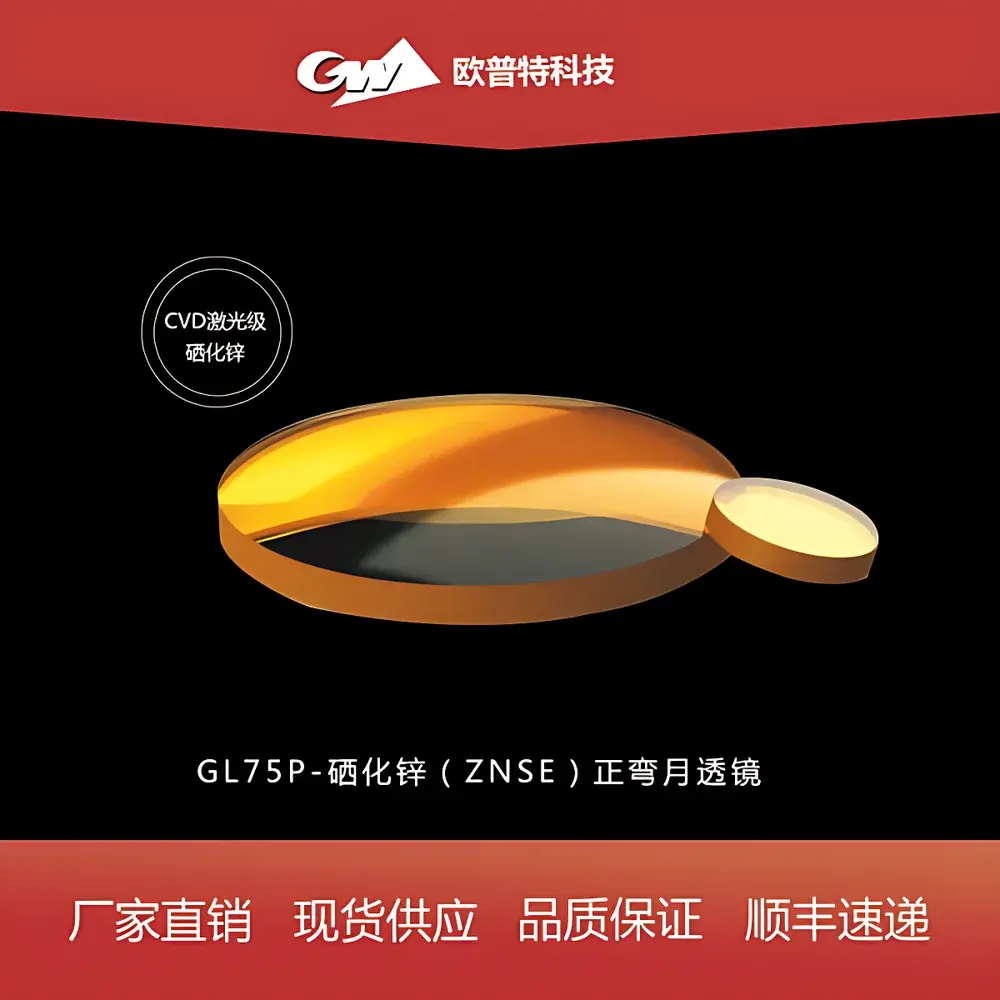
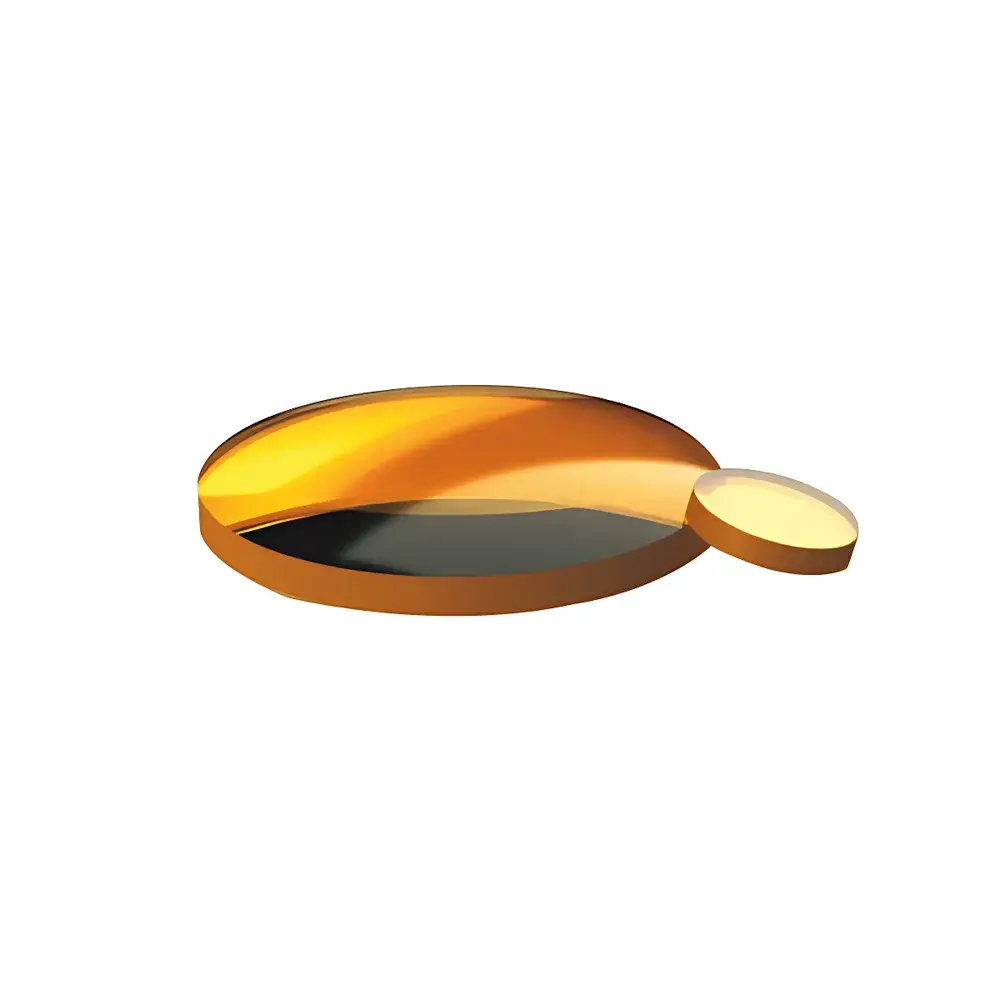
GL75P Zinc Selenide (ZnSe) Positive Meniscus Lens, Uncoated & IR Broadband Anti-Reflection Coated (8–12 µm)
| Origin | Beijing, China |
|---|---|
| Manufacturer Type | Distributor |
| Regional Origin | Domestic (China) |
| Model | GL75P |
| Price Range | USD 70–140 |
| Component Category | Optical Element |
| Focal Length | 51 mm |
| Diameter | 1.556 mm |
| Coating Options | Uncoated or IR Broadband AR (Rₐᵥg < 1.5% @ 8–12 µm) |
Overview
The GL75P is a precision-engineered zinc selenide (ZnSe) positive meniscus lens designed for demanding mid-wave to long-wave infrared (MWIR–LWIR) optical systems operating in the 8–12 µm spectral band. Constructed from high-purity, CVD-grown ZnSe substrate with exceptional transmission (>70% per surface uncoated, >97% per surface with AR coating), the lens leverages the unique refractive index (~2.4 at 10 µm) and low absorption coefficient of ZnSe to enable efficient beam shaping, collimation, and focusing in thermal imaging, FTIR spectroscopy, CO₂ laser delivery, and industrial process monitoring applications. Its positive meniscus geometry provides inherent correction for spherical aberration when used with divergent or convergent beams—particularly advantageous in compact infrared relay systems and detector coupling optics. The 51 mm effective focal length and 1.556 mm clear aperture are optimized for integration into miniaturized optical benches and OEM infrared modules where space constraints and wavefront fidelity are critical.
Key Features
- Zinc selenide (ZnSe) substrate with certified homogeneity and low bulk scatter, compliant with MIL-O-13830A scratch-dig specifications
- Positive meniscus configuration: convex surface facing incident beam, concave surface toward image plane—minimizes Petzval curvature and improves field flatness in multi-element assemblies
- Two standard surface finish options: (a) uncoated for maximum broadband transmission control or (b) dual-layer broadband anti-reflection coating optimized for 8–12 µm (Rₐᵥg < 1.5%, measured per ISO 9211-3)
- Tolerance-controlled geometry: ±0.5% focal length tolerance, ±0.02 mm center thickness tolerance, surface figure λ/4 @ 633 nm (verified via interferometry)
- Chemically stable and non-hygroscopic—suitable for operation in ambient laboratory environments without purge gas requirements
Sample Compatibility & Compliance
The GL75P lens is compatible with standard kinematic mounts (e.g., SM1-threaded lens tubes, Ø12.7 mm cage systems) and integrates seamlessly into optical paths requiring diffraction-limited performance in the thermal infrared. It meets material and dimensional requirements specified in ISO 10110-1 (optical element drawing standards) and complies with RoHS Directive 2011/65/EU for hazardous substance restrictions. While not certified to specific medical or aerospace standards out-of-the-box, its ZnSe batch traceability, certificate of conformance (CoC), and optional test report (including spectral transmittance curve and surface quality verification) support qualification under ISO 9001-based quality management systems and GxP-aligned optical subsystem validation protocols.
Software & Data Management
As a passive optical component, the GL75P requires no embedded firmware, drivers, or software interface. However, its geometric and material parameters—including refractive index dispersion (Sellmeier coefficients for ZnSe), thermal expansion coefficient (7.6 × 10⁻⁶ K⁻¹), and thermo-optic coefficient (dn/dT ≈ 6.3 × 10⁻⁵ K⁻¹)—are fully documented in the accompanying technical datasheet and compatible with industry-standard optical design platforms such as Zemax OpticStudio, CODE V, and FRED. Users may import native .ZAR or .SEQ files (available upon request) for accurate paraxial and physical optics modeling. All metrology data—including interferometric surface maps and spectral transmission scans—are archived and available in CSV or .SDF format for traceability and audit readiness.
Applications
- FTIR spectrometer fore-optics and detector-side focusing elements
- Uncooled microbolometer array illumination optics in thermal cameras
- Beam conditioning for sealed-tube CO₂ lasers (10.6 µm) in material processing and medical ablation systems
- Gas sensing cells requiring high-transmission windows and minimal etalon interference
- Research-grade infrared microscopy objectives and relay lenses
- Calibration targets and reference optics in radiometric measurement setups
FAQ
Is the GL75P lens suitable for use with pulsed CO₂ lasers?
Yes—ZnSe exhibits high damage threshold (>500 MW/cm² for 10 ns pulses at 10.6 µm) when surface quality and coating integrity are maintained; however, proper beam alignment and avoidance of hot spots are essential.
Can I specify custom diameter or focal length?
Standard GL75P units are manufactured to fixed dimensions (Ø1.556 mm, f = 51 mm); custom geometries are available under OEM agreement with minimum order quantities and extended lead times.
Does the IR broadband AR coating withstand cleaning with ethanol or acetone?
Yes—the dielectric stack is mechanically robust and chemically resistant to standard optical solvents; follow ISO 10110-7 cleaning guidelines to preserve coating longevity.
Is there thermal lensing effect under high-flux continuous-wave irradiation?
Measurable but typically negligible below 10 W/cm² average power density; for high-power systems, active cooling or thermal drift compensation in optical design is recommended.
Do you provide spectral transmission data for individual units?
Yes—batch-level spectral verification is standard; unit-specific transmission curves are available as an optional add-on with calibrated FTIR measurement report.





