
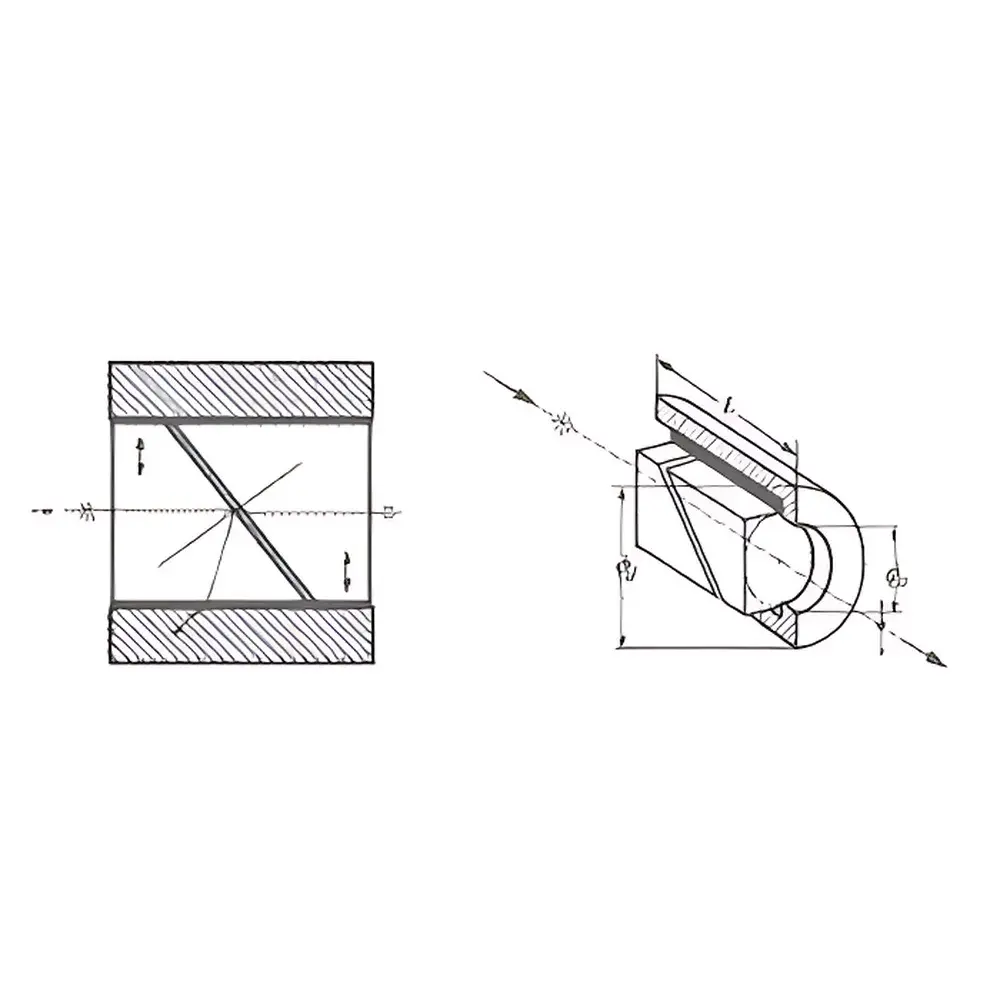
Glan-Taylor Polarizer, Glan-Laser Prism, Glan-Thompson Prism & Wollaston Prism Series
| Key | Origin: Beijing, China |
|---|---|
| Manufacturer Type | Distributor |
| Origin Category | Domestic |
| Model Range | OPGT/OPGL/OPGM/OPWT Series (25.4 mm OD, 10 mm clear aperture) |
| Price | Upon Request |
Overview
Our precision-engineered polarizing prisms are high-performance optical components designed for demanding polarization control in laser systems, spectroscopy, ellipsometry, and quantum optics applications. Based on the principle of birefringent beam separation—leveraging the anisotropic refractive indices of uniaxial crystals such as α-BBO (beta-barium borate) and calcite—these prisms achieve polarization state selection through total internal reflection (TIR) or angular walk-off, depending on crystal orientation and incident angle. Glan-Taylor and Glan-Laser prisms operate via TIR at the air–crystal interface, delivering exceptional extinction ratios (<1×10⁻⁶) across deep-UV to mid-IR spectral bands. Glan-Thompson prisms utilize a cemented interface with controlled angular tolerance to balance transmission efficiency and angular acceptance. Wollaston prisms exploit orthogonal walk-off between ordinary and extraordinary rays to generate spatially separated, orthogonally polarized output beams—ideal for differential polarization analysis and interferometric setups.
Key Features
- Multiple prism architectures optimized for distinct functional requirements: Glan-Taylor (high extinction, no side window), Glan-Laser (side-window design for high-power laser compatibility), Glan-Thompson (wider angular acceptance), and Wollaston (dual-beam polarization splitting).
- High-purity crystalline materials: α-BBO for broad UV–NIR transmission (200–3000 nm) and superior laser damage threshold; natural calcite for extended VIS–NIR range (350–2300 nm) and high birefringence.
- Standard mechanical configuration: 25.4 mm outer diameter, 10 mm clear aperture, precision-ground and polished surfaces with λ/10 surface flatness and <5 arcsec wedge accuracy.
- Anti-reflection coatings available upon request for specific wavelength bands (e.g., 532 nm, 1064 nm, or broadband 400–700 nm), reducing Fresnel losses and ghost reflections.
- Rugged black-anodized aluminum housings with kinematic mounting interfaces (M6 threaded holes or SM1-compatible flanges) for stable integration into optomechanical breadboards and OEM laser platforms.
Sample Compatibility & Compliance
These prisms are compatible with continuous-wave (CW) and pulsed laser sources up to 10 GW/cm² (for α-BBO variants at 1064 nm, 10 ns pulse width). All units comply with ISO 10110-7:2019 (optical component surface quality) and MIL-PRF-13830B scratch-dig specifications (typically 10–5). Mounting configurations meet standard optomechanical interoperability protocols (e.g., Thorlabs SM1, Newport 1-inch cage system). While not certified to IEC 61000-4-x or FDA 21 CFR Part 11 (as passive optical components), full traceable calibration documentation—including measured extinction ratio, transmission spectra, and angular field maps—is provided with each shipment per GLP-aligned internal QA procedures.
Software & Data Management
As passive optical elements, these prisms require no firmware, drivers, or embedded software. However, they are fully compatible with industry-standard optical modeling environments including Zemax OpticStudio, CODE V, and FRED for polarization ray tracing, Mueller matrix analysis, and system-level throughput optimization. Each prism is supplied with a digital test report containing spectrophotometric transmission data (200–3000 nm, ±0.5 nm resolution), measured extinction ratio at specified wavelengths, and angular acceptance verification under collimated illumination. Reports are delivered in PDF and CSV formats, supporting integration into LIMS or PLM systems for audit-ready traceability.
Applications
- Laser cavity polarization control and intracavity Q-switching in Ti:sapphire, Nd:YAG, and excimer systems.
- Polarization-sensitive metrology, including Mueller matrix polarimetry for thin-film characterization and biomedical tissue analysis.
- Quantum optics experiments requiring high-fidelity polarization state preparation (e.g., Bell-state generation, quantum key distribution setups).
- Ellipsometric measurement heads for semiconductor wafer inspection and photovoltaic coating analysis.
- Differential interference contrast (DIC) microscopy using Wollaston prisms for nanoscale phase gradient imaging.
- Calibration standards for polarimeter validation in aerospace and defense sensor qualification protocols.
FAQ
What is the difference between Glan-Taylor and Glan-Laser prisms?
Glan-Taylor prisms feature a sealed, windowless construction ideal for vacuum or inert-gas environments; Glan-Laser prisms incorporate a side-mounted AR-coated quartz window to accommodate high-power laser beams while maintaining thermal stability and minimizing surface ablation risk.
Can these prisms be used with femtosecond lasers?
Yes—α-BBO-based variants exhibit low group delay dispersion (GDD) below 50 fs² across 700–900 nm, making them suitable for pulse-preserving applications when properly aligned and cooled.
Is custom coating available?
Yes—single-wavelength or broadband anti-reflection coatings can be applied to input/output faces per customer-specified spectral band and incidence angle.
Do you provide extinction ratio measurement data at specific wavelengths?
Yes—each unit is individually tested at three representative wavelengths within its designated range (e.g., 266 nm, 532 nm, and 1064 nm for OPGT25.4-10-02027), with results documented in the certificate of conformance.
Are these prisms suitable for space-qualified instrumentation?
While not radiation-hardened or outgassing-certified by default, the α-BBO and calcite substrates meet NASA ASTM E595 low-outgassing thresholds (<1.0% TML, <0.1% CVCM) when processed per Class 100 cleanroom protocols; full space qualification testing can be arranged under NDA.



