
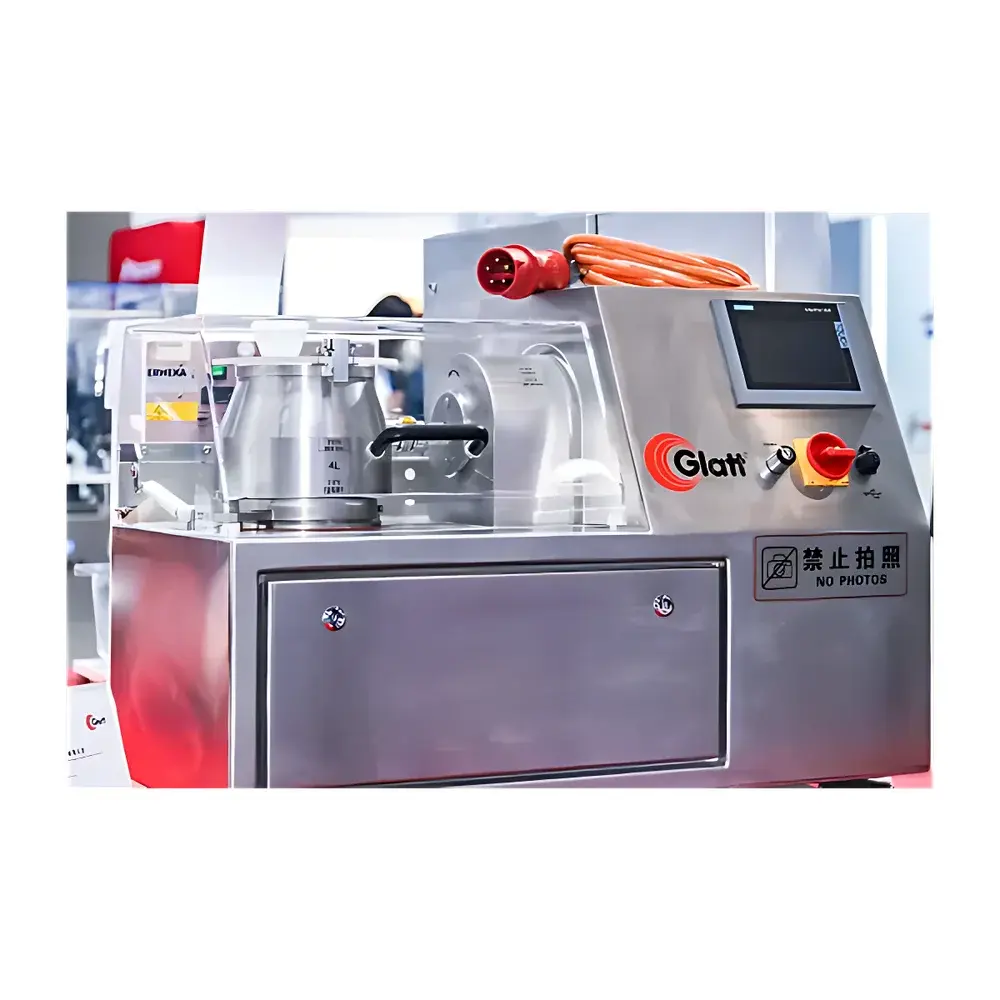
Glatt TMG Desktop High-Shear Wet Granulator
| Brand | Glatt |
|---|---|
| Origin | Germany |
| Model | TMG |
| Working Vessel Gross Volume | 1–6 dm³ |
| Working Volume Range | 0.3–4.5 dm³ |
| Rotor Diameter | 170–230 mm |
| Rotor Speed (infinitely variable) | 50–1000 rpm |
| Chopper Speed (infinitely variable) | 300–3000 rpm |
| Motor Power | 1.1 kW |
| Dimensions (L×W×H) | 900 × 515 × 675 mm |
| Weight (empty unit) | ~140 kg |
Overview
The Glatt TMG Desktop High-Shear Wet Granulator is an engineering-grade laboratory-scale system designed for reproducible, scalable wet granulation process development under controlled conditions. Based on the proven high-shear mixing principle—where simultaneous rotation of a bottom-mounted impeller and high-speed chopper induces intense mechanical energy input—the TMG generates uniform granule nuclei through controlled liquid distribution, powder wetting, nucleation, coalescence, and consolidation. Its compact tabletop architecture enables seamless integration into QC laboratories, formulation development suites, and early-phase process R&D environments without requiring dedicated floor space or structural modifications. The system operates on standard electrical supply and utility connections (e.g., compressed air, deionized water), making it suitable for both regulated and non-regulated research settings.
Key Features
- Modular vessel design with interchangeable working vessels (1, 2, 4, and 6 dm³ gross volume), each engineered for precise geometric similarity across scales to support meaningful scale-up studies.
- Two-vessel geometry options: cylindrical and conical configurations—selected based on material flow behavior, shear sensitivity, and desired granule density profile.
- Jacketed and non-jacketed vessel variants available to accommodate temperature-sensitive formulations or processes requiring thermal control during granulation (e.g., thermolabile APIs or moisture-sensitive excipients).
- Independent, infinitely variable speed control of both rotor (50–1000 rpm) and chopper (300–3000 rpm), enabling fine-tuned adjustment of shear intensity, granule growth kinetics, and final granule size distribution.
- Quick-release mechanical coupling and tool-free vessel mounting facilitate rapid changeover between batches or vessel sizes—critical for multi-formulation screening and DOE-based optimization.
- Stainless-steel 316L construction throughout product-contact surfaces ensures compliance with ISO 8573-1 (compressed air purity), USP <661>, and GMP-aligned cleaning validation requirements.
Sample Compatibility & Compliance
The TMG accommodates a broad spectrum of pharmaceutical powders—including active pharmaceutical ingredients (APIs), microcrystalline cellulose (MCC), lactose monohydrate, hydroxypropyl methylcellulose (HPMC), and polyvinylpyrrolidone (PVP)—as well as nutraceutical and veterinary dosage forms. Its design supports batch sizes from 300 mL to 4.5 L working volume, aligning with ICH Q5C and Q8(R2) guidelines for small-scale process characterization. All vessels meet ASME BPE-2021 surface finish specifications (Ra ≤ 0.4 µm) and are compatible with validated CIP/SIP protocols. The system’s mechanical architecture conforms to EN 61000-6-2 (EMC immunity) and EN 61000-6-4 (EMC emission) standards, and its operational documentation supports audit readiness for GLP and GMP environments.
Software & Data Management
While the base TMG operates via intuitive analog controls with digital tachometric readouts, optional data acquisition modules enable time-stamped recording of rotor/chopper speeds, torque load (via motor current monitoring), and process duration. Exportable CSV logs support retrospective analysis in compliance with ALCOA+ principles. When integrated with Glatt’s optional Process Analytical Technology (PAT) interface, the TMG can synchronize with inline NIR probes or FBRM sensors for real-time granule attribute monitoring—facilitating closed-loop feedback strategies aligned with FDA’s PAT guidance and Annex 11 requirements for electronic records.
Applications
- Early-stage formulation screening of binder type, concentration, and addition method.
- Design of Experiments (DoE) for identifying critical process parameters (CPPs) affecting granule size distribution (GSD), bulk density, and friability.
- Granulation endpoint determination using torque profiling or power consumption trending.
- Process transfer studies between lab-scale (TMG), pilot-scale (GLATT GPCG), and production-scale (GLATT GPCG-60/120) granulators.
- Supporting Quality-by-Design (QbD) initiatives through robust process understanding and control strategy definition per ICH Q8–Q10.
FAQ
What vessel geometries are available for the TMG, and how do they affect granule properties?
Cylindrical and conical vessels are offered; conical designs promote improved powder circulation and reduced dead zones for cohesive materials, while cylindrical vessels provide higher shear homogeneity—ideal for low-moisture or high-density formulations.
Can the TMG be used for continuous granulation development?
No—the TMG is a batch system optimized for discrete granulation cycles; however, its kinetic data informs residence time distribution modeling for downstream continuous twin-screw granulation systems.
Is the TMG compliant with 21 CFR Part 11 for electronic records?
The base unit is not Part 11–enabled; however, when paired with Glatt’s optional validated data logging and user access control module, full Part 11 compliance—including audit trail, electronic signatures, and role-based permissions—is achievable.
What maintenance intervals are recommended for rotor and chopper bearings?
Glatt recommends bearing inspection every 500 operational hours and lubrication every 1,000 hours using ISO VG 68 synthetic grease, per the manufacturer’s Technical Service Bulletin TSB-TMG-04.
How is cleaning validation supported for multi-product use?
Vessels feature fully drainable, crevice-free internal contours and are supplied with detailed swab sampling maps and residue detection limits (≤1.0 µg/cm² for common APIs), supporting protocol development per PDA TR29 and EU GMP Annex 15.




