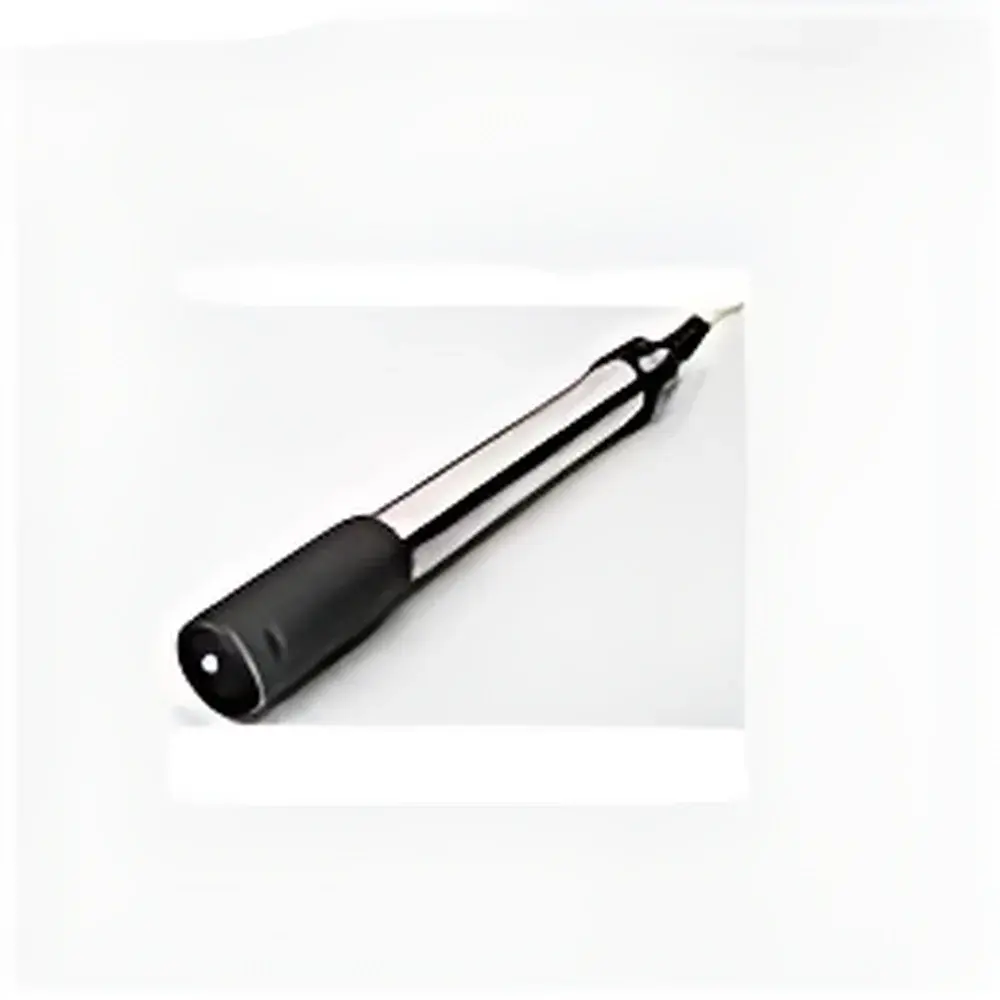
Global Water WQ401 Online Dissolved Oxygen Analyzer
| Brand | Global Water |
|---|---|
| Origin | Germany |
| Manufacturer Status | Authorized Distributor |
| Origin Category | Imported |
| Model | WQ401 |
| Output | 4–20 mA |
| Measurement Range | 0–100% saturation / 0–8 ppm |
| Temperature Compensation Accuracy | ±0.5% |
| Max Pressure Rating | 40 psi |
| Operating Voltage | 10–36 VDC |
| Load Current | 15.5 mA + sensor output |
| Warm-up Time | 10 s |
| Operating Temperature | −40 to +55 °C |
| Membrane Material | 0.001″ FEP Teflon (standard probe) |
| Combined Measurement Error | ±2% FS |
| Probe Dimensions (Standard) | Ø32 mm × 279 mm |
| Probe Dimensions (Inline) | Ø50 mm × 305 mm |
| Weight | 454 g |
| Standard Kit | DD0000WQ401 electrode, 7.5 m cable, manual |
| Optional Accessories | WQEXC extension cable (up to 150 m), 00-740 replaceable DO membrane electrode |
Overview
The Global Water WQ401 Online Dissolved Oxygen Analyzer is a rugged, field-deployable electrochemical sensor engineered for continuous, real-time monitoring of dissolved oxygen (DO) concentration in aqueous environments. Based on polarographic (Clark-type) sensing technology, the WQ401 employs a gas-permeable FEP Teflon membrane that selectively allows molecular oxygen diffusion into an electrolyte-filled cathode chamber. Oxygen reduction at the noble metal cathode generates a current linearly proportional to the partial pressure of dissolved O₂—converted and temperature-compensated to deliver stable readings in either % saturation or mg/L (ppm) units. Designed for integration into industrial process control loops, wastewater treatment plants, aquaculture systems, and environmental monitoring networks, the WQ401 operates reliably across wide ambient and process temperature ranges (−40 to +55 °C) and withstands static pressures up to 40 psi. Its fully sealed electronics, marine-grade cable, and 316 stainless steel housing ensure long-term stability in aggressive chemical and high-humidity conditions.
Key Features
- True galvanic-free polarographic sensing with factory-calibrated, replaceable 00-740 DO electrodes
- Integrated temperature compensation circuitry delivering ±0.5% accuracy across full operating range
- 4–20 mA analog output compliant with industrial PLC and DCS input standards (HART optional via external interface)
- Robust mechanical construction: IP68-rated stainless steel body, FEP membrane optimized for fouling resistance and long service life
- Low-power design: draws only 15.5 mA (excluding output load), compatible with solar-powered remote telemetry stations
- Fast thermal stabilization: <10-second warm-up time enables rapid deployment and system commissioning
- Two mechanical configurations available: standard immersion probe (Ø32 mm × 279 mm) and inline NPT-mount version (1″ NPT PVC housing, Ø50 mm × 305 mm)
Sample Compatibility & Compliance
The WQ401 is validated for use in freshwater, seawater, activated sludge, effluent streams, and recirculating aquaculture systems. It meets material compatibility requirements per ASTM D1129 and ISO 5814 for DO measurement in natural and treated waters. While not certified for direct FDA 21 CFR Part 11 compliance as a standalone device, its 4–20 mA output supports traceable data acquisition when integrated with validated SCADA or LIMS platforms configured for electronic record integrity, audit trails, and user access controls. The sensor’s ±2% full-scale error specification aligns with EPA Method 360.1 and ISO 5815-1 for routine field DO monitoring where GLP-level validation is not mandated. All wetted materials—including FEP membrane, Ag/AgCl reference element, and Pt cathode—are chemically inert and non-leaching under typical municipal and industrial pH (4–10) and conductivity (<20 mS/cm) conditions.
Software & Data Management
The WQ401 operates as a self-contained analog transducer and does not require embedded firmware or host software for basic operation. However, when connected to programmable logic controllers (PLCs), distributed control systems (DCS), or cloud-based IIoT gateways, its 4–20 mA signal enables seamless integration into centralized data historians. For calibration verification and maintenance logging, users may employ third-party HART communicators (e.g., Emerson AMS Device Manager or FieldCare) if a HART-enabled version is specified. Configuration parameters—including zero/span offsets, temperature coefficient tuning, and unit selection (% sat vs. ppm)—are retained in non-volatile memory and survive power cycling. All calibration events and sensor replacements should be documented per site-specific QA/QC procedures to support ISO/IEC 17025 or GMP-aligned environmental monitoring programs.
Applications
- Wastewater treatment: Aeration basin DO control, denitrification monitoring, and secondary clarifier performance assessment
- Drinking water distribution: Residual oxygen profiling in storage tanks and pipeline networks to assess corrosion risk
- Aquaculture & hatchery operations: Real-time DO feedback for automated oxygen dosing and alarm-triggered emergency response
- Industrial cooling towers: Corrosion mitigation via continuous DO tracking and biocide dosing optimization
- Environmental compliance monitoring: Regulatory reporting for NPDES permits requiring DO trend data at discharge points
- Research & education: Field-based limnology studies, bioreactor characterization, and bench-scale process development
FAQ
What is the recommended recalibration interval for the WQ401 in continuous operation?
For critical applications such as wastewater aeration control, quarterly calibration against air-saturated water (100% sat at local temperature and barometric pressure) is advised. In low-fouling environments like clean river monitoring, semiannual verification suffices.
Can the WQ401 be used in seawater or high-conductivity brines?
Yes—the FEP membrane and stainless steel housing provide excellent chloride resistance. However, salinity-induced oxygen solubility corrections must be applied externally in the receiving SCADA system using standard Henry’s law coefficients.
Is the 00-740 electrode field-replaceable without tools?
Yes. The electrode cartridge features a threaded retention collar; replacement requires only a 17 mm wrench and takes under 90 seconds with no recalibration needed if using the same lot-coded membrane.
Does the WQ401 support digital communication protocols like Modbus RTU or Profibus?
No—the base model outputs only 4–20 mA. Digital protocol support requires external signal converters or selection of Global Water’s WQ401-D variant (discontinued but supported via legacy integration kits).
How does temperature compensation work internally?
A built-in platinum RTD (Pt1000) measures probe tip temperature in real time. The analog conditioning circuit applies a polynomial correction curve derived from the Benson-Krause oxygen solubility model, referenced to NIST-traceable calibration tables.