
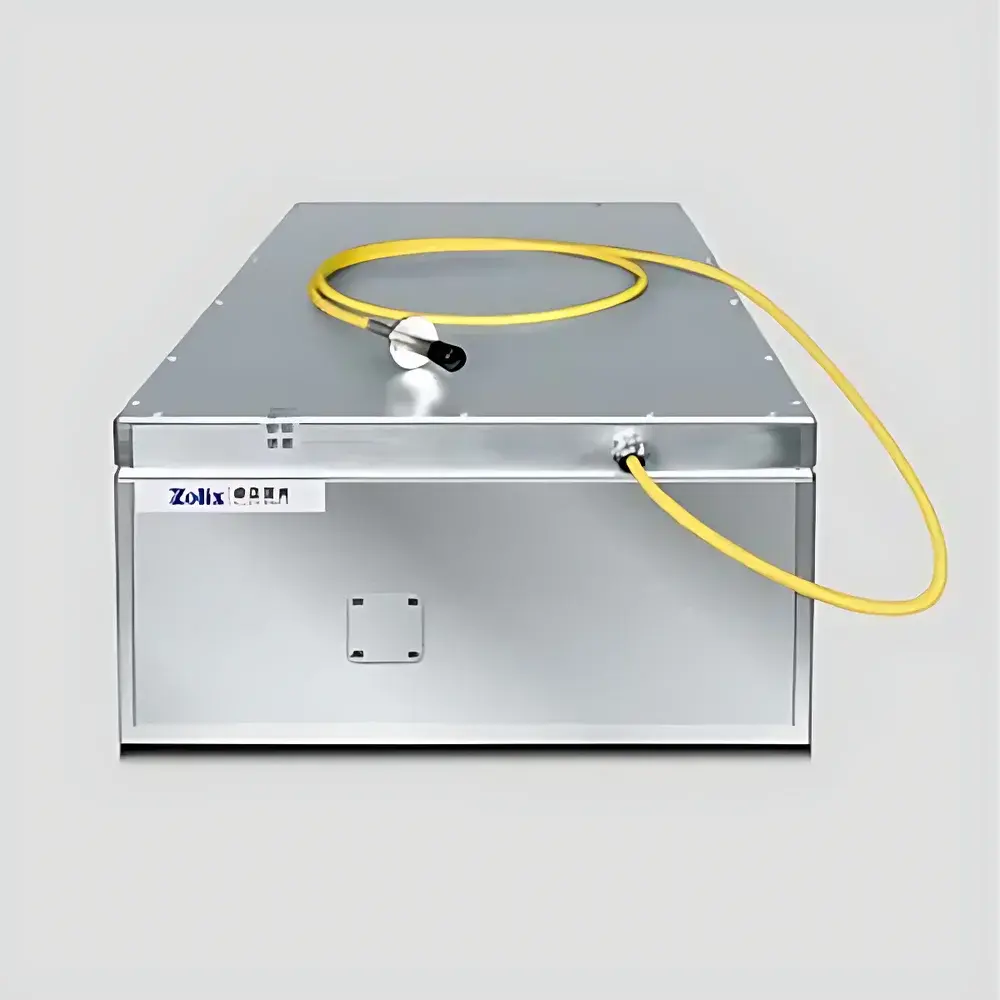
Gloria-SC-P Series Ultrafast Supercontinuum Laser System by ZOLIX
| Brand | ZOLIX |
|---|---|
| Origin | Beijing, China |
| Manufacturer Type | OEM Manufacturer |
| Origin Category | Domestic (China) |
| Model | Gloria-SC-P |
| Light Source Type | Supercontinuum Laser (ps-pulsed, fiber-based) |
| Cut-in Wavelength | 420 nm |
| Total Output Power | 7.5 W |
| Visible Power (350–850 nm) | 2.2 W |
| Spectral Range | 420–2200 nm |
| Power Stability (RMS) | < 0.5% |
| Repetition Rate Tunability | 160 kHz – 80 MHz |
| Beam Quality (M²) | < 1.1 |
| Polarization | Random |
| Output Fiber Length | 1.5 m |
| Synchronization Output | BNC, TTL-compatible |
| Operating Voltage | 100–240 V AC, 50/60 Hz |
| Power Consumption | < 150 W |
| Dimensions (W×H×L) | 600 × 400 × 200 mm |
| Weight | < 25 kg |
Overview
The Gloria-SC-P Series Ultrafast Supercontinuum Laser System is a turnkey, fiber-based supercontinuum source engineered for demanding optical laboratory and industrial R&D applications requiring broad spectral coverage with picosecond temporal structure. It generates high-brightness, spatially coherent broadband light via nonlinear spectral broadening in photonic crystal fiber, pumped by a mode-locked Yb-fiber laser. Unlike CW or nanosecond white-light sources, the Gloria-SC-P delivers pulsed output with intrinsic time-gated capability—enabling time-resolved spectroscopy, pump-probe experiments, and fluorescence lifetime imaging without external gating. Its spectral output spans from deep visible (420 nm) through near-infrared (2200 nm), covering key absorption and emission bands of quantum dots, perovskites, 2D materials, and biological fluorophores. Designed for integration into automated optical platforms, the system supports external TTL triggering and offers fully adjustable repetition rate and average power—facilitating optimization across diverse detection modalities including spectrometers, streak cameras, and single-photon avalanche diodes (SPADs).
Key Features
- Picosecond-pulsed supercontinuum generation with tunable repetition rate (160 kHz to 80 MHz) for synchronization with ultrafast detectors and scanning systems
- High total average power (7.5 W) and visible-band power (2.2 W, 350–850 nm), enabling high signal-to-noise ratio in low-light applications
- Wide, smooth spectral coverage from 420 nm to 2200 nm—validated by calibrated NIST-traceable spectroradiometric measurements
- Excellent beam quality (M² < 1.1) and spatial coherence, supporting diffraction-limited focusing and efficient coupling into single-mode fibers or microscope objectives
- Long-term power stability (< 0.5% RMS over 8 hours) under ambient lab conditions—critical for quantitative spectral calibration and long-duration acquisitions
- Integrated BNC TTL sync output for precise timing control in multi-instrument setups compliant with IEEE 1588 or custom FPGA-based timing architectures
- Compact benchtop form factor (600 × 400 × 200 mm) with internal thermal management and EMI-shielded power supply, suitable for Class 1 laser safety-compliant enclosures
Sample Compatibility & Compliance
The Gloria-SC-P is compatible with standard optical components rated for UV-VIS-NIR use—including fused silica lenses, broadband dielectric mirrors, and silicon- or InGaAs-based detectors. Its random polarization state necessitates optional polarization control modules (e.g., motorized half-wave plates or polarization-maintaining fiber pigtails) for polarization-sensitive applications such as anisotropy imaging or ellipsometry. The system complies with IEC 60825-1:2014 (Class 4 laser product) and meets CE marking requirements for electromagnetic compatibility (EN 61326-1) and low-voltage directive (2014/35/EU). While not inherently GLP/GMP-certified, its stable output and traceable calibration support validation protocols required for ISO/IEC 17025-accredited laboratories performing material characterization per ASTM E275, ISO 13406-2, or JIS Z 8141 standards.
Software & Data Management
The Gloria-SC-P operates as a hardware-controlled light source with no embedded GUI; it is managed via front-panel controls or remote RS-232/USB-C interface using ZOLIX’s open-command-set protocol (ASCII-based SCPI-like syntax). Users integrate the laser into existing acquisition frameworks—such as LabVIEW, Python (PyVISA), MATLAB, or EPICS—using provided driver libraries and timing configuration examples. All operational parameters (repetition rate, output power setpoint, sync polarity) are programmable and logged alongside timestamps. For audit-ready environments, third-party data acquisition software (e.g., Andor Solis, Thorlabs Kinesis, or National Instruments DIAdem) can record synchronized metadata—including laser status flags and TTL trigger latency—supporting 21 CFR Part 11 compliance when deployed with electronic signature and audit trail modules.
Applications
- Nanoscale material characterization: broadband transient absorption spectroscopy of plasmonic nanoparticles and colloidal quantum dots
- Photovoltaic device analysis: external quantum efficiency (EQE) mapping of perovskite and organic solar cells across 400–1100 nm
- Optical sensor validation: spectral responsivity calibration of CMOS image sensors, scientific CCDs, and SWIR InGaAs line-scan cameras
- 2D material metrology: Raman excitation profiling of graphene layer count and strain via wavelength-dependent resonance enhancement
- Fluorescence lifetime imaging microscopy (FLIM): time-correlated single-photon counting (TCSPC) with sub-100 ps instrument response function
- Optical coherence tomography (OCT): axial resolution enhancement in swept-source and full-field OCT systems through extended bandwidth illumination
- Ultrafast pump-probe spectroscopy: dual-output configurations (pump + supercontinuum probe) enabled via optional fiber splitting and delay stages
FAQ
Is the Gloria-SC-P suitable for fluorescence correlation spectroscopy (FCS)?
Yes—its high brightness, narrow pulse width, and low intensity noise enable photon-counting FCS with minimal afterpulsing artifacts. A bandpass filter and APD detector are recommended for optimal signal isolation.
Can the repetition rate be locked to an external RF reference?
Yes—the system accepts external 10 MHz or user-defined clock signals via the SYNC IN port for phase-locked operation in heterodyne or frequency-comb referenced experiments.
What is the typical spectral flatness across the 420–2200 nm range?
Spectral flatness varies by model variant; standard Gloria-SC-P units exhibit ±3 dB variation over 480–1800 nm when measured with a calibrated integrating sphere and grating spectrometer.
Does ZOLIX provide spectral calibration certificates?
Upon request, factory calibration reports traceable to NIST-standard radiometric references are available—including spectral power density (mW/nm), cut-in wavelength verification, and RMS stability data.
Is the output fiber polarization-maintaining?
No—the standard delivery uses non-PM SMF-28 fiber. Polarization-maintaining (PANDA or bow-tie) fiber pigtails are available as a custom option with specified extinction ratio (>20 dB).



