
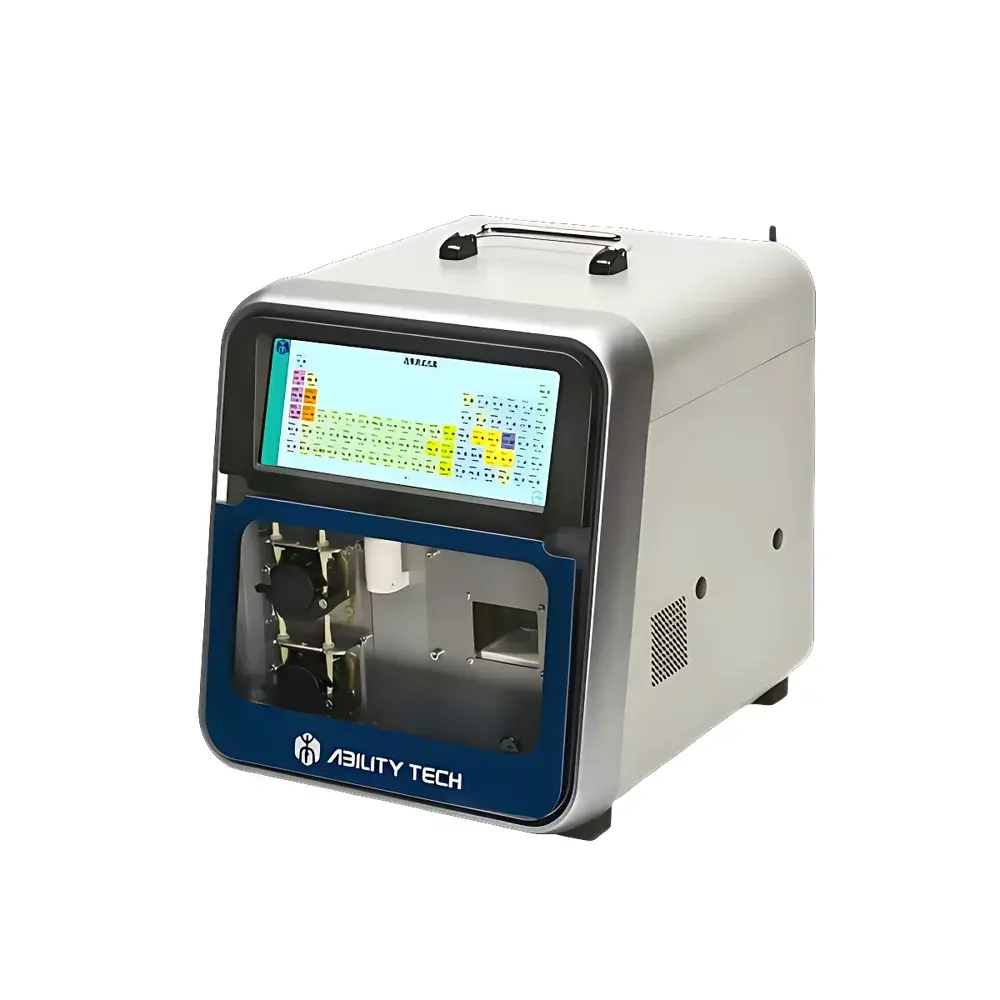
Glow Discharge Optical Emission Spectrometer PPA-6100 by Ability Technology
| Brand | Ability Technology |
|---|---|
| Origin | Beijing, China |
| Manufacturer Type | Direct Manufacturer |
| Country of Origin | China |
| Model | PPA-6100 |
| Target Analytes | Thallium (Tl), Cadmium (Cd), Silver (Ag), Zinc (Zn) in environmental water matrices |
| Detection Limit | Tl ≤ 0.005 ppb |
| Analysis Time | < 120 s per sample |
| Power Consumption | Low |
| Form Factor | Compact, Portable, Vehicle-Mountable |
| Gas Consumption | Low |
| Interference Resistance | High |
| Positioning | Integrated High-Precision GNSS Module (enables future online monitoring integration) |
Overview
The Ability Technology PPA-6100 Glow Discharge Optical Emission Spectrometer (GD-OES) is an engineered solution for field-deployable, real-time trace metal analysis in environmental water samples. Unlike conventional atomic absorption or ICP-based systems, the PPA-6100 employs a low-power, pulsed glow discharge plasma source coupled with high-resolution optical emission spectroscopy to achieve direct elemental quantification without extensive sample digestion or matrix separation. The instrument operates on the principle of sputtering aqueous analytes—pre-concentrated on a conductive substrate—into a stabilized argon plasma, where excited atoms and ions emit characteristic wavelengths detectable by a Czerny–Turner monochromator and CCD-based detector array. This configuration delivers laboratory-grade sensitivity in a ruggedized, transportable platform specifically designed for emergency response, mobile environmental labs, and regulatory compliance screening under ISO 17025–aligned workflows.
Key Features
- Sub-part-per-trillion detection capability for thallium (Tl ≤ 0.005 ppb), validated against EPA Method 200.8 reference protocols for trace metals in drinking and surface water
- Full-spectrum acquisition from 190–800 nm with spectral resolution < 0.02 nm (FWHM), enabling unambiguous peak deconvolution for multi-element interference correction (e.g., Cd 228.8 nm vs. Zn 228.4 nm)
- Integrated solid-phase microextraction (SPME) interface for on-site preconcentration—eliminates need for offline acid digestion or chelation chemistry
- Compact footprint (420 × 310 × 180 mm) and < 8 kg mass support rapid deployment from vehicle-mounted racks or handheld operation with optional battery pack (up to 4 h runtime)
- Low argon consumption (< 120 mL/min during measurement, 120 analyses per fill
- Embedded dual-frequency GNSS module (GPS + BeiDou) provides geotagged result metadata compliant with EPA’s Data Quality Objectives (DQO) framework for spatially referenced environmental monitoring
Sample Compatibility & Compliance
The PPA-6100 accepts raw, filtered (0.45 µm membrane), or preserved (HNO₃-acidified to pH < 2) environmental water samples—including surface water, groundwater, wastewater effluents, and drinking water distribution system taps. It meets ASTM D5673–22 requirements for field-portable metal analyzers and supports data integrity controls aligned with FDA 21 CFR Part 11 (electronic signatures, audit trails, user access levels). All calibration and QC procedures follow ISO/IEC 17025:2017 Annex A.3 guidelines for trace element analysis. Instrument firmware includes built-in method validation templates for USP and EU Pharmacopoeia Chapter 5.20 heavy metal screening in environmental contexts.
Software & Data Management
The proprietary GD-Analyzer v3.2 software suite runs on Windows 10 IoT Enterprise and provides full instrument control, spectral processing, and report generation. It features automated background correction via iterative least-squares fitting, internal standard normalization (using co-deposited In or Sc), and dynamic linear range extension across 5 orders of magnitude (0.005–500 ppb). Raw spectra and processed results are stored in vendor-neutral HDF5 format with embedded metadata (time stamp, GPS coordinates, operator ID, calibration status). Export options include CSV, PDF (ISO-compliant), and XML for integration into LIMS platforms such as LabWare or STARLIMS. Audit trail logs record all parameter changes, calibration events, and user actions with cryptographic time-stamping.
Applications
- Rapid assessment of heavy metal contamination following industrial spills or mining tailings breaches
- Mobile surveillance of drinking water quality in rural or disaster-affected regions
- Regulatory verification of effluent discharge compliance (e.g., NPDES permits, EU WFD Annex X parameters)
- Baseline mapping of Tl and Ag hotspots near electronic waste recycling zones or battery manufacturing facilities
- Method development support for ISO/TC 147/WG 5 working group on field-deployable elemental analysis standards
FAQ
What sample preparation is required prior to analysis?
Minimal preparation: filtration through 0.45 µm membrane followed by acidification to pH < 2 using ultrapure HNO₃. Preconcentration via SPME cartridge is optional but recommended for sub-ppq level Tl detection.
Can the PPA-6100 be used for soil or sediment extracts?
Yes—when paired with standardized leaching protocols (e.g., TCLP or SPLP), the system quantifies extractable metal fractions without modification to hardware or software.
Is remote diagnostics and firmware updates supported?
Yes—via secure TLS 1.3–encrypted OTA channel; requires cellular or Wi-Fi connectivity and authenticated enterprise account.
Does the system comply with GLP/GMP documentation requirements?
Yes—full electronic record retention, role-based access control, and 21 CFR Part 11–compliant audit trails are enabled by default.
What maintenance intervals are recommended for field operation?
Plasma source cleaning every 200 analyses; optical window inspection every 500 analyses; annual factory recalibration recommended for ISO 17025 accreditation.
Related Products







