
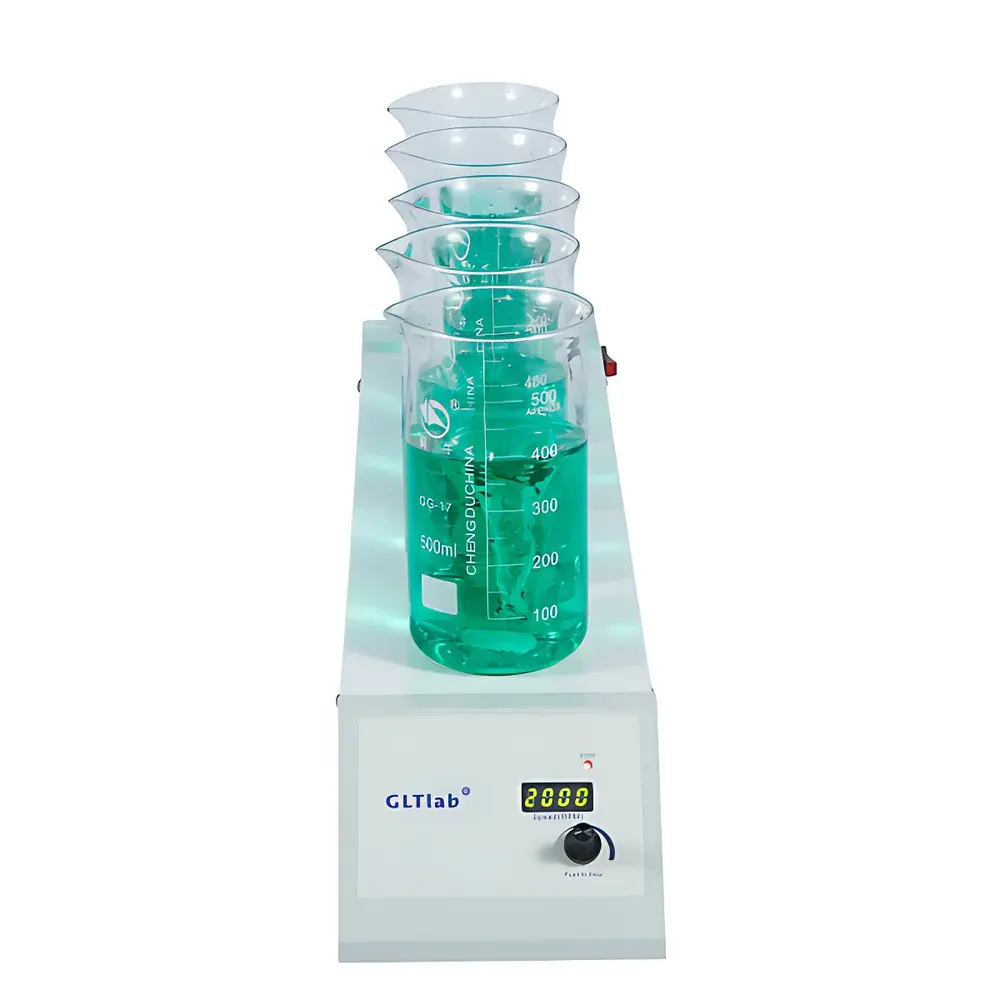
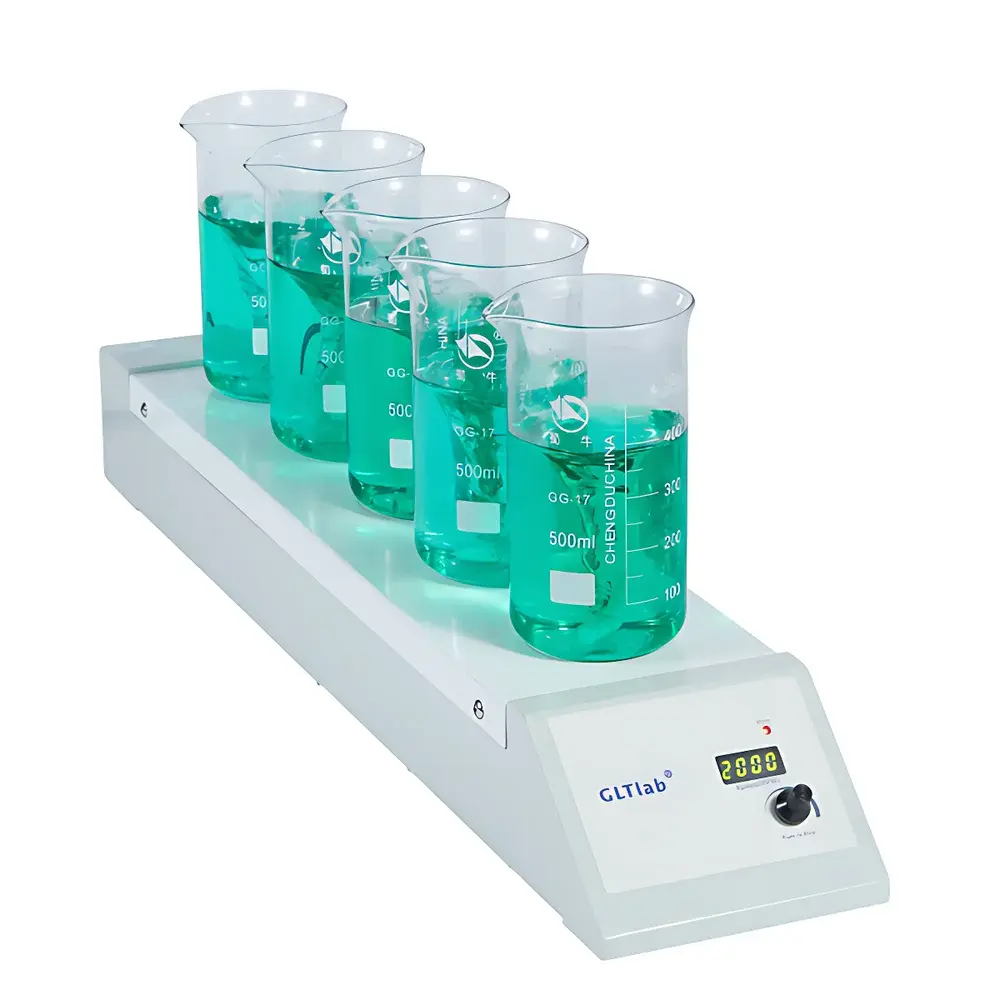
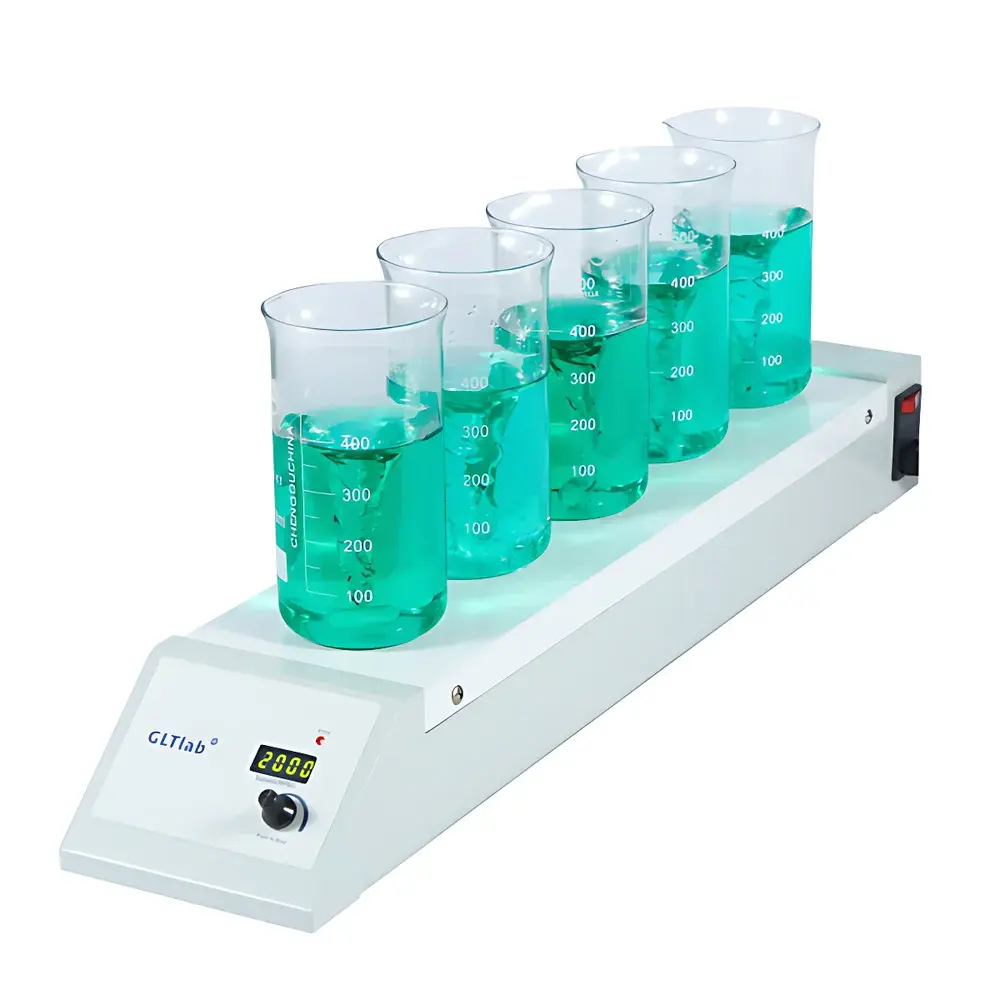
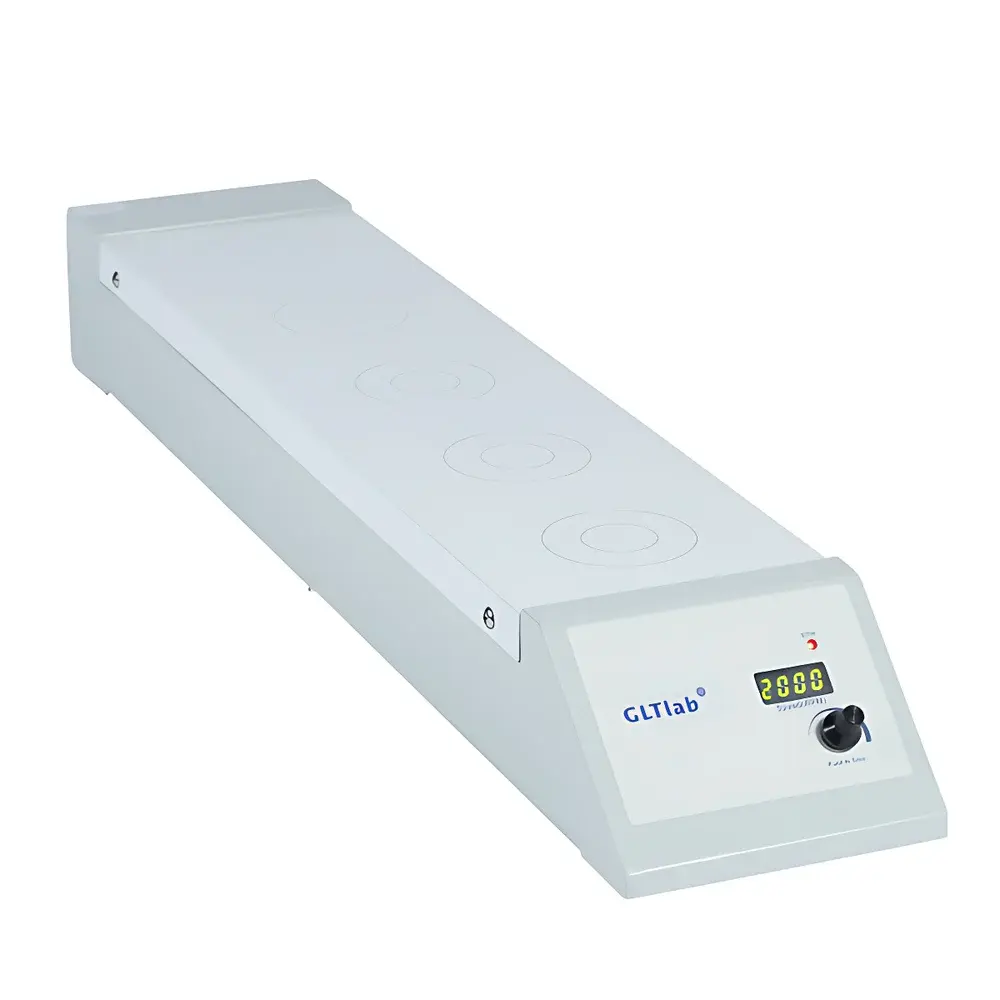
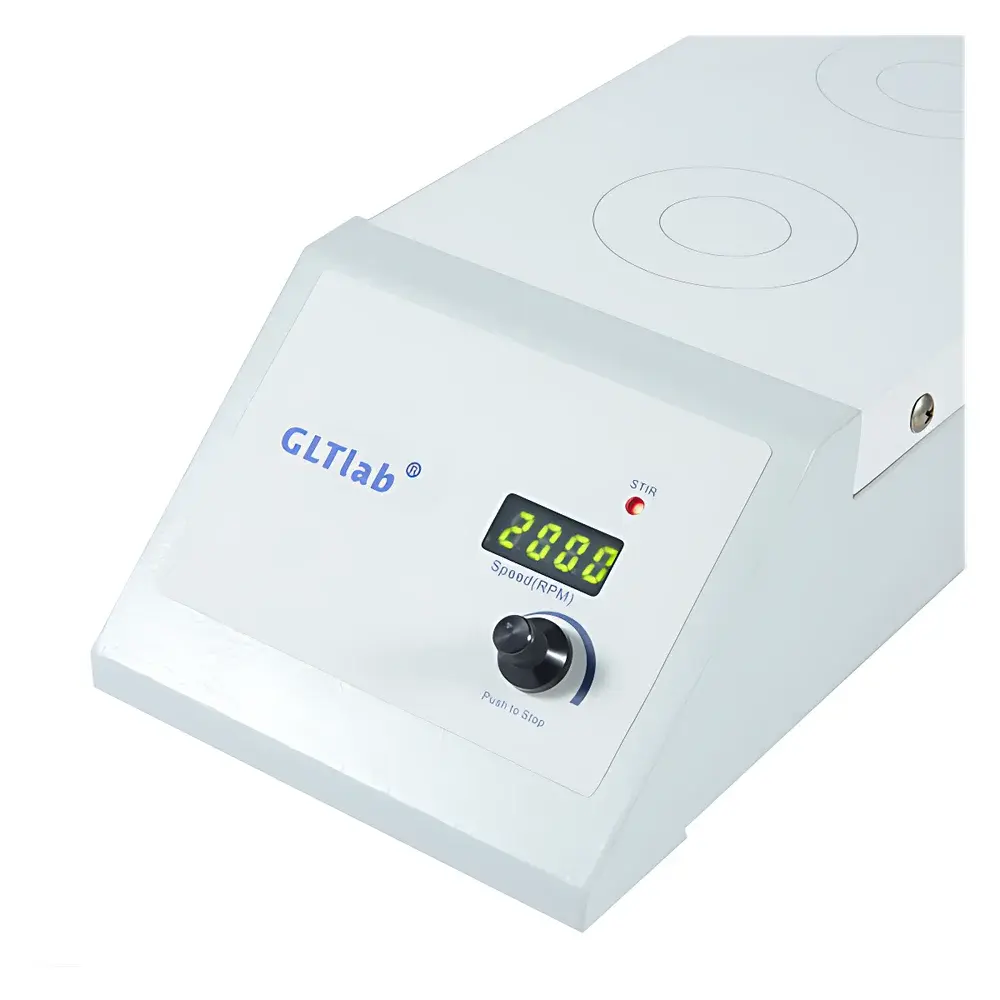
GLTLab SS-5N Five-Position Digital Magnetic Stirrer
| Brand | GLTLab |
|---|---|
| Origin | Guangdong, China |
| Manufacturer Type | Direct Manufacturer |
| Product Category | Domestic |
| Model | SS-5N |
| Instrument Type | Magnetic Stirrer |
| Max. Stirring Volume per Position | 1 L (5 × 1 L total) |
| Speed Range | 150–2000 rpm |
| Temperature Control Range | Ambient to 120 °C (optional heating module) |
| Display | LED digital interface |
| Drive Motor | Brushless DC motor |
| Plate Material | Ceramic-coated stainless steel |
| Plate Dimensions | 130 × 500 mm |
| Overall Dimensions (W × L × H) | 130 × 540 × 84 mm |
| Weight | 5.5 kg |
| Power Consumption | 30 W |
| Compliance | CE-marked design principles, RoHS-compliant materials |
Overview
The GLTLab SS-5N is a five-position digital magnetic stirrer engineered for reproducible, parallel sample agitation in quality control laboratories, academic research settings, and routine analytical workflows. Unlike single-station units, the SS-5N enables simultaneous, independent operation across five discrete stirring zones—each supporting vessels up to 1 L—thereby improving throughput without compromising speed stability or positional consistency. Its core actuation relies on permanent magnet coupling driven by a brushless DC motor, eliminating mechanical wear and ensuring long-term torque fidelity across the full 150–2000 rpm range. The ceramic-coated stainless steel plate provides uniform thermal distribution (when equipped with optional heating), chemical resistance against common solvents and mild acids, and non-magnetic surface integrity critical for maintaining consistent magnetic field geometry. Designed for benchtop integration, the unit’s low-profile footprint (84 mm height) and narrow width (130 mm) allow placement beneath fume hoods or within constrained lab cabinets while retaining full access to all five positions.
Key Features
- Five independently controllable stirring stations with synchronized or asynchronous speed adjustment via intuitive LED interface
- Brushless DC motor architecture delivering high-speed stability, minimal electromagnetic interference, and >50,000-hour operational lifespan
- Ceramic-coated stainless steel plate (130 × 500 mm) offering abrasion resistance, thermal uniformity, and compatibility with glass, PTFE, and polypropylene containers
- Digital speed control with ±2 rpm repeatability at setpoints ≥300 rpm; resolution of 1 rpm across entire range
- Optional integrated heating module (sold separately) enabling precise temperature regulation from ambient to 120 °C with ±1 °C accuracy at steady state
- Low-power consumption (30 W nominal) suitable for continuous unattended operation in ISO 17025-accredited environments
Sample Compatibility & Compliance
The SS-5N accommodates standard laboratory vessels including borosilicate glass beakers (50–1000 mL), cylindrical reaction tubes, and flat-bottomed flasks. Stir bars ranging from 15 mm to 40 mm length are fully engaged across the operational speed range. The ceramic coating meets ASTM F899-22 requirements for biocompatible surface finishes, and the device’s electrical design adheres to IEC 61010-1:2010 safety standards for laboratory equipment. While not intrinsically rated for hazardous area use, its non-sparking motor and absence of exposed contacts render it appropriate for general-purpose organic synthesis, buffer preparation, and dissolution testing under GLP conditions. Documentation includes factory calibration certificates traceable to NIM (National Institute of Metrology, China).
Software & Data Management
The SS-5N operates as a standalone instrument with no proprietary software dependency. All parameters—including speed setpoint, runtime (when timer option is installed), and temperature (if heating module active)—are retained in non-volatile memory following power cycling. Optional RS-232 or USB-to-serial interface kits enable integration into LIMS or ELN platforms for audit-trail generation. When configured with the timer accessory, the unit supports programmable start/stop sequences compliant with USP dissolution protocol timing requirements. Full event logging (start time, duration, final speed) satisfies FDA 21 CFR Part 11 data integrity expectations when paired with validated third-party acquisition software.
Applications
- Parallel preparation of calibration standards and QC reference solutions in pharmaceutical QC labs
- Homogenization of nanoparticle suspensions prior to DLS or TEM analysis
- pH buffer equilibration across multiple samples in environmental testing workflows
- Accelerated solvent extraction pre-treatment steps in food safety residue analysis
- Cell culture media conditioning where oxygen transfer rate correlates with agitation intensity
- Long-duration stability studies requiring unattended mixing over 72+ hour intervals
FAQ
Is the SS-5N compatible with corrosive reagents such as concentrated HCl or NaOH solutions?
Yes—the ceramic coating exhibits >98% resistance to 1 M aqueous HCl and 1 M NaOH after 72-hour static exposure per ISO 4527:2017. However, prolonged contact with hot alkaline solutions above 80 °C is not recommended.
Can individual stations be disabled while others remain active?
Yes—each position has a dedicated ON/OFF toggle in firmware; disabling one station does not affect torque delivery or thermal profile of adjacent zones.
What stir bar dimensions are optimal for maximum efficiency at 2000 rpm?
A 30 mm × 8 mm elliptical stir bar (PTFE-coated NdFeB) achieves laminar flow onset at ~1800 rpm in 1 L beakers; larger bars (>35 mm) may induce vortex instability above 1600 rpm.
Does the unit support external trigger signals for synchronization with other lab instruments?
Not natively—but the optional RS-232 interface supports TTL-level start/stop commands via ASCII protocol, enabling coordination with peristaltic pumps or spectrophotometers.
Is calibration verification required before first use?
No formal recalibration is needed; however, users should perform a speed verification test using a certified optical tachometer at three points (300, 1000, and 2000 rpm) and record results in their equipment log per ISO/IEC 17025 clause 6.4.6.



