
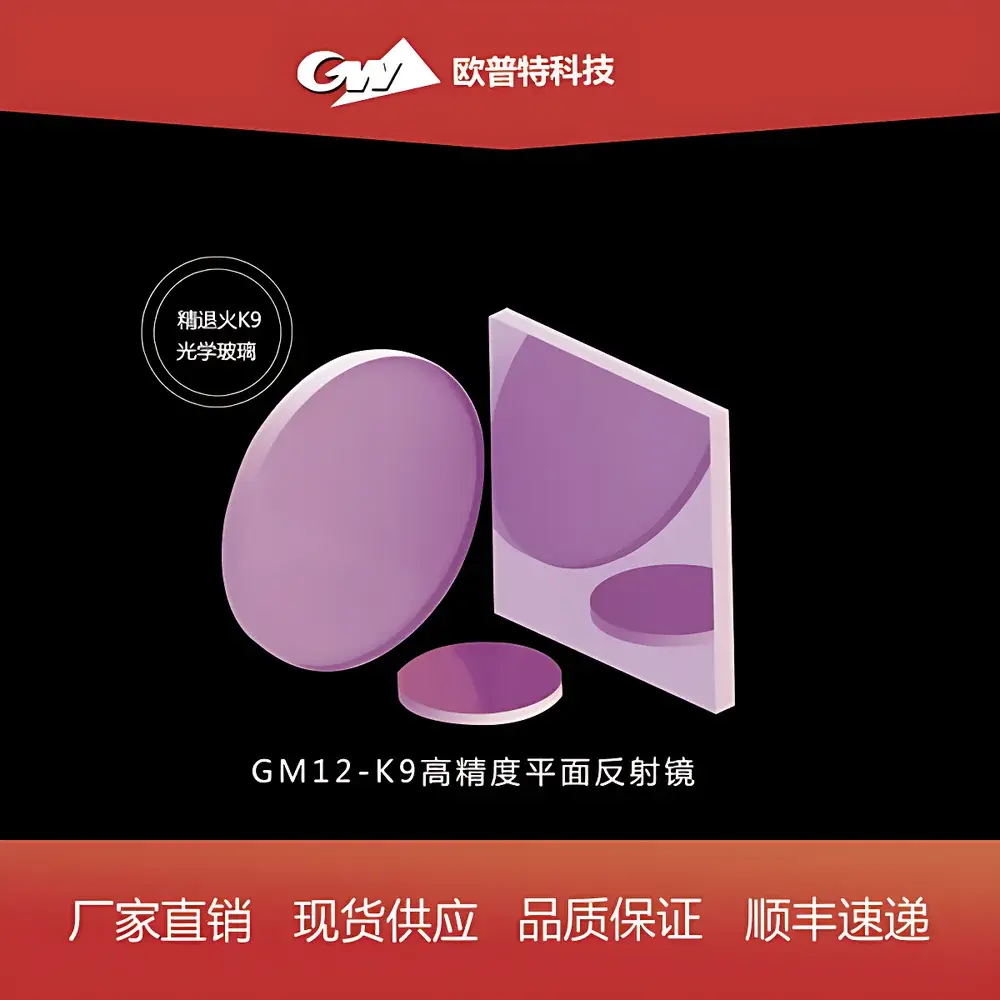
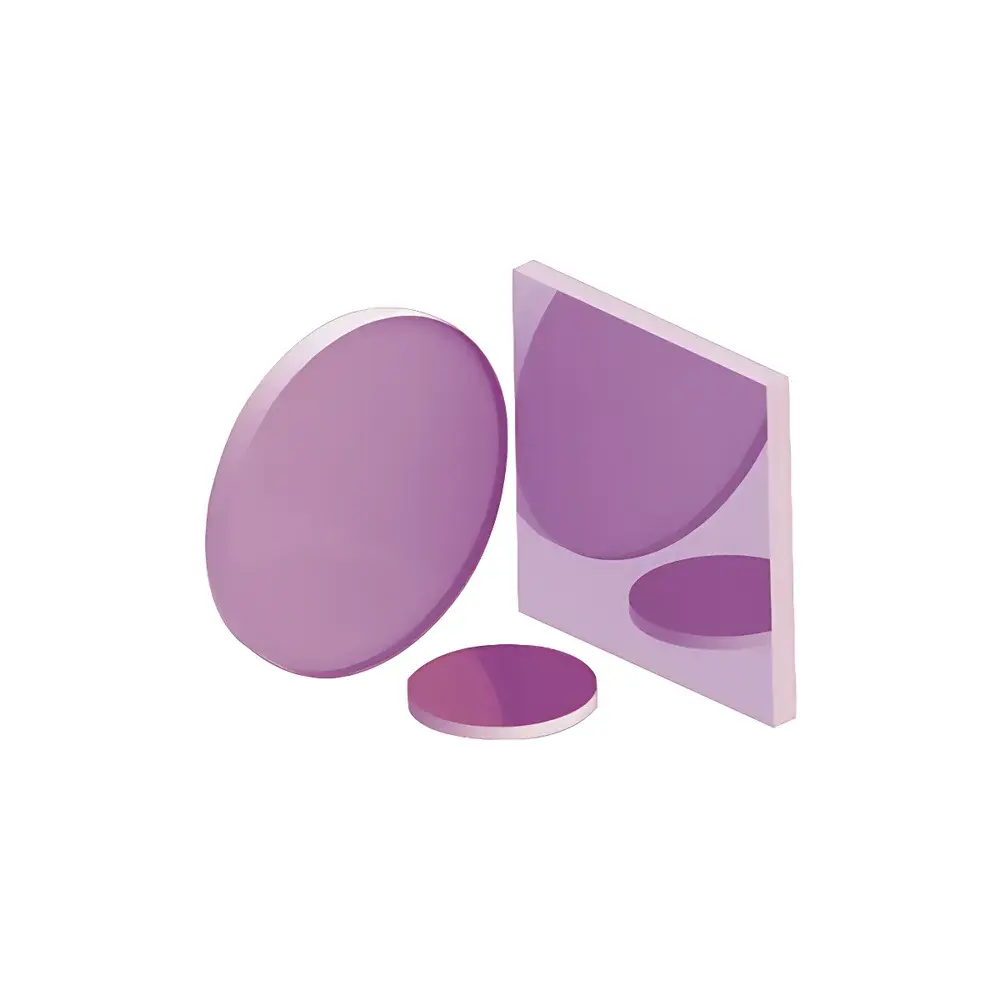
GM12-K9 High-Precision Plane Mirror
| Origin | Beijing, China |
|---|---|
| Manufacturer Type | Authorized Distributor |
| Origin Category | Domestic (PRC) |
| Model | GM12 |
| Unit Price Range | USD 0.15–75.00 (varies by size, coating, and quantity) |
| Component Category | Optical Element |
| Substrate Material | Precision-Annealed K9 Optical Glass |
| Surface Figure | λ/10 @ 633 nm |
| Parallelism | < 3 arcmin |
| Surface Quality | 10-5 scratch-dig (ISO 10110-7) |
| Back Surface | Fine Ground |
| Dimensional Tolerance | +0.0 / −0.1 mm (diameter or side length) |
| Thickness Tolerance | ±0.2 mm |
| Edge Treatment | Protective 45° chamfer, 0.2–0.5 mm |
| Coating Options | Uncoated, Protected Aluminum (Al+SiO₂), UV-Enhanced Aluminum (UVAL), Protected Silver (Ag+SiO₂), Protected Gold (Au+SiO₂) |
Overview
The GM12-K9 High-Precision Plane Mirror is a metrology-grade optical component engineered for demanding applications in laser alignment, interferometry, beam steering, optical cavity construction, and precision imaging systems. Fabricated from precision-annealed K9 borosilicate crown glass—a material specified in ISO 10110-4 and widely accepted in international optical design standards—the mirror delivers exceptional homogeneity, low birefringence, and thermal stability (dn/dT ≈ 2.3 × 10⁻⁶ /°C). Its surface figure of λ/10 at the HeNe reference wavelength (633 nm) ensures minimal wavefront distortion, critical for applications requiring high Strehl ratio preservation or sub-microradian angular stability. Unlike standard commercial mirrors, the GM12 series undergoes full interferometric verification per ISO 10110-5, with surface flatness traceable to NIST-traceable calibration artifacts. The substrate’s fine-ground back surface minimizes stray reflections while maintaining mechanical rigidity under mounting-induced stress—key for vacuum-compatible or kinematic mount integration.
Key Features
- Precision-annealed K9 optical glass substrate compliant with ISO 10110-4 and MIL-O-13830A material specifications
- Surface flatness certified to λ/10 @ 633 nm (RMS deviation < 63.3 nm), verified via Zygo GPI interferometer
- Parallelism controlled to < 3 arcminutes between front reflective surface and back ground surface
- Surface quality rated 10-5 per ISO 10110-7 (equivalent to 10 µm scratch, 5 µm dig), suitable for Class 100 cleanroom handling
- Dimensional tolerances held to +0.0 / −0.1 mm on diameter/side length; thickness tolerance ±0.2 mm for consistent mechanical mounting
- Protective 45° edge chamfer (0.2–0.5 mm) mitigates chipping during handling and clamping without compromising optical clear aperture
- Five standardized coating variants available—including broadband protected aluminum (350–2000 nm), UV-enhanced aluminum (250–2000 nm), protected silver (450–2000 nm), and protected gold (700–12000 nm)—all deposited via electron-beam evaporation and monitored in situ for spectral consistency
Sample Compatibility & Compliance
The GM12-K9 mirror is compatible with standard optomechanical mounts (e.g., Thorlabs KM100, Newport U100 series) and vacuum-compatible kinematic bases (up to 10⁻⁶ Torr). All coated variants meet ISO 9022-3 environmental durability requirements for abrasion, humidity, and adhesion (tested per MIL-C-48497A). Uncoated versions support custom thin-film deposition protocols. The product conforms to RoHS Directive 2011/65/EU and REACH Annex XVII restrictions on hazardous substances. Documentation includes material certificates (EN 10204 3.1), coating spectral reflectance curves (measured on Agilent Cary 5000), and interferometric test reports—all archived for GLP-compliant traceability upon request.
Software & Data Management
While the GM12-K9 is a passive optical component, its performance data integrates seamlessly into optical design workflows. Zemax OpticStudio and Code V prescription files (including surface figure Zernike coefficients and coating dispersion models) are provided upon order confirmation. Reflectance spectra (350–12000 nm) are delivered in CSV and .SPECT formats compatible with Python (NumPy/Pandas), MATLAB, and LabVIEW. Batch-specific test reports include interferogram exports (.tif), phase map metadata (ISO 10110-5 compliant headers), and uncertainty budgets aligned with GUM (JCGM 100:2008). For regulated environments, audit trails and electronic signatures can be enabled via optional integration with validated LIMS platforms supporting FDA 21 CFR Part 11.
Applications
- Laser cavity end mirrors and folding mirrors in DPSS, Ti:sapphire, and fiber laser systems
- Reference surfaces in Michelson, Mach-Zehnder, and Twyman-Green interferometers
- Beam combiners and pick-off mirrors in multi-wavelength spectroscopy setups
- Alignment fiducials in synchrotron beamlines and EUV lithography prototyping
- Imaging relay optics in confocal microscopy and adaptive optics wavefront sensors
- Calibration standards for optical surface metrology labs accredited to ISO/IEC 17025
FAQ
Is the λ/10 surface figure measured at 633 nm applicable to other wavelengths?
Yes—the specification reflects peak-to-valley deviation relative to a perfect plane; RMS wavefront error scales linearly with wavelength, so performance remains within λ/10 tolerance across visible and NIR bands when used at normal incidence.
Can GM12 mirrors be mounted in vacuum without outgassing concerns?
All substrates are pre-baked per ASTM E595, with total mass loss (TML) < 0.5% and collected volatile condensable materials (CVCM) < 0.05%, satisfying NASA SP-R-0022A for space-qualified optics.
Do you provide custom sizes or non-standard coatings?
Yes—custom diameters up to Φ100 mm and thicknesses up to 20 mm are available; dielectric HR coatings (e.g., 1064 nm R > 99.99%) can be quoted separately with lead time and MOQ details.
Are test reports supplied with each shipment?
Yes—individual interferometric certification, spectral reflectance curves, and dimensional inspection reports accompany every order; digital copies are provided via secure download link.
What is the typical lead time for coated variants?
Standard coated items ship within 5–7 business days; UV-enhanced aluminum and protected silver require 10–12 days due to additional process steps and in-situ monitoring.



