
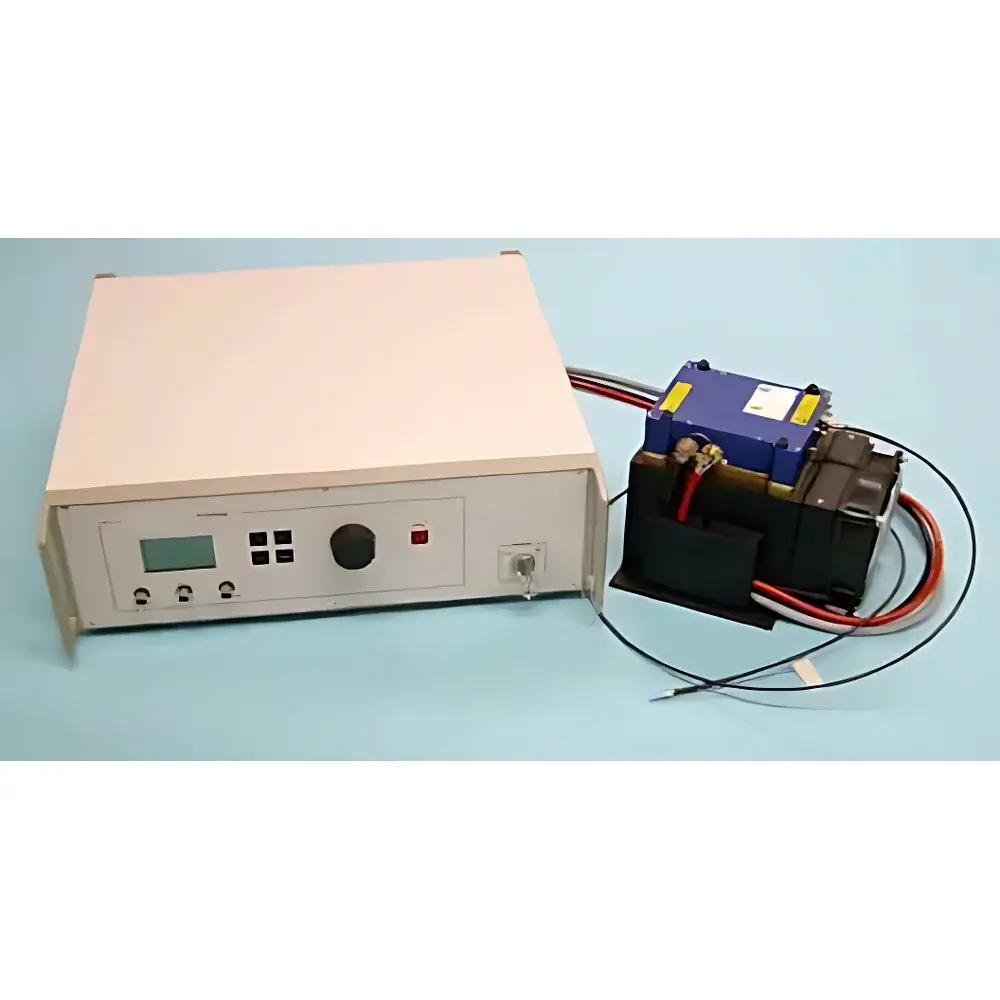
A.L.S. GmbH DiLas DD50-2 High-Power Semiconductor Laser Module System with DioMod–808-50-600-Pi Diode Module and HS 120 Heat Sink
| Brand | A.L.S. GmbH / Advanced Laser Diode Systems |
|---|---|
| Origin | Germany |
| Manufacturer Type | Authorized Distributor |
| Product Origin | Imported |
| Model | DiLas DD50-2 |
| Core Components | Fiber-Coupled Semiconductor Laser Module, Integrated Laser Driver & TEC Controller, Active Air-Cooled Heat Sink |
| Max Output Current | 50 A |
| Max Output Voltage | 3–6 V (configurable) |
| Pulse Rise Time | 100 µs |
| Operating Modes | CW and Pulsed |
| Wavelength Options | 808 nm, 940 nm, 980 nm |
| Fiber Coupling | SMA905 connector, 400 µm or 600 µm core diameter |
| Thermal Load Capacity | Up to 120 W (HS 120) |
| TEC Integration | Integrated Peltier element with temperature sensor and active fan cooling |
| Control Interface | Front-panel keypad + RS232 |
| Analog Modulation | Supported (50 A version only) |
Overview
The A.L.S. GmbH DiLas DD50-2 is a modular, high-power semiconductor laser system engineered for demanding industrial processing, materials testing, and advanced R&D applications requiring stable, controllable, and fiber-delivered optical power. At its core, the system integrates three precision-engineered subsystems: the DioMod–808-50-600-Pi diode module — a 50 W, 808 nm fiber-coupled semiconductor laser array; the DD50-2 driver unit — featuring fully integrated current regulation and thermoelectric cooler (TEC) control; and the HS 120 active heat sink — designed for reliable thermal management under sustained high-load operation. Unlike fixed-output OEM modules, the DiLas platform adopts a component-level architecture: users may configure complete systems or select individual subsystems (e.g., driver + heatsink only) to integrate custom laser diodes. This modularity supports application-specific optimization while maintaining traceable performance across development, pilot-scale trials, and production environments.
Key Features
- High-current laser driver with programmable output up to 50 A and configurable voltage range (3 V or 6 V), optimized for low-inductance, high-stability current delivery in both continuous-wave (CW) and pulsed modes.
- Integrated dual-loop control: real-time current regulation combined with closed-loop TEC temperature stabilization (±0.1 °C setpoint accuracy), enabling wavelength stability critical for pumping solid-state lasers or absorption-sensitive processes.
- Active air-cooled heat sink (HS 120) rated for thermal loads up to 120 W, incorporating a Peltier element, NTC temperature sensor, aluminum fin stack, and brushless DC fan — all housed in a rigid, EMI-shielded mechanical assembly.
- Front-panel interface with LCD display and membrane keypad for local parameter configuration (current limit, pulse width, duty cycle, TEC setpoint); full remote control via RS232 with ASCII command protocol compliant with standard SCPI-like syntax.
- Comprehensive laser protection architecture: AC line filtering, transient voltage suppression (TVS), microcontroller-monitored fault detection (overcurrent, overtemperature, open/short load), automatic current shutdown, and soft-start/soft-stop sequencing to suppress inductive transients.
- Analog modulation input (0–5 V or 0–10 V, 50 A version only) supporting external waveform control — including sine, triangle, and arbitrary pulse trains — for dynamic power profiling in laser annealing, selective soldering, or photothermal stimulation protocols.
Sample Compatibility & Compliance
The DiLas DD50-2 system accommodates industry-standard fiber-coupled semiconductor laser modules with SMA905 connectors and 400 µm or 600 µm core diameters. It supports multi-wavelength configurations (808 nm, 940 nm, 980 nm) to match absorption peaks of target materials (e.g., silicon, polymers, biological chromophores). All electronic subsystems comply with IEC 61000-6-3 (EMI emission) and IEC 61000-6-2 (immunity) standards. The driver firmware implements configurable safety interlocks and hardware-enforced current limits, aligning with functional safety principles referenced in ISO 13849-1. While not certified as a medical device, the system’s design supports integration into Class 1 or Class 4 laser enclosures per IEC 60825-1:2014, and its logging capabilities (via RS232) can be extended to support GLP/GMP audit trails when paired with validated third-party data acquisition software.
Software & Data Management
The DD50-2 operates without proprietary PC software — all operational parameters are accessible via a documented ASCII command set over RS232. Users may implement custom control logic using Python, LabVIEW, MATLAB, or PLC-based HMI systems. The driver logs key operational events (e.g., fault triggers, TEC status changes) to non-volatile memory and reports real-time values (actual current, TEC voltage, heatsink temperature) on request. For regulated environments, the system supports time-stamped parameter export and can be embedded within FDA 21 CFR Part 11-compliant workflows when used with validated external software that enforces electronic signatures, audit trails, and role-based access control. Firmware updates are performed via UART bootloader and require physical access — ensuring integrity and preventing unauthorized modification.
Applications
- Laser pumping of Nd:YAG, Yb:fiber, and thin-disk lasers in research and industrial amplifier systems.
- Materials processing: plastic welding, metal cladding preheating, and localized thermal treatment of composites.
- Biomedical instrumentation: photoacoustic imaging excitation sources and optogenetic stimulation platforms requiring precise temporal control.
- Accelerated life testing of photovoltaic cells and LED packaging under controlled thermal-optical stress.
- Calibration and validation of optical power meters, integrating spheres, and spectroradiometers in metrology labs.
- Development of hybrid laser systems where modular drivers and thermal interfaces enable rapid prototyping of multi-diode architectures.
FAQ
Can the DD50-2 drive laser diodes at wavelengths other than 808 nm, 940 nm, or 980 nm?
Yes — the driver is wavelength-agnostic and compatible with any fiber-coupled semiconductor laser module operating within its electrical specifications (max 50 A, 3–6 V compliance voltage). Optical performance depends solely on the selected DioMod module.
Is the HS 120 heat sink suitable for continuous operation at 120 W thermal load?
Yes — the HS 120 is rated for sustained 120 W dissipation under ambient temperatures ≤25 °C and airflow ≥100 L/min. Derating applies above 25 °C ambient or with restricted airflow; detailed thermal derating curves are provided in the technical datasheet.
Does the system support analog modulation in CW mode only, or also in pulsed mode?
Analog modulation is supported in both CW and pulsed modes. In pulsed operation, the analog input modulates the amplitude of each pulse envelope, preserving user-defined pulse width and repetition rate.
What safety certifications does the DD50-2 carry?
The unit complies with CE marking requirements under the Low Voltage Directive (2014/35/EU) and EMC Directive (2014/30/EU). Full type certification reports (including test summaries per EN 61000-6-2/-3) are available upon request for integration into certified end equipment.
Can I replace the built-in pilot red laser in the DioMod module?
The pilot LD (635 nm, <5 mW) is factory-aligned and sealed within the module housing. It is not user-replaceable; however, modules without pilot LD are available as a configuration option (DioMod–808-50-600-Pi-NP).





