
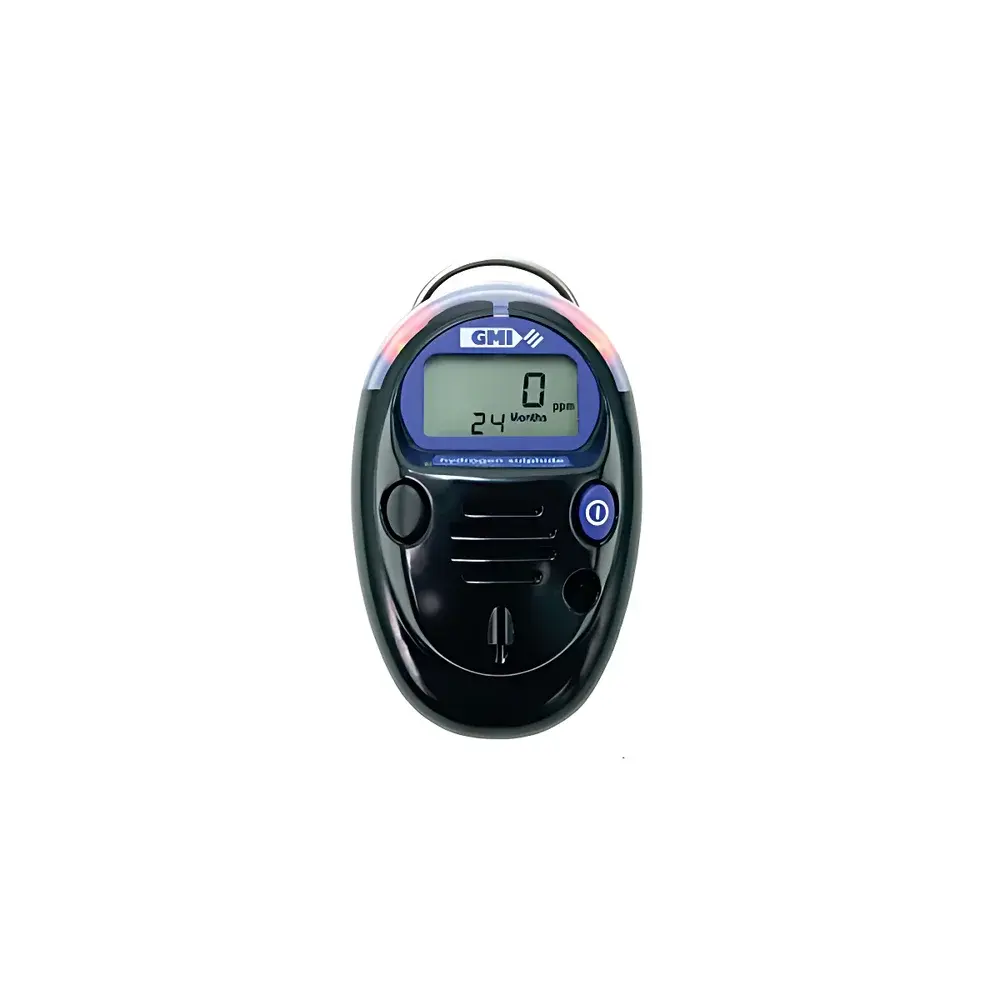
GMI PS1 Oxygen Gas Detector
| Brand | GMI (UK) |
|---|---|
| Origin | United Kingdom |
| Model | PS1 |
| Gas Detection | O₂ (0–25% vol, 0.1% res), H₂S (0–100 ppm, 1 ppm res), CO (0–500 ppm, 1 ppm res), SO₂ (0–20 ppm, 0.1 ppm res) |
| Display | Backlit LCD |
| Protection Rating | IP67 |
| Operating Temperature | −20 °C to +50 °C |
| Relative Humidity | 0–95% RH (non-condensing) |
| Dimensions | 85 × 55 × 29 mm |
| Weight | 86 g |
| Power | 3.6 V lithium-thionyl chloride battery |
| Alarm Types | Visual (360° high-brightness LED), Audible (95 dB), Vibration |
| Certifications | IECEx Ex ia IIC T4 Ga, ATEX Ex II 1G Ex ia IIC T4 Ga, UL913 Class I Div 1 Groups A–D T4, CE, MED 96/98/EC, CSA Class I Div 1 Groups A–D T4 (pending) |
Overview
The GMI PS1 Oxygen Gas Detector is a compact, intrinsically safe single-gas monitoring instrument engineered for continuous real-time detection of oxygen (O₂) and other critical toxic or combustible gases—including hydrogen sulfide (H₂S), carbon monoxide (CO), and sulfur dioxide (SO₂)—in demanding industrial environments. Utilizing electrochemical sensor technology, the PS1 delivers stable, linear response with high selectivity and low cross-sensitivity, conforming to international performance benchmarks for portable gas detection. Designed specifically for personnel safety in confined or high-risk zones, it operates within the breathing zone—clip-on mounting enables unobtrusive wear on collars, vests, or harnesses—ensuring immediate exposure awareness without compromising mobility. Its robust mechanical architecture and certified intrinsic safety make it suitable for Zone 0/20 hazardous locations across oil & gas, power generation, chemical processing, and emergency response applications.
Key Features
- Intrinsically safe design certified to IECEx Ex ia IIC T4 Ga and ATEX Ex II 1G Ex ia IIC T4 Ga for use in explosive atmospheres (Zone 0/20)
- IP67-rated enclosure constructed from high-impact ABS/polymer blend, resistant to dust ingress and submersion up to 1 m for 30 minutes
- Backlit LCD display with real-time gas concentration, battery status, and alarm indicators; optimized for readability under low-light or high-glare conditions
- Triple-mode alarm system: 360° visible LED strobe (≥120 cd), audible alert (95 dB at 30 cm), and tactile vibration—fully programmable for TWA, STEL, low-battery, end-of-sensor-life, and gas-specific thresholds
- Integrated calibration and functional test station (PS1 Dock): automated 90-second verification with printed calibration certificate; manual bump test and span calibration supported via external gas cylinder and regulator
- Onboard data logging as standard—stores time-stamped gas readings, alarm events, and calibration history for post-event analysis and regulatory review
- Stainless steel alligator clip for secure, repeatable attachment; lightweight (86 g) form factor minimizes user fatigue during extended shifts
Sample Compatibility & Compliance
The PS1 is validated for direct ambient air sampling in occupational settings where worker exposure must comply with OSHA PELs, ACGIH TLVs®, and EU Directive 2004/37/EC (Carcinogens and Mutagens). Sensor response characteristics meet EN 45544-1:2019 (electrochemical gas detectors) and ISO 16000-25:2021 (indoor air quality monitoring). Its certifications satisfy mandatory requirements for deployment in marine, offshore, and onshore energy infrastructure—including compliance with MED 96/98/EC for maritime equipment and alignment with IEC 60079-29-1 for sensor performance validation. The device supports GLP-aligned recordkeeping through timestamped calibration logs and tamper-evident event histories.
Software & Data Management
Data export is enabled via optical infrared interface (no physical ports required), compatible with GMI’s proprietary configuration and reporting software. Logged datasets include gas concentration values, alarm triggers (type, duration, threshold), battery voltage trends, and calibration metadata—including date, gas type, concentration, and technician ID. All records are stored with immutable timestamps and support audit-ready export in CSV or PDF formats. Firmware updates preserve configuration integrity and maintain traceability per FDA 21 CFR Part 11 principles—user authentication, electronic signatures, and change logs are enforced during calibration and parameter modification.
Applications
- Power generation: boiler room O₂ deficiency monitoring, turbine hall CO surveillance, and transformer vault H₂S leak detection
- Petrochemical facilities: flare stack perimeter monitoring, tank farm entry verification, and pipeline maintenance zone air quality assurance
- Maritime & offshore: engine rooms, cargo holds, and confined space entry pre-checks per IMO SOLAS Chapter II-2
- Chemical manufacturing: reactor vent scrubber efficiency verification and solvent storage area SO₂ exposure control
- Public infrastructure: wastewater treatment plant digester areas, subway ventilation shafts, and municipal gas distribution hubs
- Emergency services: fire department SCBA compatibility checks, hazmat incident perimeter screening, and rescue team personal exposure tracking
FAQ
What gases does the PS1 detect by default?
The PS1 is configured as a single-gas detector; each unit is factory-set for one target gas—O₂, H₂S, CO, or SO₂. Multi-gas variants are not available in the PS1 platform.
How often must the PS1 be calibrated?
Daily bump testing is recommended prior to each shift per OSHA 1910.120 and IEC 62040-2. Full span calibration is required every 6 months or after exposure to sensor-poisoning compounds (e.g., silicones, H₂, Cl₂).
Can the PS1 operate in extreme cold or high humidity?
Yes—the device maintains full functionality between −20 °C and +50 °C and up to 95% relative humidity (non-condensing), validated per IEC 60068-2 environmental test standards.
Is the battery replaceable in the field?
No—the 3.6 V lithium-thionyl chloride cell is sealed and non-user-replaceable; end-of-life units are returned to authorized service centers for battery replacement and full recalibration.
Does the PS1 support wireless connectivity or cloud-based reporting?
No—the PS1 relies exclusively on optical IR for local data transfer; it does not incorporate Bluetooth, Wi-Fi, or cellular modules to preserve intrinsic safety certification and minimize electromagnetic interference risk.




