
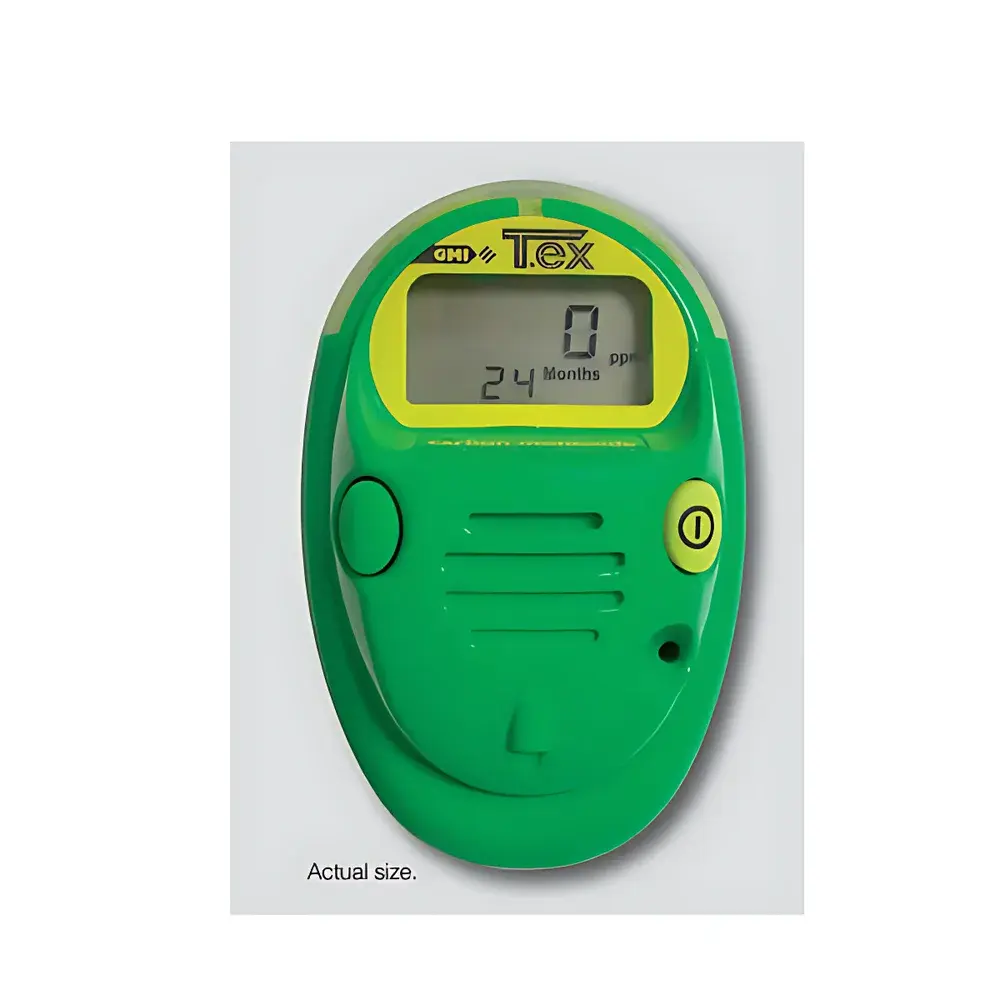
GMI T.ex-O2 Oxygen Gas Detector
| Brand | GMI (UK) |
|---|---|
| Origin | United Kingdom |
| Model | T.ex-O2 |
| Detection Principle | Electrochemical Sensor |
| Gas Measured | O₂ |
| Range | 0–25% vol |
| Resolution | 0.1% vol |
| Operating Temperature | −20 °C to +50 °C |
| Relative Humidity | 0–95% RH (non-condensing) |
| Display | Backlit high-contrast LCD (analog bar + digital readout) |
| Audible Alarm | 95 dB at 10 cm, 85 dB at 30 cm |
| Visual Alarm | Dual LED flash indicators |
| Vibration Alert | Integrated haptic feedback |
| Enclosure Material | Impact-resistant polypropylene |
| Ingress Protection | IP67 |
| Certifications | ATEX II 1 G Ex ia IIC T4, UL 913 Class I, Div 1, Groups A/B/C/D, MED |
| Battery | Rechargeable Li-ion, 3-year typical service life |
| Dimensions | 85 × 55 × 29 mm |
| Weight | 81 g (O₂ configuration) |
| Data Logging | Standard internal memory with timestamped records |
| Connectivity | USB interface for data download and calibration verification |
| Alarm Modes | STEL (Short-Term Exposure Limit), TWA (Time-Weighted Average), Peak, Lockable Alarm |
| Pump | Integrated micro-diaphragm sampling pump |
| Self-Test | Power-on diagnostic sequence with sensor and circuit validation |
| Mounting | Clip-on design for collar or vest placement near breathing zone |
Overview
The GMI T.ex-O2 Oxygen Gas Detector is a certified intrinsically safe, single-gas electrochemical monitoring instrument engineered for continuous, real-time detection of ambient oxygen concentration in potentially hazardous environments—particularly within power generation facilities, confined space entry operations, substation maintenance zones, and turbine enclosures. Operating on the principle of amperometric electrochemical sensing, the device delivers stable, linear response across its full 0–25% vol measurement range with 0.1% vol resolution. Its compact, ergonomic form factor (85 × 55 × 29 mm) and lightweight construction (81 g) enable unobtrusive wear at the breathing zone—ensuring proximity-based exposure assessment compliant with OSHA 1910.146 and EU Directive 1999/92/EC (ATEX). The unit meets rigorous international safety standards including ATEX II 1 G Ex ia IIC T4 for Zone 0/1 gas group IIC atmospheres, UL 913 Class I, Div 1 certification for North American hazardous locations, and Marine Equipment Directive (MED) compliance for offshore and marine power infrastructure applications.
Key Features
- Robust polypropylene housing rated IP67—fully dust-tight and submersible to 1 m for 30 minutes—suitable for high-moisture, high-particulate utility environments.
- Integrated micro-diaphragm sampling pump enabling active draw-through sampling, critical for verifying oxygen levels in ventilation ducts, cable trenches, and transformer vaults.
- Dual-mode display: simultaneous analog bar graph and numeric readout with adjustable backlight intensity for low-light switchgear rooms or nighttime outage response.
- Triple-alert system: 95 dB audible alarm (measured at 10 cm), dual-color flashing LEDs, and programmable vibration feedback—ensuring notification under PPE-heavy conditions (e.g., arc-flash suits, hearing protection).
- On-device configurability: user-defined alarm thresholds (LO/Hi, STEL, TWA), lockable alarm mode, custom calibration intervals, and pump self-test initiation via single-button interface.
- Comprehensive diagnostics: automated power-on self-test verifying sensor integrity, battery voltage, buzzer functionality, LED operation, and pump performance—generating pass/fail status before deployment.
- Long-life electrochemical O₂ sensor with 24–36 month operational expectancy under typical utility duty cycles; field-replaceable without recalibration tools.
Sample Compatibility & Compliance
The T.ex-O2 is specifically validated for oxygen measurement in air matrices containing common power industry contaminants—including trace SO₂, NOₓ, CO, and hydrocarbon vapors—without cross-sensitivity interference. It operates reliably across −20 °C to +50 °C ambient temperatures and 0–95% non-condensing relative humidity—covering outdoor substations, underground cable tunnels, and turbine hall environments. Regulatory alignment includes full traceability to ISO 8573-1 (compressed air quality), EN 50104 (oxygen deficiency warning devices), and IEC 60079-29-1 (gas detector performance requirements). All firmware and calibration logs retain audit-ready timestamps per GLP/GMP-aligned data integrity protocols. Device configuration and alarm history are exportable in CSV format for integration into EHS incident reporting systems.
Software & Data Management
Data transfer occurs via standard USB interface to Windows-based GMI LogView software (v4.2+), supporting full download of time-stamped O₂ concentration logs (sample interval configurable from 1 s to 10 min), alarm event metadata (type, duration, reset method), calibration certificates, and pump runtime statistics. Software enforces role-based access control and supports 21 CFR Part 11-compliant electronic signatures for calibration verification and report generation. Internal memory retains ≥10,000 data points with automatic overwrite protection enabled during alarm events. Firmware updates are delivered via signed binary packages with SHA-256 hash verification to ensure integrity in regulated utility IT environments.
Applications
- Confined space entry pre-check and continuous monitoring in boiler drums, flue gas desulfurization (FGD) scrubbers, and hydrogen-cooled generator housings.
- Oxygen depletion hazard surveillance during SF₆ gas handling, nitrogen purging, or inerting procedures in switchgear and GIS installations.
- Post-maintenance atmospheric verification prior to re-energization of transformers, reactors, and capacitor banks.
- Mobile patrol monitoring for thermal runaway detection in battery energy storage systems (BESS) where O₂ displacement may indicate off-gassing events.
- Regulatory compliance documentation for NFPA 70E arc-flash risk assessments requiring documented ambient atmosphere verification.
FAQ
What is the expected service life of the O₂ sensor under typical power plant operating conditions?
The electrochemical O₂ sensor is rated for 24–36 months of continuous operation when exposed to standard ambient air; extended life is achievable with intermittent use and proper storage in clean, dry conditions.
Does the T.ex-O2 support bump testing and full calibration using standard gas cylinders?
Yes—bump tests and span calibrations are performed using certified 18% or 21% O₂ in N₂ test gases via the integrated pump; calibration requires only a 30-second stabilization period and generates an auditable electronic certificate.
Can the device be mounted on hard hats or helmets?
The standard clip allows secure attachment to collars or vests; optional helmet-mount adapters (GMI HM-KIT) are available for hands-free operation during turbine inspections or overhead line work.
Is the USB data interface compatible with enterprise EHS platforms such as Intelex or Sphera?
Raw CSV exports from LogView can be ingested into third-party EHS platforms via standard API or scheduled file import; GMI provides documented field mapping templates for seamless integration.
How does the T.ex-O2 handle condensation in high-humidity environments like steam turbine halls?
The IP67-rated enclosure and hydrophobic membrane filter on the sensor inlet prevent moisture ingress; internal temperature compensation algorithms correct for vapor pressure effects on O₂ partial pressure readings.





