
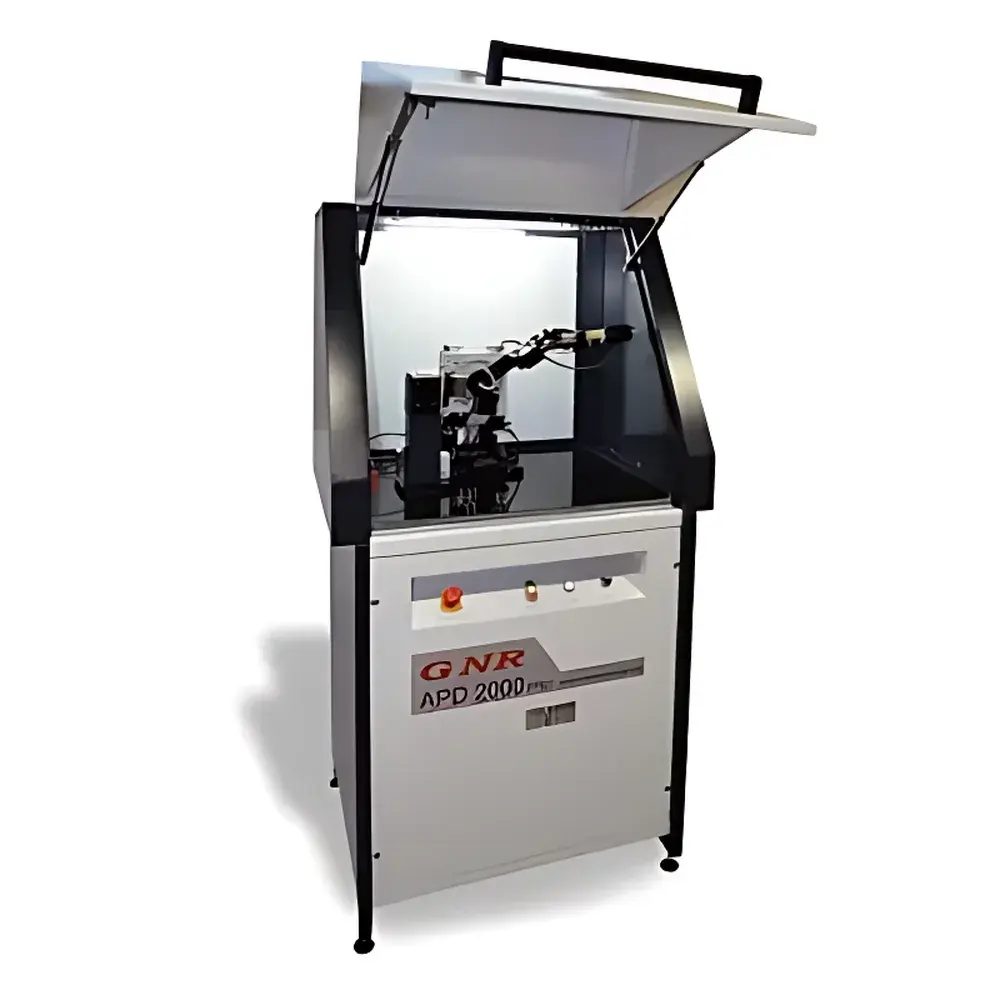
GNR APD 2000 PRO Powder X-ray Diffractometer
| Brand | GNR |
|---|---|
| Origin | Italy |
| Model | APD 2000 PRO |
| Instrument Type | Powder X-ray Diffractometer |
| X-ray Tube Power | 0.0001 kW (100 W) |
| Radiation Source | Fine-focus Ceramic X-ray Tube |
| Monochromator | Johannson-type Kα₁ monochromator |
| Detector Types | Scintillation Counter & Energy-Dispersive Detector |
| Goniometer Control | Optical Encoder |
| Sample Stage | Motorized Multi-Sample Rotating Stage with Low-Background Options |
| Safety System | Dual Redundant Interlock Circuit |
| Compliance | CE, IEC 61010-1, ISO 9001 |
Overview
The GNR APD 2000 PRO Powder X-ray Diffractometer is a high-stability, laboratory-grade XRD system engineered for rigorous qualitative and quantitative phase analysis of crystalline powder samples. It operates on Bragg’s law-based X-ray diffraction principles, utilizing monochromatic Cu Kα₁ radiation (λ = 1.54056 Å) generated by a fine-focus ceramic X-ray tube. The instrument integrates a precision optical encoder-driven goniometer, enabling accurate 2θ angular positioning with sub-arcminute reproducibility and scanning speeds up to 5°/min. Its closed-tube architecture eliminates the need for water cooling or external vacuum pumps, supporting continuous operation in standard laboratory environments. Designed for structural characterization, residual stress evaluation, crystallite size analysis (via Scherrer equation), and Rietveld refinement workflows, the APD 2000 PRO delivers consistent data integrity across extended measurement sessions—critical for method validation under GLP or ISO/IEC 17025 frameworks.
Key Features
- Stable X-ray generation via feedback-controlled high-voltage and filament current regulation, ensuring <±0.01% output stability over 8-hour acquisitions
- Automated ramp-up of tube voltage and current to minimize thermal shock and extend tube lifetime
- Johannson-type Kα₁ monochromator delivering background suppression below 0.1 cps in 2θ range 10–80°, enhancing signal-to-noise ratio for trace-phase detection
- Interchangeable monochromator options: flat graphite and doubly curved graphite (DCG) for Ag, Cr, Fe, Cu, Co, and Mo anodes—enabling flexible excitation source adaptation without hardware modification
- Switchable reflection and transmission geometries controlled via motorized beam path selector, supporting both conventional Bragg–Brentano and parallel-beam configurations
- High-resolution single-capillary collimator (FWHM < 0.1 mm at sample position) for improved angular resolution and reduced peak broadening
- Dual-detector architecture: scintillation counter for high-count-rate applications and energy-dispersive detector (EDD) for simultaneous multi-angle acquisition and rapid screening
- Motorized multi-sample rotating stage accommodating up to 12 standard 25 mm Ø sample holders; optional low-background silicon or zero-diffraction quartz sample stages available
- Dual-redundant safety interlock circuit compliant with IEC 61010-1, including door-mounted microswitches, radiation shutter feedback, and real-time tube current monitoring
Sample Compatibility & Compliance
The APD 2000 PRO accepts standard powdered specimens (particle size < 10 µm recommended), pressed pellets, thin films, and bulk polycrystalline materials. Its modular sample stage supports variable incidence angle (GIXRD), grazing-incidence geometry (for thin-film analysis), and humidity-controlled sample chambers (optional). All mechanical and electrical subsystems conform to CE marking requirements and meet essential health and safety provisions under Directive 2014/30/EU (EMC) and 2014/35/EU (LVD). The system architecture supports audit-ready operation: full electronic logbooks, user-access-level permissions, and timestamped parameter change records align with FDA 21 CFR Part 11 readiness when integrated with validated LIMS or ELN platforms.
Software & Data Management
Controlled via GNR’s proprietary APD Suite v5.x software, the system provides intuitive workflow-driven acquisition, real-time pattern visualization, and automated phase identification using ICDD PDF-4+ database integration. Data processing modules include peak deconvolution (Pseudo-Voigt fitting), amorphous halo subtraction, preferred orientation correction, and full-pattern Rietveld refinement (via embedded GSAS-II engine). Raw data are stored in industry-standard .raw and .xye formats; metadata embedding follows NeXus/HDF5 conventions for long-term archival interoperability. Software validation documentation—including IQ/OQ protocols and traceable calibration reports—is provided per ISO/IEC 17025 clause 5.5.2.
Applications
- Pharmaceutical solid-state characterization: polymorph screening, hydrate/anhydrate differentiation, and excipient compatibility studies per USP and ICH Q5A
- Cement and clinker phase quantification (e.g., alite, belite, free lime) in accordance with ASTM C1365 and EN 196-2
- Geological mineral identification and semi-quantitative abundance estimation using reference intensity ratio (RIR) methods
- Metallurgical analysis of alloy phases, precipitate identification, and texture evaluation in rolled or heat-treated metals
- Quality control of battery cathode materials (e.g., NMC, LFP) for crystallinity index, lattice parameter drift, and impurity detection
- Forensic and cultural heritage analysis of pigments, ceramics, and corrosion products under non-destructive sampling protocols
FAQ
What X-ray tube anode materials are supported?
The APD 2000 PRO is optimized for Cu Kα radiation but supports interchangeable anodes (Ag, Cr, Fe, Co, Mo) via compatible monochromator selection and high-voltage configuration.
Is the system compatible with Rietveld refinement software?
Yes—raw data export supports GSAS-II, FullProf, TOPAS, and MAUD. Built-in Rietveld module uses fundamental parameters modeling and includes constrained refinement templates for common material classes.
Can the instrument operate in high-humidity environments?
The electronics and goniometer are sealed against ingress (IP54-rated enclosure); ambient operation is certified from 10–40 °C and 20–80% RH non-condensing.
Does the system support automated calibration verification?
Yes—software-guided alignment routines use NIST-traceable Si SRM 640e and LaB₆ standards; results are logged with uncertainty budgets per ISO/IEC 17025 Annex A.3.
What safety certifications does the APD 2000 PRO hold?
CE marking, IEC 61010-1:2010 compliance, and RoHS 2011/65/EU conformity documentation are supplied with each unit; radiation leakage < 0.1 µSv/h at 5 cm distance per IEC 61223-3-2.





