
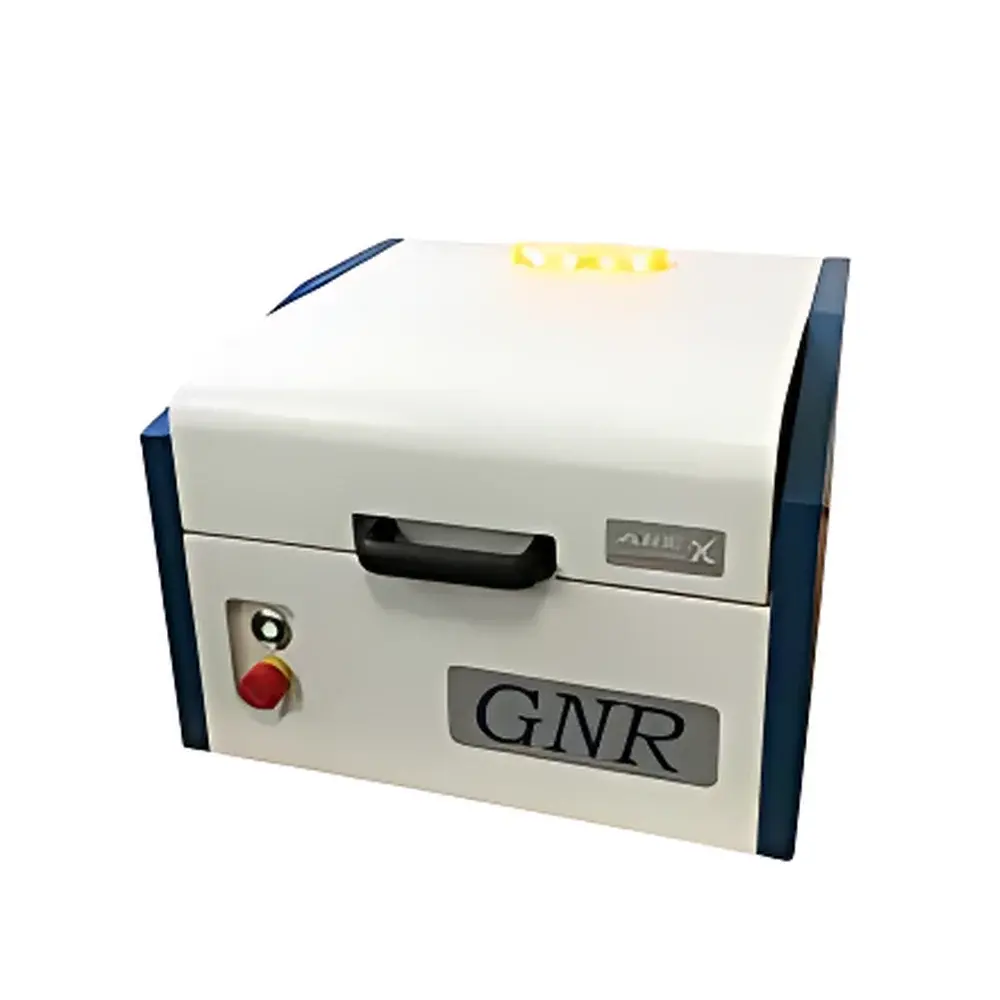
GNR AreX D Benchtop Residual Austenite Analyzer
| Brand | GNR |
|---|---|
| Origin | Italy |
| Model | AreX D |
| X-ray Source | 50 W Mo microfocus tube with Zr filter |
| Cooling | Air-cooled |
| Detection | High-resolution USB camera for precise sample positioning |
| Safety | Interlocked X-ray shielding system |
| Measurable Diffraction Peaks | Austenite (220), (311) |
| Measurement Time | < 3 minutes per sample |
| Compliance | ASTM E975-22 Standard |
| Minimum Detectable Austenite Content | 0.5 vol% |
| Sample Compatibility | Flat, polished metallic specimens (steel, stainless steel, tool steels, bearing alloys) |
| Software | Integrated Windows-based analysis suite with peak integration, phase quantification, and report generation |
Overview
The GNR AreX D Benchtop Residual Austenite Analyzer is a dedicated X-ray diffraction (XRD)-based instrument engineered for rapid, non-destructive quantification of residual austenite in ferrous alloys—primarily hardened and tempered steels, stainless steels, and bearing-grade materials. It operates on the fundamental principle of Bragg’s law, utilizing characteristic Mo-Kα radiation (λ = 0.07107 nm) to resolve and integrate intensity ratios between austenite-specific reflections (220 and 311 planes) and ferrite/martensite reflections (200 and 211 planes). Unlike metallographic etching or electron backscatter diffraction (EBSD), which suffer from operator dependence, surface preparation artifacts, and limited statistical sampling, XRD provides volumetric, bulk-phase quantification with high reproducibility across laboratory and production QC environments. The AreX D is explicitly designed and validated to conform to ASTM E975-22, “Standard Test Method for Determining Residual Austenite in Steel Utilizing X-Ray Diffraction,” ensuring traceability and regulatory acceptability in industries subject to ISO/IEC 17025, AS9100, or automotive OEM process validation requirements.
Key Features
- Compact benchtop architecture optimized for space-constrained QA/QC labs—no external chiller, water supply, or vibration isolation required.
- Stable 50 W microfocus molybdenum X-ray tube with zirconium foil filtration ensures consistent spectral purity and minimizes background noise during low-intensity peak detection.
- Integrated high-resolution USB camera enables real-time visual alignment of polished sample surfaces with sub-100 µm positional accuracy—critical for repeatable irradiation of representative microstructural zones.
- Hardware-enforced safety interlocks comply with IEC 61010-1 and local radiation safety regulations; beam shutter automatically deactivates upon door opening or emergency stop activation.
- Multi-peak quantification algorithm simultaneously processes (220) and (311) austenite peaks alongside (200) and (211) ferritic/martensitic peaks, mitigating systematic error from preferred orientation effects common in rolled or ground specimens.
- Measurement cycle—including auto-alignment, exposure, peak integration, and phase fraction calculation—is completed in under 180 seconds, supporting throughput of >20 samples per shift without compromising precision.
Sample Compatibility & Compliance
The AreX D accepts flat, mirror-polished metallic specimens up to 100 mm × 100 mm × 25 mm (L×W×H), with minimum surface roughness Ra ≤ 0.05 µm. It is routinely deployed for quality control of case-hardened gears, bearing rings, turbine blades, and cold-worked tool steels where residual austenite content directly influences dimensional stability, fatigue life, and wear resistance. All measurement protocols adhere strictly to ASTM E975-22, including mandatory calibration verification using NIST-traceable austenite–ferrite reference standards. Instrument performance is documented per ISO/IEC 17025 clause 7.7 (uncertainty of measurement) and supports GLP/GMP audit trails when operated with optional electronic signature and 21 CFR Part 11-compliant software modules.
Software & Data Management
The proprietary AreX Control & Analysis Suite runs natively on Windows 10/11 and provides full workflow automation: sample registration, exposure parameter selection (kV/mA/timing), live diffraction image preview, automated peak search and fitting (using pseudo-Voigt profiles), Rietveld-free quantitative phase analysis, and customizable PDF report export (including raw data, integrated intensities, phase fractions, and measurement metadata). Audit logs record user ID, timestamp, instrument configuration, and raw scan files—retained for ≥36 months as required by internal QA policies. Raw .raw and .csv outputs are compatible with third-party crystallographic tools (e.g., Jade, HighScore Plus) for advanced validation or cross-platform correlation studies.
Applications
- Verification of austenite stabilization post-cryogenic treatment in high-carbon steels.
- In-process monitoring of tempering cycles to prevent over-tempering-induced austenite reversion.
- Root-cause analysis of premature cracking in induction-hardened components.
- Supplier qualification testing per SAE AMS 2750 (Pyrometry) and GM GMW14872 (Material Specifications).
- Research into TRIP (Transformation-Induced Plasticity) and Q&P (Quenching and Partitioning) steel development.
FAQ
What is the minimum detectable residual austenite content using the AreX D?
The instrument achieves a lower limit of quantification (LLOQ) of 0.5 vol% under standard measurement conditions (polished surface, optimal texture, ≥10 s exposure per peak).
Does the AreX D require liquid nitrogen cooling or external water circulation?
No—its air-cooled microfocus X-ray tube eliminates dependency on cryogenic or hydraulic infrastructure.
Can the AreX D quantify retained austenite in coated or surface-treated parts?
Yes, provided the coating thickness is ≤5 µm and non-diffracting (e.g., TiN, CrN); thicker or crystalline coatings require mechanical removal of the top layer prior to analysis.
Is ASTM E975 compliance verified at installation?
Yes—GNR-certified field engineers perform on-site validation using certified reference materials and issue a Certificate of Conformance compliant with ISO/IEC 17025 Annex A.2.
How is data integrity ensured during long-term deployment?
All measurements are timestamped, digitally signed, and stored in an encrypted local database with automatic daily backup to network-attached storage—fully auditable for FDA, ISO, or customer-facing quality audits.





