
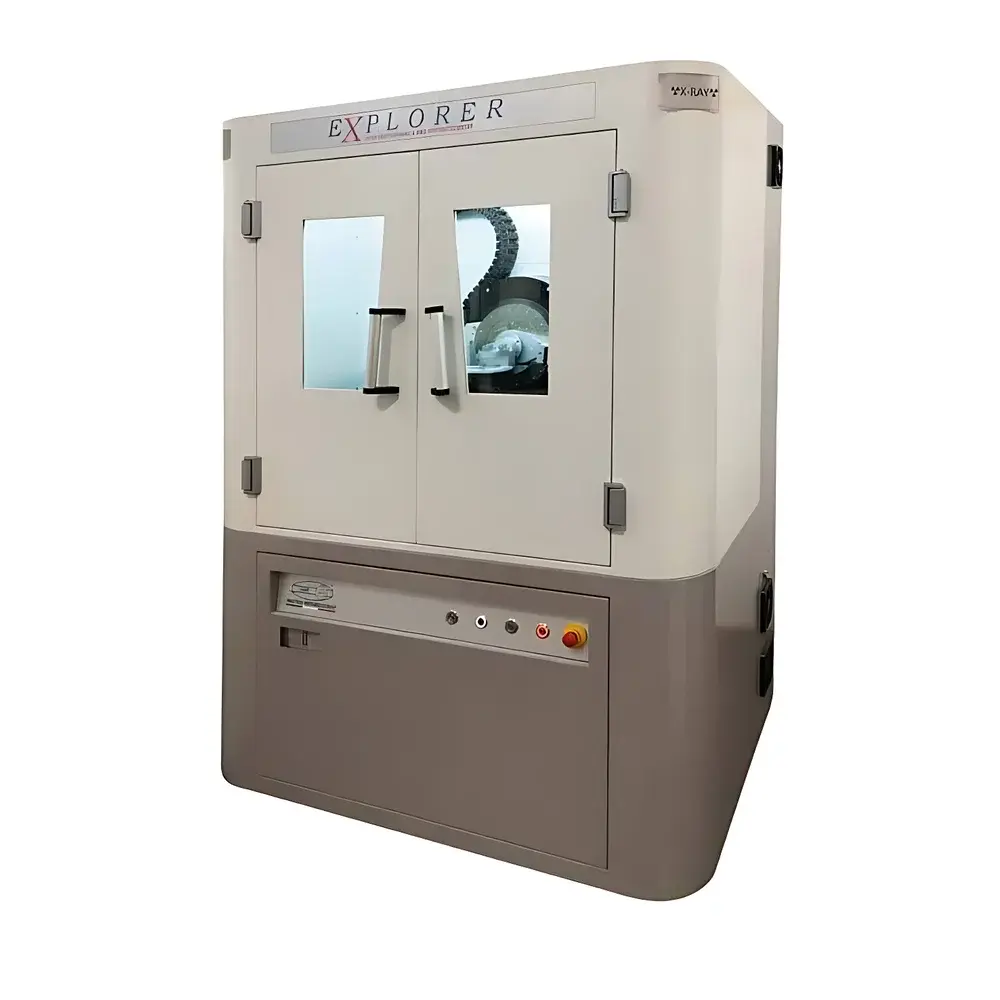
GNR EXPLORER Modular Powder X-ray Diffractometer
| Brand | GNR |
|---|---|
| Origin | Italy |
| Model | EXPLORER |
| Instrument Type | Powder X-ray Diffractometer |
| Power Rating | 0.0001 kW |
| Optical Configuration | Switchable Bragg-Brentano focusing / Johansson monochromator / Parabolic mirror monochromator |
| Beam Geometry | Parallel-beam optics with low-angle reflection capability |
| Thin-film Thickness Detection Range | 1–500 nm |
| Degrees of Freedom for Sample Manipulation | 5 |
| Modular Units | 7 |
| Primary Applications | Phase identification & quantification, crystallite size and microstrain analysis, residual stress measurement, texture analysis, thin-film characterization, depth profiling, nanocrystalline material assessment |
Overview
The GNR EXPLORER Modular Powder X-ray Diffractometer is a high-precision, research-grade X-ray diffraction system engineered for comprehensive structural characterization of crystalline and semi-crystalline materials. Based on Bragg’s law and optimized for both conventional θ–2θ scanning and advanced parallel-beam geometries, the EXPLORER delivers high angular resolution and exceptional signal-to-noise performance across diverse sample forms—including powders, polycrystalline bulk specimens, epitaxial and polycrystalline thin films, and multilayer stacks. Its modular architecture enables seamless adaptation to evolving analytical requirements, supporting configurations ranging from routine phase identification to in-depth residual stress mapping, crystallographic texture analysis, and nanoscale structural refinement.
Key Features
- Direct-drive high-torque motor coupled with high-resolution optical encoders ensures sub-arcsecond angular positioning accuracy and stable rotational velocity control—critical for reproducible line-profile analysis and Rietveld refinement.
- Seven fully decoupled mechanical modules facilitate rapid reconfiguration and field-serviceability; all core components—including goniometer, detector arm, sample stage, and optical path elements—are independently accessible and replaceable.
- Five-axis sample manipulation (X, Y, Z, χ, φ) supports precise alignment of anisotropic samples, enabling quantitative texture analysis and orientation-dependent diffraction measurements compliant with ASTM E1188 and ISO 14379 standards.
- Dual optical pathways: switchable between Bragg-Brentano parafocusing geometry for standard powder analysis and parallel-beam optics with Johansson or parabolic mirror monochromators for high-resolution thin-film and grazing-incidence applications.
- Integrated parabolic mirror monochromator mounted in the incident beam path delivers intense, low-divergence Cu Kα₁ monochromatic radiation—optimized for high-resolution lattice parameter determination and strain analysis per ASTM E915 and ISO 21946.
- Low-angle reflection mode (0.1°–5° 2θ) combined with dedicated thin-film attachments enables non-destructive thickness and density profiling of single- and multi-layer coatings in the 1–500 nm range.
Sample Compatibility & Compliance
The EXPLORER accommodates a broad spectrum of physical sample formats without requiring specialized mounting fixtures: free-flowing powders (≥10 mg), pressed pellets, solid metal or ceramic blocks, sputtered or evaporated thin films on Si/SiO₂ substrates, and flexible polymer-supported layers. All operational modes adhere to IEC 61000-6-3 (EMC) and IEC 61000-6-4 emission standards. Software workflows support audit-trail generation, electronic signatures, and user-access controls aligned with FDA 21 CFR Part 11 and EU Annex 11 requirements for regulated environments. Routine calibration verification follows NIST-traceable reference standards (e.g., SRM 660c LaB₆, SRM 640e Si).
Software & Data Management
The proprietary EXPLORER Control & Analysis Suite provides integrated instrument control, real-time data acquisition, and advanced post-processing in a single unified interface. Core capabilities include automatic phase identification via ICDD PDF-4+ database search, full-pattern Rietveld refinement (using GSAS-II and TOPAS-compatible output), crystallite size/strain deconvolution (Williamson-Hall and Warren-Averbach methods), and residual stress calculation using sin²ψ and multiple-peak fitting algorithms. Raw and processed datasets are stored in vendor-neutral HDF5 format with embedded metadata (sample ID, operator, date/time, instrument parameters, calibration history). Export options include CIF, XYE, CSV, and XML—ensuring compatibility with third-party crystallographic and statistical platforms.
Applications
- Quantitative phase analysis (QPA) of multiphase ceramics, pharmaceuticals, catalysts, and geological samples per ASTM D7789 and ISO 21376.
- Residual austenite quantification in heat-treated steels using the direct comparison method (ASTM E975).
- Grazing-incidence XRD (GIXRD) for depth-resolved crystallinity assessment in battery electrode coatings and perovskite solar cell layers.
- Crystallographic texture evaluation in rolled metals and additive-manufactured alloys via pole figure and ODF reconstruction.
- Nanoparticle size distribution modeling from peak broadening analysis, validated against TEM correlation studies.
- In-situ thermal and mechanical stress experiments using optional environmental stages (not included).
FAQ
What X-ray source options are available for the EXPLORER?
The standard configuration uses a sealed-tube Cu anode source (40 kV / 40 mA); optional upgrades include Co, Mo, and Cr anodes for element-specific excitation and reduced fluorescence interference.
Is the system compatible with automated sample changers?
Yes—GNR offers a 16-position robotic sample changer with programmable XYZ alignment and barcode recognition, fully integrated into the control software.
Can the EXPLORER perform reciprocal space mapping (RSM)?
Yes—when equipped with high-precision ω and 2θ encoders and optional six-circle diffractometer add-on, it supports full RSM acquisition for epitaxial thin-film strain analysis.
Does the software support GLP-compliant reporting?
Yes—report templates include instrument qualification records, daily intensity checks, and raw-data integrity logs, all exportable as PDF/A-2b with digital signature support.
What maintenance intervals are recommended?
Vacuum pump oil change every 6 months; X-ray tube replacement at ~2,000 h nominal operation; annual optical alignment verification and encoder calibration by certified service engineers.





