
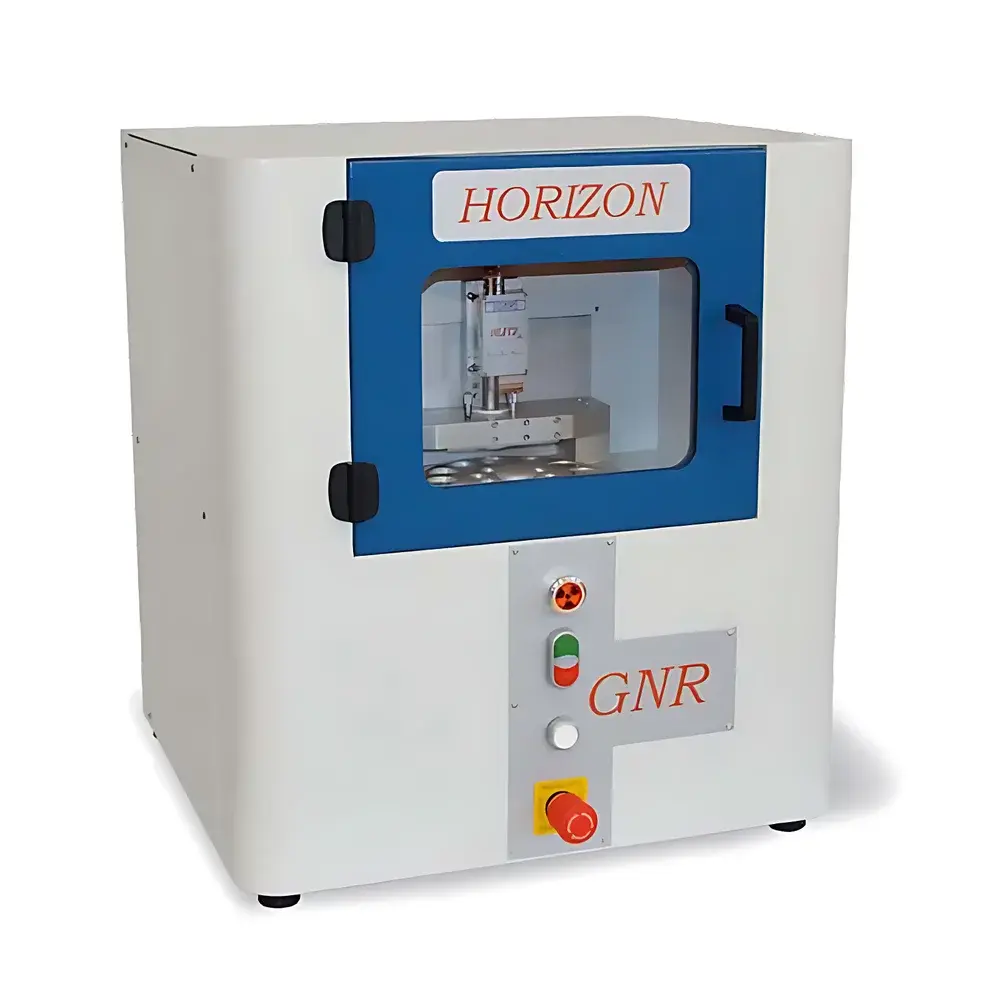
GNR HORIZON Total Reflection X-Ray Fluorescence Spectrometer
| Brand | GNR |
|---|---|
| Origin | Italy |
| Model | HORIZON |
| Configuration | Benchtop/Floor-standing |
| Application Type | General-purpose |
| Elemental Range | Na (11) to Pu (94) |
| Quantification Range | 10 pg – 100% |
| Energy Resolution | 124 eV (at Mn Kα) |
| Repeatability | ≤ 0.1% RSD |
Overview
The GNR HORIZON Total Reflection X-Ray Fluorescence (TXRF) Spectrometer is an advanced benchtop or floor-standing elemental analysis system engineered for ultra-trace to major-element quantification in minimal sample volumes. Unlike conventional Energy Dispersive X-Ray Fluorescence (ED-XRF), TXRF operates on the physical principle of total external reflection: the primary X-ray beam strikes the sample-carrying quartz carrier at a grazing incidence angle below the critical angle (typically < 0.1°), resulting in near-total reflection of the incident beam. This geometry suppresses substrate absorption and scattering, drastically reducing background noise and matrix-related spectral interferences. The resultant high signal-to-background ratio enables detection limits in the low-picogram range—orders of magnitude lower than standard ED-XRF—while preserving non-destructive, solid- or liquid-phase analysis without chemical digestion or dilution.
Key Features
- High-performance Peltier-cooled Silicon Drift Detector (SDD) with 124 eV energy resolution at Mn Kα, optimized for low-noise, high-count-rate spectral acquisition
- Automated 12-position sample stage with optical encoder-controlled stepper motors, ensuring sub-milliradian angular reproducibility for precise critical-angle alignment
- Single internal standard calibration protocol—eliminates matrix effects and simplifies quantitative workflows across heterogeneous sample types
- Simultaneous multi-element analysis (Na–Pu) with dynamic linear range exceeding 10⁶, supporting both trace (pg-level) and bulk (wt%) quantification in one measurement
- No sample preparation required: direct analysis of liquids (e.g., acids, solvents, biological fluids), dried residues, thin films, or polished solids—zero memory effect and no consumable reagents
- Robust mechanical architecture compliant with ISO 8549 (TXRF terminology and definitions) and aligned with ASTM E3067–17 guidelines for trace metal analysis by TXRF
Sample Compatibility & Compliance
The HORIZON accommodates a broad spectrum of sample forms—including aqueous standards, digested environmental extracts, pharmaceutical excipients, semiconductor wafer rinsates, nuclear fuel solutions, and forensic trace evidence—without modification to hardware or software. All measurements adhere to GLP/GMP-relevant data integrity requirements: full audit trail logging, user-access controls, electronic signatures, and compliance-ready reporting structures compatible with FDA 21 CFR Part 11 validation frameworks. Instrument performance verification follows ISO/IEC 17025–2017 metrological principles, with routine checks traceable to NIST SRM 2782 (Trace Elements in Water) and BAM CRM 110 (Silicon Wafer Surface Contamination).
Software & Data Management
Controlled via GNR’s proprietary TXRF Suite v4.x, the system delivers intuitive method setup, real-time spectral visualization, automated peak deconvolution using fundamental parameter (FP) algorithms, and customizable calibration models (single-standard, multi-standard, or empirical). Raw spectra and processed results are stored in vendor-neutral .csv and .rdb formats; metadata—including instrument parameters, environmental conditions, and operator ID—is embedded per ICH M7-compliant archiving protocols. Export modules support LIMS integration (via ASTM E1482-compliant XML schema) and automated report generation conforming to ISO 17025 clause 7.8.2.
Applications
The HORIZON serves as a reference-grade platform in regulated and research-intensive environments: monitoring trace metallic impurities in ultrapure water for semiconductor fab process control (per SEMI F57); quantifying catalyst poisons (e.g., As, Pb, V) in refinery feedstocks; validating elemental purity of active pharmaceutical ingredients (APIs) per ICH Q3D; characterizing surface contamination on photomasks and EUV optics; and supporting nuclear safeguards through isotopic ratio screening of U/Pu in swipe samples. Its sensitivity and flexibility also make it suitable for academic studies in geochemistry, nanomaterial toxicity, and microplastic additive profiling.
FAQ
What is the minimum detectable mass for sodium (Na) under typical operating conditions?
Detection limits vary with acquisition time and sample matrix but typically reach 1–5 pg for Na on quartz carriers with 300 s counting time.
Can the HORIZON analyze viscous or particulate-laden liquids directly?
Yes—samples are deposited as microliter droplets and dried in situ; suspended particles remain analyzable if homogeneously distributed in the dried residue.
Is certification available for ISO/IEC 17025 accreditation?
GNR provides factory-verified performance reports, uncertainty budgets, and method validation templates aligned with ILAC-G8:2022 for laboratory accreditation.
Does the system support isotopic analysis?
No—it performs elemental quantification only; isotopic resolution requires high-resolution mass spectrometry (e.g., ICP-MS or TIMS).
What maintenance intervals are recommended for long-term stability?
Annual vacuum pump oil replacement and biannual SDD energy calibration using certified Mn and Co sources ensure continued compliance with stated resolution and repeatability specifications.






