
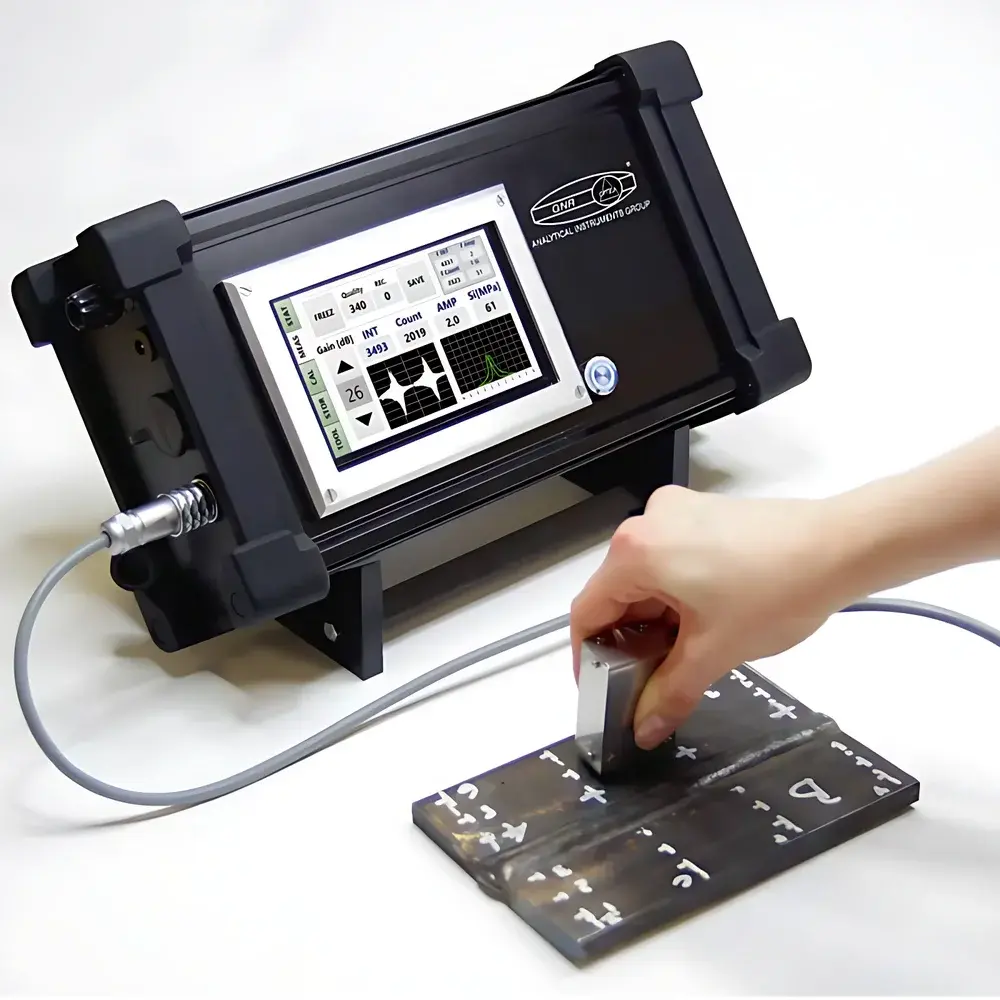
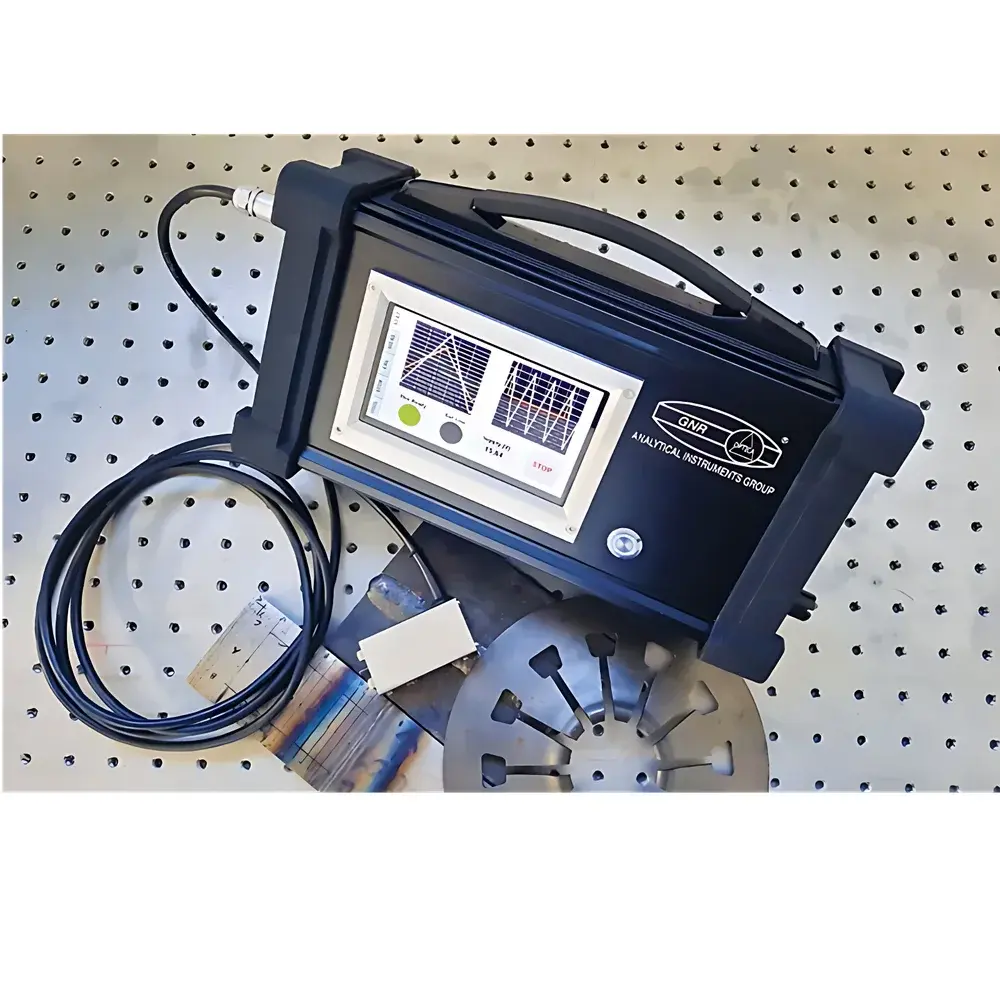
GNR MagStress5c Barkhausen Noise Residual Stress Analyzer
| Brand | GNR |
|---|---|
| Origin | Italy |
| Model | MagStress5c |
| Measurement Principle | Magnetic Barkhausen Noise (MBN) |
| Sample Type | Ferromagnetic Metals (e.g., carbon steel, alloy steel, cast iron) |
| Portability | Integrated battery-powered handheld system with touch-screen interface and USB connectivity |
| Output | Quantitative residual stress in MPa, graphical trend visualization, calibration curve support |
| Compliance Context | Designed for field-deployable non-destructive evaluation (NDE) in accordance with ASTM E1447, ISO 20956, and EN 10328 guidelines for magnetic methods of stress assessment |
Overview
The GNR MagStress5c Barkhausen Noise Residual Stress Analyzer is an engineered field-portable instrument designed for rapid, non-destructive evaluation of near-surface and subsurface residual stress states in ferromagnetic metallic components. Unlike X-ray diffraction (XRD)—which measures lattice strain at shallow depths (typically < 20 µm) and requires precise sample alignment and radiation shielding—the MagStress5c leverages the physical phenomenon of Magnetic Barkhausen Noise (MBN), a stochastic emission of voltage pulses generated during irreversible domain wall motion under controlled magnetization. This principle enables depth-sensitive stress assessment up to approximately 0.5–1.2 mm beneath the surface, depending on material permeability and microstructure. The system operates by applying a low-frequency alternating magnetic field via a probe coil while simultaneously sensing induced MBN signals through a pickup coil. Signal amplitude, root-mean-square (RMS) intensity, and spectral centroid shift correlate quantitatively with residual stress magnitude and directionality in polycrystalline steels and other ferromagnetic alloys. As such, the MagStress5c serves not as a replacement but as a complementary tool to XRD-based stress analyzers—particularly where accessibility, throughput, or subsurface relevance is critical.
Key Features
- Compact, self-contained design housed in a ruggedized transport case compliant with IATA carry-on dimensions; includes integrated rechargeable Li-ion battery supporting ≥6 hours of continuous operation.
- Capacitive touch-screen interface (7-inch, 1024×600 resolution) with intuitive navigation, real-time waveform display, and on-device data annotation.
- Modular probe architecture: interchangeable sensor heads optimized for flat, curved, or contoured surfaces (radius down to 15 mm); all probes feature spring-loaded contact force control (0.8–1.2 N) ensuring consistent magnetic coupling.
- Built-in calibration library covering common structural steels (e.g., S235JR, S355J2, AISI 1045, 4140) with traceable reference data from certified tensile/compression test specimens per ISO 6892-1.
- User-definable calibration curve generation via guided procedure using reference samples with known stress states (e.g., mechanically bent beams or shot-peened coupons).
- Real-time digital signal processing (DSP) engine performing FFT-based spectral analysis, noise floor suppression, and peak amplitude normalization to mitigate lift-off and surface roughness effects.
Sample Compatibility & Compliance
The MagStress5c is validated for use on carbon steels, low-alloy steels, ferritic stainless steels, and cast irons exhibiting coercivity < 1.2 kA/m and relative permeability > 100. It is unsuitable for austenitic stainless steels, aluminum, titanium, or non-magnetic coatings. Surface preparation requirements are minimal: removal of thick oxide layers or conductive paints is recommended, though mill scale or light rust does not preclude measurement. The analyzer conforms to electromagnetic compatibility (EMC) standards IEC 61326-1 and safety standard IEC 61010-1. While not a radiological device, its application aligns with industrial NDE quality assurance frameworks—including ASNT SNT-TC-1A personnel qualification requirements—and supports documentation workflows compliant with ISO 9001, ISO/IEC 17025, and customer-specific PPAP Level 3 submission protocols.
Software & Data Management
Data acquisition, visualization, and reporting are managed through MagStress Studio v3.2 software (Windows 10/11 compatible). The software enables synchronized multi-point mapping, statistical process control (SPC) charting, and export of ASCII CSV, PDF reports, and XML datasets compliant with ASTM E2782 metadata schema. Audit trails record operator ID, timestamp, probe serial number, calibration status, and environmental temperature—supporting GLP/GMP traceability. Raw time-domain waveforms and power spectral density (PSD) plots are preserved for post-acquisition reprocessing. USB 2.0 interface allows direct transfer without proprietary drivers; no cloud dependency or subscription licensing is required.
Applications
- Verification of stress relief effectiveness after welding, heat treatment, or machining operations in pressure vessels, pipelines, and rail components.
- In-process monitoring of shot peening intensity and coverage uniformity across aerospace turbine blades and landing gear parts.
- Field assessment of residual stress gradients in bridge girders, wind turbine towers, and offshore platform joints prior to fatigue life modeling.
- Quality gate screening for forged crankshafts, gear blanks, and bearing races where XRD access is geometrically constrained.
- Correlative studies with neutron diffraction or synchrotron XRD to validate subsurface stress profiles in R&D environments.
FAQ
Does the MagStress5c require radiation safety certification or licensing?
No. It is a purely electromagnetic device emitting no ionizing radiation and poses no regulatory barrier for use in public or confined worksites.
Can it measure absolute stress values, or only relative changes?
When calibrated against traceable reference samples, it delivers quantitative residual stress values in MPa with typical repeatability ±15 MPa (k = 2) under controlled lab conditions and ±25 MPa in field environments.
How does surface roughness affect measurement accuracy?
Surface roughness (Ra > 6.3 µm) may introduce minor amplitude attenuation; however, the DSP algorithm compensates for lift-off variations up to 0.3 mm, and empirical correction factors are available in MagStress Studio.
Is third-party calibration service available?
Yes—GNR-certified calibration is offered annually, including verification against NIST-traceable stress reference blocks and full uncertainty budget documentation per ISO/IEC 17025.
What maintenance is required?
Annual verification of probe coil impedance and touchscreen responsiveness; no consumables or optical alignment procedures are needed.






