
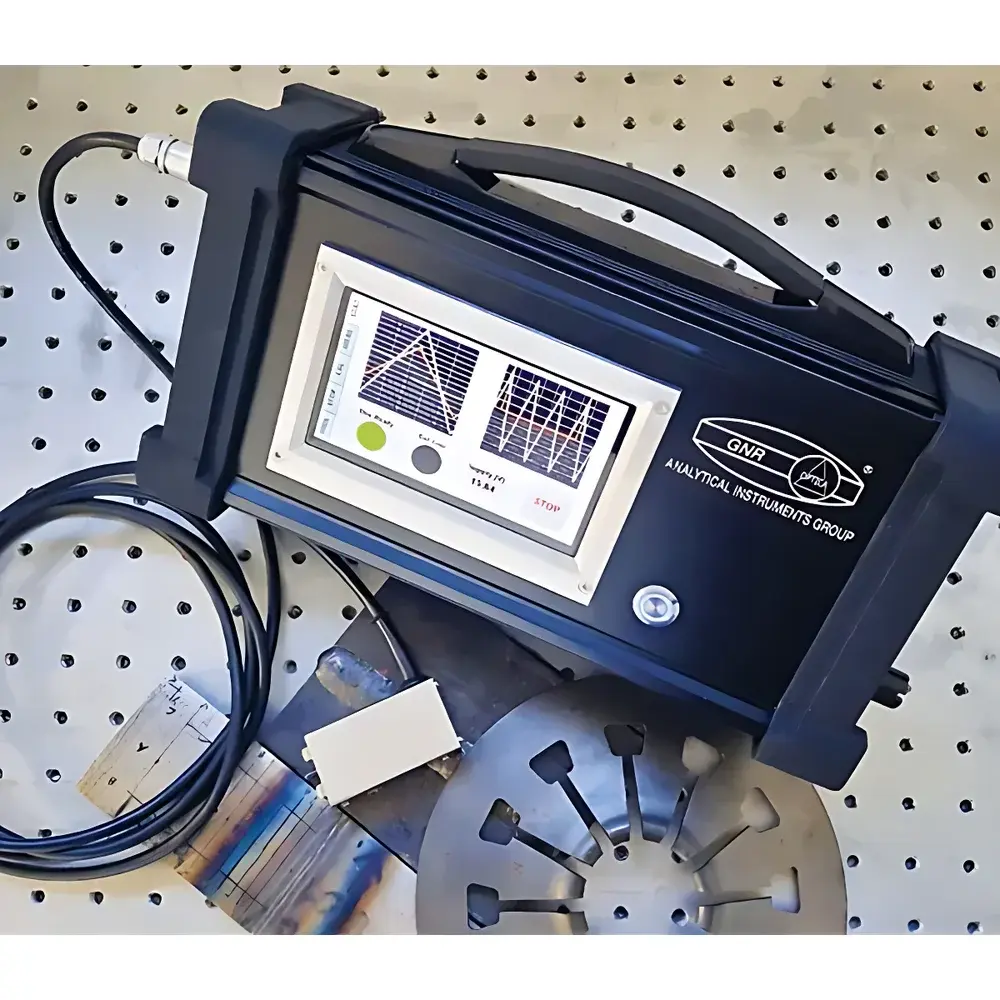
GNR MagStress5c Portable Magnetic Barkhausen Noise (MBN) Grinding Burn Detector
| Brand | GNR |
|---|---|
| Origin | Italy |
| Model | MagStress5c |
| Measurement Principle | Magnetic Barkhausen Noise (MBN) Analysis |
| Portability | Integrated battery-powered handheld unit with touch display and USB interface |
| Compliance | Designed for field-deployable NDT per ISO 10893-13 and ASTM E3027 guidelines |
| Sample Type | Ferromagnetic metallic components (e.g., bearing races, gear teeth, camshafts, turbine blades) |
| Output | Real-time MBN amplitude & frequency spectrum, quantitative burn index, pass/fail classification |
Overview
The GNR MagStress5c is a portable, battery-operated Magnetic Barkhausen Noise (MBN) testing instrument engineered for rapid, non-destructive assessment of grinding-induced thermal damage in ferromagnetic steel components. Unlike conventional metallographic or hardness-based verification methods—which require destructive sampling, surface preparation, and laboratory turnaround—the MagStress5c delivers immediate, in-situ evaluation by detecting microstructural changes associated with overheating during grinding operations. The instrument operates on the physical principle that localized martensitic phase transformations, residual stress gradients, and dislocation density variations—hallmarks of grinding burn—alter the magnetic domain wall mobility in hardened steels. These alterations manifest as measurable shifts in MBN signal amplitude, root-mean-square (RMS) voltage, and spectral centroid frequency. As such, the MagStress5c serves as a field-deployable compliance tool for quality assurance in high-precision manufacturing environments where thermal damage compromises fatigue life, dimensional stability, and service reliability.
Key Features
- Compact, integrated design housed in a ruggedized transport case compliant with IATA carry-on dimensions—enabling seamless deployment to production floors, maintenance hangars, or remote field sites.
- Self-contained operation: rechargeable Li-ion battery supports ≥6 hours of continuous measurement; no external power supply or laptop required.
- Capacitive touchscreen interface with intuitive icon-driven navigation—optimized for gloved operation and low-light industrial settings.
- Dual-mode output: real-time waveform visualization (time-domain MBN burst envelope) alongside quantitative metrics including normalized MBN amplitude ratio, spectral bandwidth (kHz), and a proprietary Burn Severity Index (BSI) scaled 0–100.
- Modular probe architecture: interchangeable MBN sensors (standard 1.5 mm and optional 0.8 mm active diameter) accommodate curved surfaces, narrow grooves, and complex geometries without coupling media or surface finishing.
- USB-C port enables direct data export to secure network drives or offline analysis workstations; firmware updates delivered via signed binary packages.
Sample Compatibility & Compliance
The MagStress5c is validated for use on hardened and tempered carbon and alloy steels (e.g., AISI 52100, 4340, 100Cr6, 18CrNiMo7-6) with hardness ranges from 55 to 67 HRC. It detects both white-layer (untempered martensite) and overtempered zones resulting from inadequate coolant flow, excessive feed rates, or wheel dressing errors. The system adheres to the technical scope of ISO 10893-13 (Non-destructive testing of steel tubes — Part 13: Magnetic Barkhausen noise analysis for detection of grinding burns) and aligns with ASTM E3027-16 (Standard Practice for Magnetic Barkhausen Noise Testing of Ferromagnetic Steel Components). While not a standalone certification device, its output supports GLP-compliant documentation workflows and integrates into enterprise quality management systems (QMS) requiring traceable, auditable NDT records per ISO 9001:2015 Clause 8.5.2.
Software & Data Management
Data acquisition and preliminary interpretation are performed onboard using embedded ARM Cortex-A53 processor running a real-time Linux kernel. Raw MBN waveforms (sampled at 20 MHz) and derived parameters are stored in encrypted .mbn binary format with embedded metadata: timestamp, GPS coordinates (optional external module), operator ID, probe calibration ID, and ambient temperature. Exported files comply with ASTM E2772-21 metadata standards for NDT data interchange. Optional PC-based MagStress Studio software provides advanced post-processing—including comparative spectral overlay, statistical process control (SPC) charting, and automated report generation compliant with AIAG CQI-9 Heat Treat System Assessment requirements. Audit trails record all user actions, parameter modifications, and calibration events in accordance with FDA 21 CFR Part 11 principles.
Applications
- Aerospace: In-service inspection of landing gear axles, turbine disk rims, and actuator shafts prior to rework or overhaul.
- Automotive: Final QA screening of transmission synchronizer rings, CV joint housings, and brake caliper pistons after cylindrical grinding.
- Railway: Field verification of wheelset journals and axle fillets following reprofiling operations.
- Energy: Condition monitoring of generator rotor dovetails and steam turbine blade roots during scheduled maintenance outages.
- Medical device manufacturing: Verification of surface integrity on orthopedic implant stems and dental abutments processed via precision grinding.
FAQ
Does the MagStress5c require surface preparation before measurement?
No—measurements are performed directly on as-ground surfaces; neither polishing nor etching is necessary. Surface roughness up to Ra 3.2 µm does not impair signal fidelity.
Can it distinguish between different burn types (e.g., tensile vs. compressive residual stress-induced burn)?
The instrument identifies burn severity and location but does not independently resolve stress sign. Correlation with XRD or hole-drilling residual stress mapping is recommended for full stress-state characterization.
Is probe calibration traceable to national metrology institutes?
Yes—each probe ships with a certificate of calibration traceable to INRIM (Italy) and includes reference measurements on certified burn standards per ISO/IEC 17025-accredited procedures.
What is the minimum detectable burn depth?
Detection threshold corresponds to subsurface damage layers ≥20 µm thick in through-hardened steels under optimal probe contact conditions.
How frequently must the system be recalibrated?
Annual recalibration is recommended; however, daily verification using the included reference sample (certified burn-free and burn-positive specimens) satisfies ISO 9001 internal verification requirements.



