
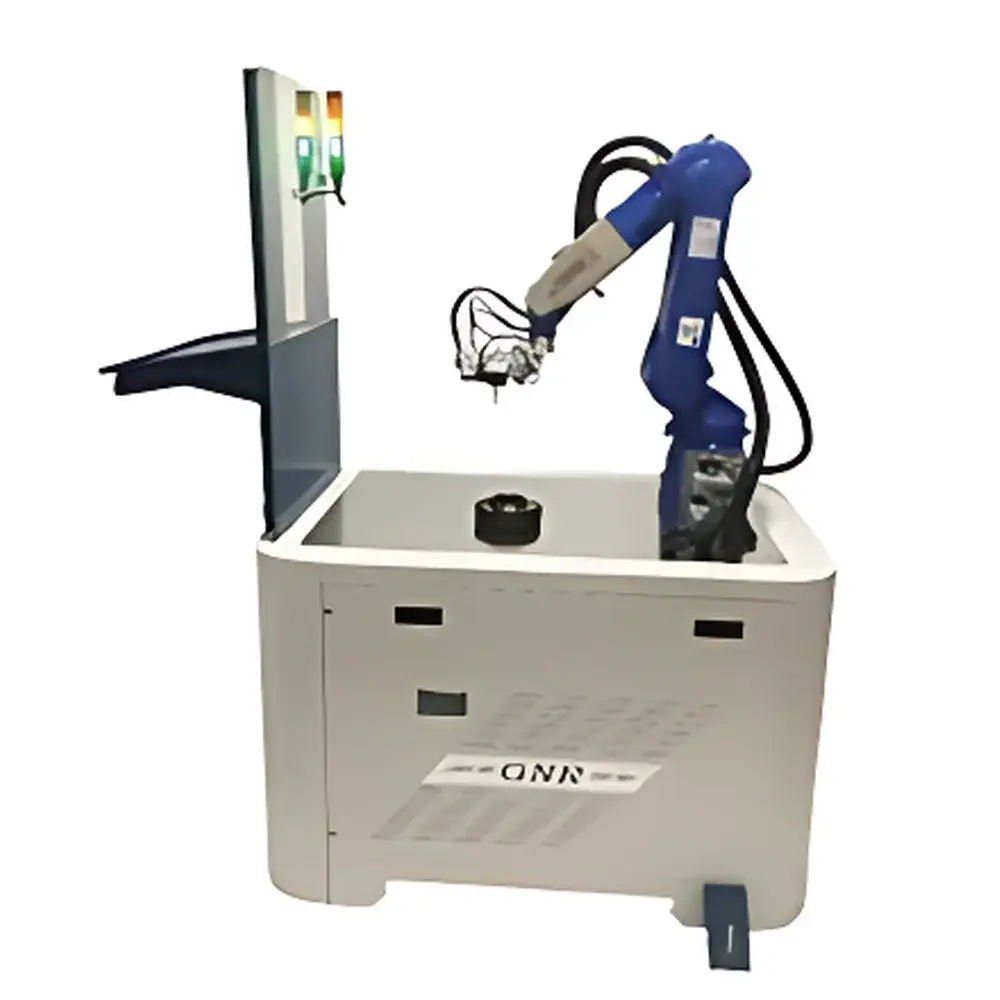
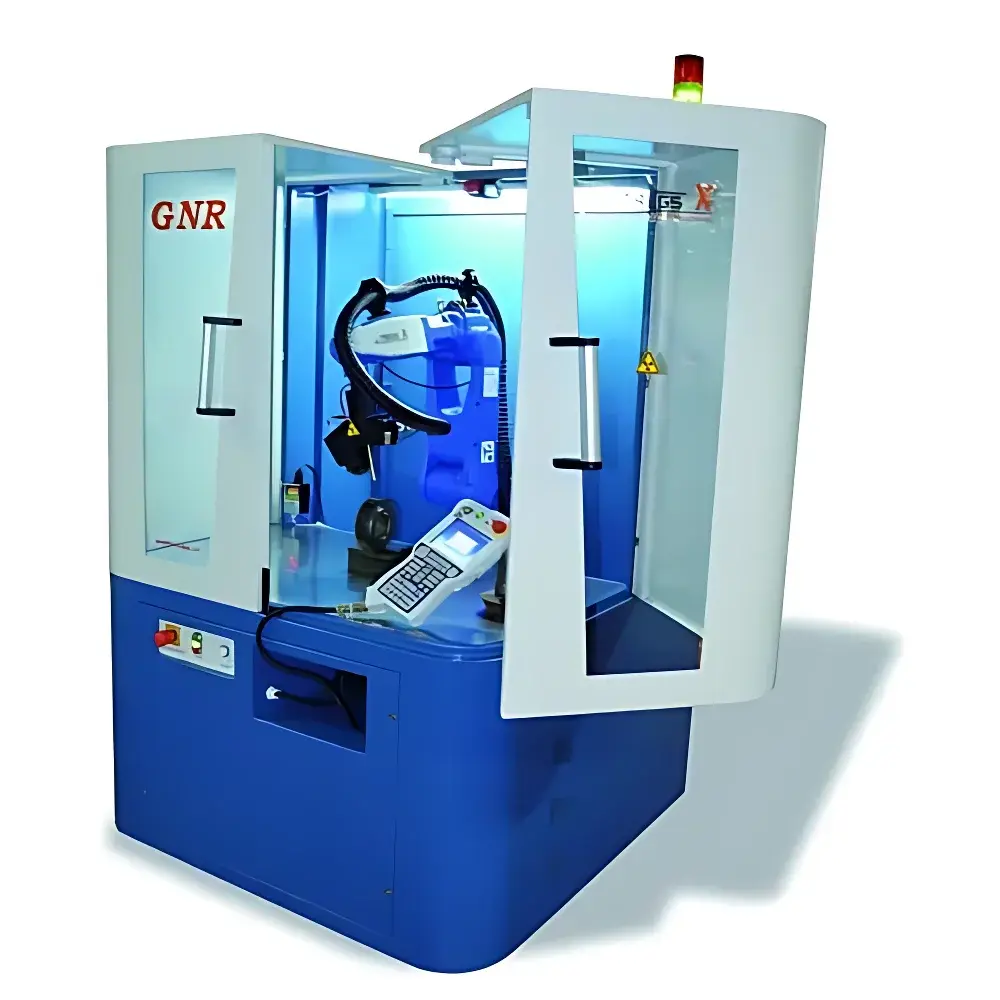
GNR STRESS-X X-Ray Residual Stress Analyzer
| Brand | GNR |
|---|---|
| Origin | Italy |
| Model | STRESS-X |
| Compliance | ASTM E915, EN 15305 |
| Motion System | 6-axis robotic arm |
| Deployment Options | Benchtop shielded enclosure or mobile four-wheel alloy cart |
| Measurement Principle | Sin²ψ X-ray diffraction (XRD) |
| Application Scope | Non-destructive residual stress mapping on metallic components |
Overview
The GNR STRESS-X X-Ray Residual Stress Analyzer is a high-precision, non-destructive measurement system engineered for quantitative determination of near-surface residual stress states in polycrystalline metallic materials. It operates on the fundamental principle of sin²ψ X-ray diffraction, where lattice strain—induced by residual stress—is derived from angular shifts (Δ2θ) in Bragg diffraction peaks measured at multiple sample tilt angles (ψ). By applying Hooke’s law and known elastic constants, the instrument calculates principal stress components (σ₁, σ₂, σ₃) in the measurement plane with traceable uncertainty. Designed for both laboratory and field environments, the STRESS-X integrates a fully motorized 6-degree-of-freedom robotic arm that positions the X-ray optics with sub-arcminute repeatability, enabling automated stress profiling across complex geometries—including curved surfaces, gear teeth, weld beads, and asymmetric castings—without requiring sample re-fixturing.
Key Features
- Modular deployment architecture: Configurable as a Class I radiation-shielded benchtop system (EN 61000-6-3 compliant) or as a mobile unit mounted on a rigid four-wheel aluminum cart with integrated battery backup and shock-dampened optical baseplate.
- Robotic precision motion: 6-axis articulated arm with ±0.01° angular resolution and <5 µm positional repeatability, supporting automated multi-point stress mapping and contouring on parts up to 1.2 m in diameter.
- Dual-source X-ray optics: Optional Cr-Kα (2.29 Å) or Co-Kα (1.79 Å) microfocus tube with programmable voltage (20–50 kV) and current (0.1–2.0 mA), optimized for Fe-, Al-, Ti-, and Ni-based alloys.
- Real-time detector synchronization: High-speed silicon strip detector (SSD) with 256-channel energy discrimination and dead-time correction, enabling dynamic background subtraction during continuous ψ-scanning.
- Radiation safety integration: Interlocked lead-acrylic viewing window, automatic beam shutter, and real-time dose monitoring compliant with IEC 61000-6-4 and national regulatory requirements for industrial X-ray equipment.
Sample Compatibility & Compliance
The STRESS-X accommodates ferrous and non-ferrous engineering alloys—including structural steels, austenitic stainless grades, aluminum 2xxx/6xxx/7xxx series, titanium Ti-6Al-4V, and nickel superalloys—provided they exhibit measurable diffraction peaks within the accessible 2θ range (20°–160°). Surface preparation requirements follow ASTM E915: electropolishing or fine grit blasting (≤120 nm Ra) is recommended to minimize plastic deformation artifacts. All measurements adhere strictly to the data acquisition protocols, uncertainty evaluation frameworks, and reporting conventions defined in ASTM E915-23 and EN 15305:2022. The system supports full audit trail generation per ISO/IEC 17025:2017 Clause 7.8.2, with timestamped raw diffraction frames, calibration logs, and operator metadata stored in encrypted SQLite databases.
Software & Data Management
Control and analysis are performed via GNR StressSuite v4.2—a Windows-based application validated under FDA 21 CFR Part 11 for electronic records and signatures. The software provides guided workflow modules for calibration (standardless and reference-sample modes), sin²ψ linear regression with outlier rejection (Chauvenet’s criterion), stress tensor transformation (including rotation into part-coordinate systems), and export of stress maps in industry-standard formats (CSV, HDF5, and VTK). Raw data files include embedded EXIF-style metadata: tube parameters, detector geometry, ψ/φ angles, exposure time, ambient temperature/humidity, and user-defined sample ID. All processing steps are fully scriptable using Python API bindings, facilitating integration into automated QA/QC pipelines aligned with AS9100 Rev D and IATF 16949 requirements.
Applications
The STRESS-X delivers actionable stress data across critical manufacturing and R&D workflows: validation of shot peening intensity and coverage on landing gear components; quantification of thermal gradient-induced stresses in laser-welded aerospace joints; optimization of machining parameters (feed rate, depth of cut, coolant flow) to suppress tensile stress accumulation in crankshaft fillets; assessment of stress relaxation kinetics during post-weld heat treatment of pressure vessel nozzles; and correlation of surface compressive stress with fatigue life extension in automotive suspension arms. Additional use cases include residual stress screening of additive-manufactured Inconel 718 turbine blades, verification of stress relief in electron-beam welded nuclear fuel cladding, and in-process monitoring of cold spray coating adhesion integrity via interfacial stress gradients.
FAQ
What X-ray diffraction method does the STRESS-X employ?
It uses the sin²ψ technique with monochromatic radiation, following the standard methodology described in ASTM E915 and EN 15305.
Can the system measure through coatings or surface treatments?
Yes—provided the coating thickness is ≤10 µm and does not fully absorb the incident X-ray beam; stress in substrate layers beneath thin PVD/CVD coatings can be resolved using energy-dispersive mode.
Is operator certification required to run the instrument?
Users must complete GNR-certified radiation safety training and receive site-specific authorization per local regulatory authority (e.g., NRC, HSE, or national nuclear regulator).
Does the system support automated calibration against NIST-traceable standards?
Yes—integrated CeO₂ and Si reference foils enable daily energy and angular calibration; certificate of conformance is generated for each session.
How is data integrity ensured during mobile field deployments?
All measurements include GPS-stamped location metadata, accelerometer-derived vibration logs, and real-time environmental sensor readings (temperature, barometric pressure), all embedded in the primary data file.
Related Products





