
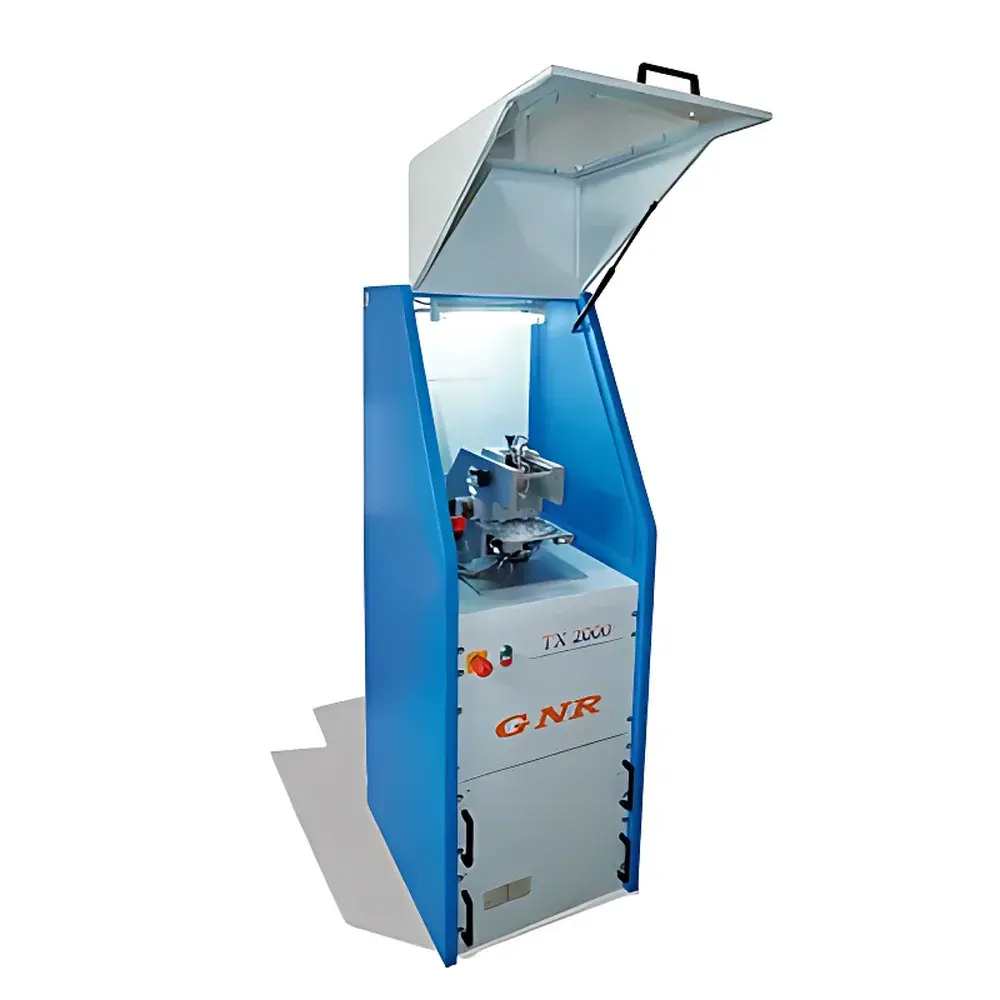
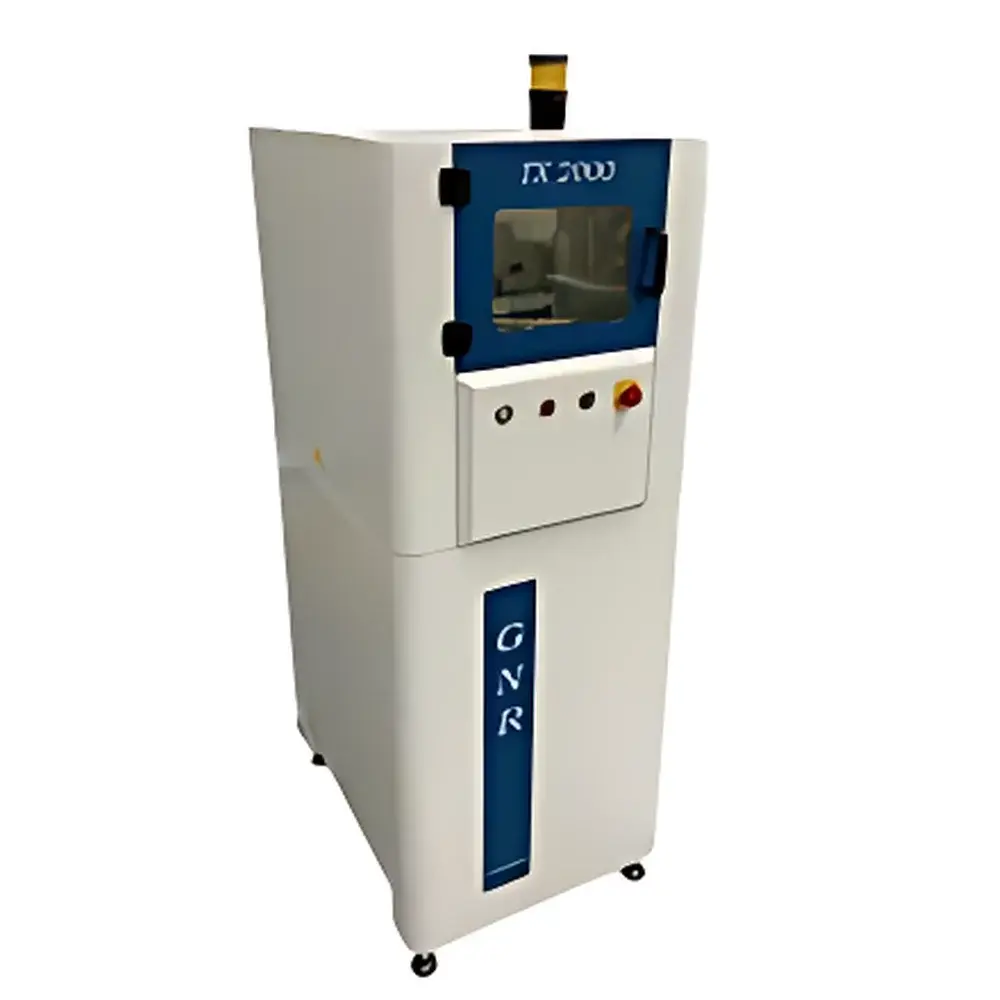
GNR TX 2000 Total Reflection X-Ray Fluorescence Spectrometer
| Brand | GNR |
|---|---|
| Origin | Italy |
| Model | TX 2000 |
| Configuration | Benchtop/Floor-standing |
| Application Type | General-purpose |
| Elemental Range | Na (11) to Pu (94) |
| Quantification Range | 10 pg – 100% |
| Energy Resolution | 124 eV (at Mn Kα) |
| Repeatability | 0.1% RSD |
| Detector | Peltier-cooled Silicon Drift Detector (SDD) |
| Excitation Source | Switchable Mo/W anode X-ray tube |
| Angular Control | High-precision optical encoder stepper motor |
Overview
The GNR TX 2000 Total Reflection X-Ray Fluorescence (TXRF) Spectrometer is a high-performance benchtop or floor-standing analytical instrument engineered for ultra-trace elemental quantification in micro-volume samples. Unlike conventional Energy Dispersive X-Ray Fluorescence (ED-XRF), which employs a fixed ~45° incidence angle, the TX 2000 leverages the physical principle of total external reflection—where the primary X-ray beam strikes the sample carrier at a grazing incidence angle below the critical angle (typically < 0.1°). This geometry minimizes substrate absorption and scattering, suppresses background continuum, and enhances signal-to-noise ratio by over two orders of magnitude compared to standard ED-XRF. As a hybrid platform integrating TXRF methodology with robust ED-XRF hardware architecture, the TX 2000 delivers sub-pg absolute detection limits while maintaining full compatibility with routine laboratory workflows. Its design adheres to fundamental principles of X-ray optics and fluorescence physics, enabling quantitative analysis without matrix-matched standards in many cases.
Key Features
- Switchable Mo/W anode X-ray source, software-controlled for optimal excitation across light (Na–Cl) and heavy (Pb–Pu) elements
- Optical encoder-based goniometric stage ensuring angular reproducibility better than ±0.002°, critical for stable critical-angle alignment
- Peltier-cooled silicon drift detector (SDD) with 124 eV energy resolution at Mn Kα (5.89 keV), low intrinsic background, and high count-rate capability (>500,000 cps)
- Single internal standard calibration protocol—enabling matrix-independent quantification without empirical correction models
- Non-destructive, solvent-free analysis requiring only 1–10 µL liquid deposits or ≤100 ng solid residues on quartz/glass carriers
- No chemical digestion, no acid fuming, no memory effect—ideal for high-throughput labs operating under GLP or ISO/IEC 17025 frameworks
- Dynamically adjustable live-time and dead-time correction algorithms ensuring linearity over 8 orders of magnitude (10 pg to 100 wt%)
Sample Compatibility & Compliance
The TX 2000 accepts both liquid and solid micro-samples—including aqueous solutions, digests, suspensions, thin films, and particulate residues—deposited onto flat, low-background carriers (e.g., polished quartz, Si wafers, or ultrapure glass). It supports direct analysis of environmental waters (drinking, wastewater, seawater), biological fluids (urine, serum), pharmaceutical excipients, semiconductor rinse solutions, nuclear fuel cycle intermediates, and forensic trace evidence. The system complies with key international methodological standards including ASTM D7724 (trace metals in water), ISO 17294-2 (water quality—elemental analysis by TXRF), and USP / (elemental impurities in pharmaceuticals). Full audit trail, user access control, and electronic signature support align with FDA 21 CFR Part 11 requirements when deployed in regulated environments.
Software & Data Management
The proprietary GNR TXRF Suite provides intuitive acquisition, real-time spectrum visualization, peak deconvolution using iterative least-squares fitting (including Compton scatter modeling), and automated quantification via internal standard normalization. All raw spectra, processing parameters, calibration curves, and metadata are stored in a secure, timestamped database compliant with ISO 20653:2022 data integrity guidelines. Export options include CSV, PDF reports, and XML-formatted results compatible with LIMS integration. Batch processing, SOP-driven method templates, and customizable report generation support multi-user laboratories performing routine QC/QA across diverse sample types.
Applications
- Environmental monitoring: ppt-level quantification of As, Cd, Pb, Hg, U in drinking water, atmospheric particulates (PM₂.₅), and sediment extracts
- Pharmaceutical quality control: elemental impurity screening per ICH Q3D in APIs, catalysts, and parenteral formulations
- High-purity chemicals: verification of trace metal contaminants (Fe, Ni, Cr) in acids, solvents, and electronic-grade reagents
- Nuclear materials analysis: isotopic-insensitive measurement of actinides (U, Pu, Am) in spent fuel dissolution matrices
- Forensic trace evidence: microanalysis of gunshot residue (Ba, Sb, Pb), ink composition, and paint layer stratigraphy
- Semiconductor process control: monitoring metallic contamination (Cu, Al, Na) on wafer surfaces post-cleaning
FAQ
What is the minimum sample volume required for liquid analysis?
Typically 1–5 µL deposited as a dried micro-spot; lower volumes (sub-µL) are feasible with capillary dispensing and optimized carrier geometry.
Can the TX 2000 analyze suspended particles directly?
Yes—centrifuged pellets or filtered residues on carriers can be measured without dissolution, preserving particle morphology and oxidation state information.
Is vacuum or helium purge required for light element analysis?
No—ambient air operation suffices for Na–F quantification due to the ultra-low background and high photon collection efficiency of the SDD-TXRF configuration.
How does TXRF differ from conventional ED-XRF in terms of detection limits?
TXRF achieves typical detection limits of 0.1–10 pg for most elements, representing a 10–100× improvement over standard ED-XRF on the same sample mass, primarily due to suppressed bremsstrahlung background.
Does the system support regulatory compliance documentation?
Yes—the software includes 21 CFR Part 11-compliant electronic signatures, change history logs, and IQ/OQ documentation templates for GMP/GLP validation.





