
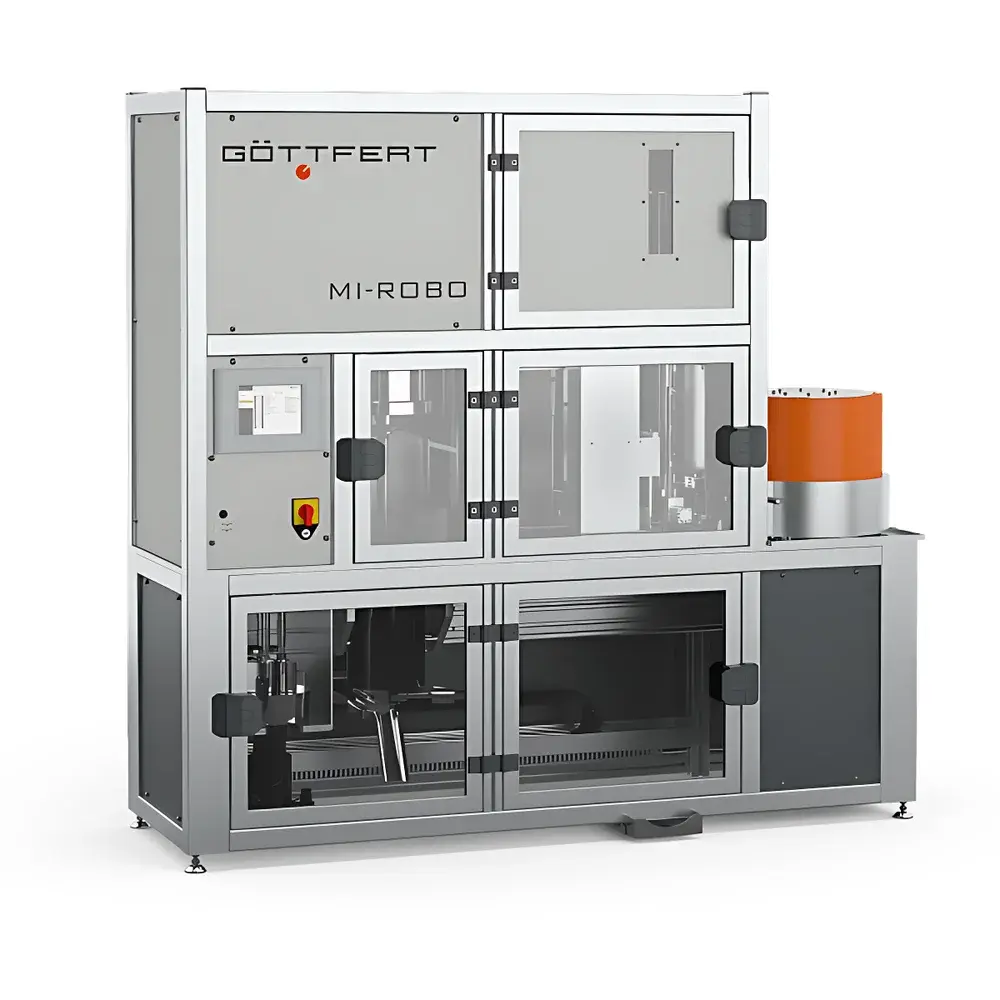
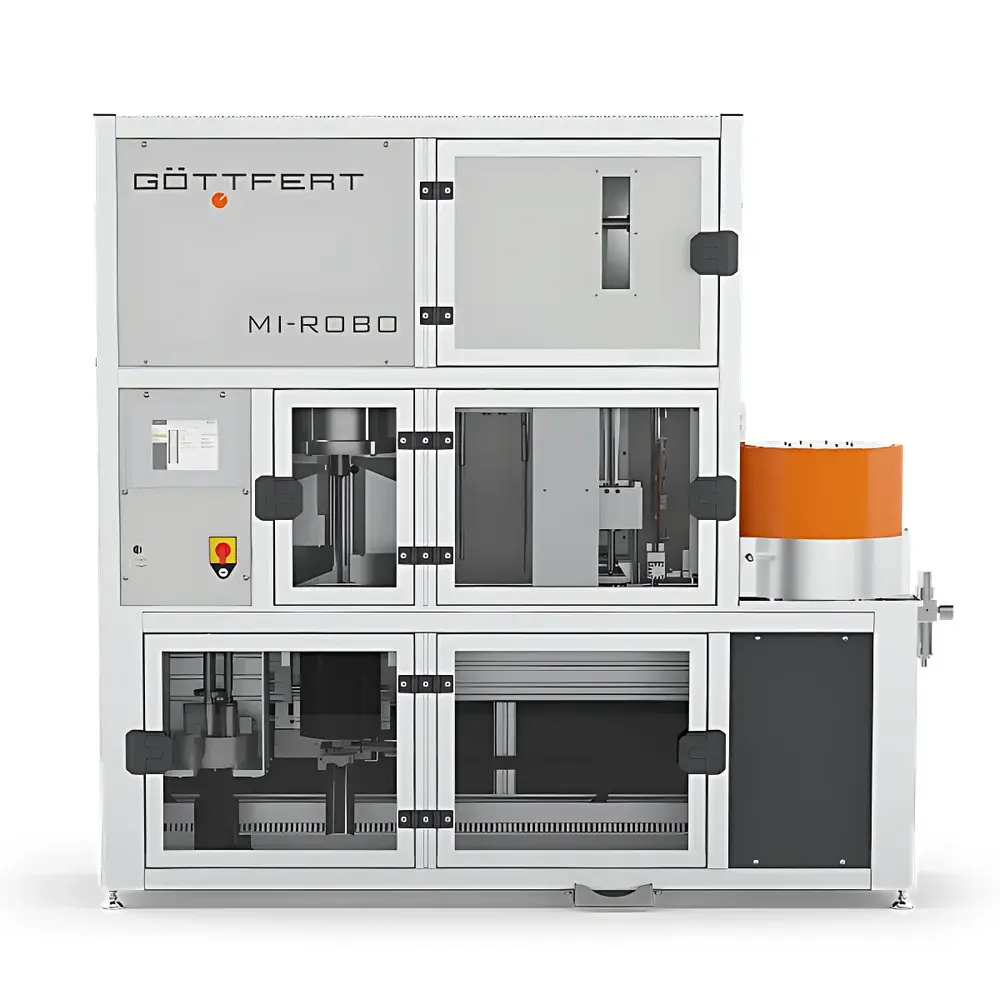
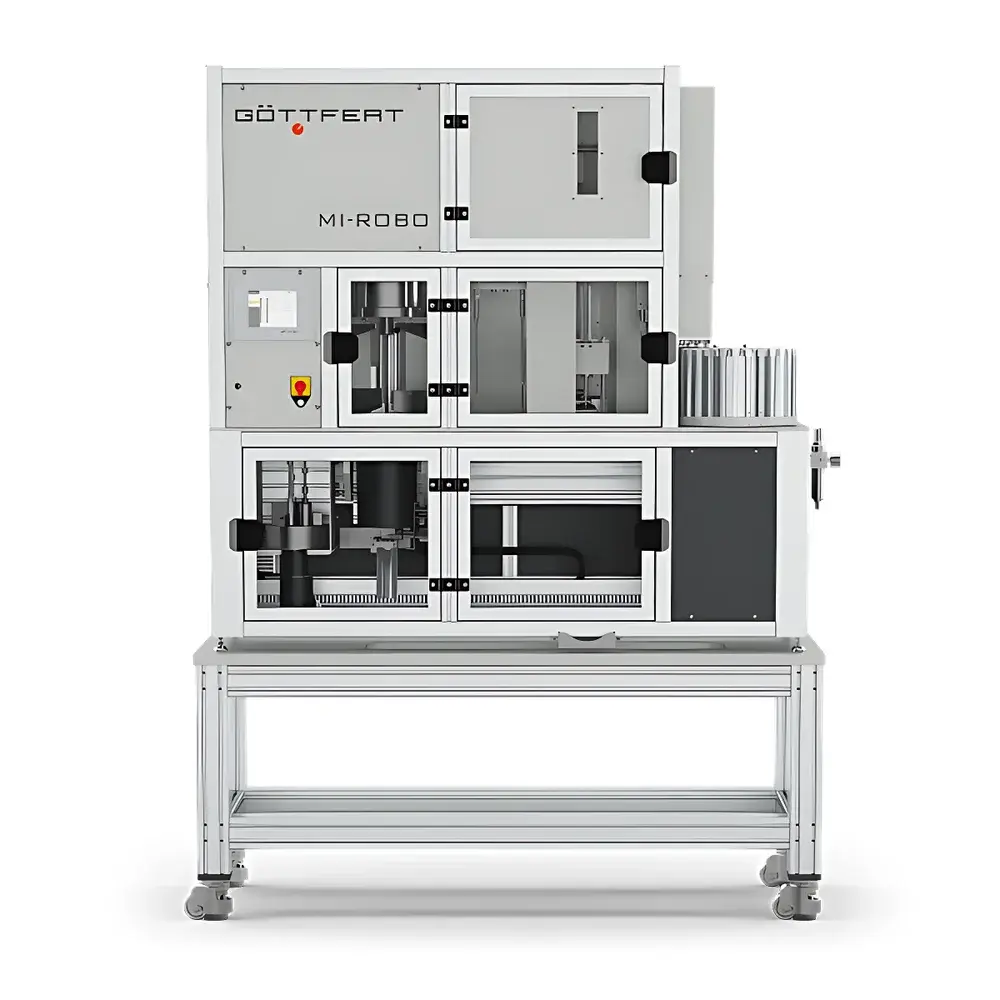
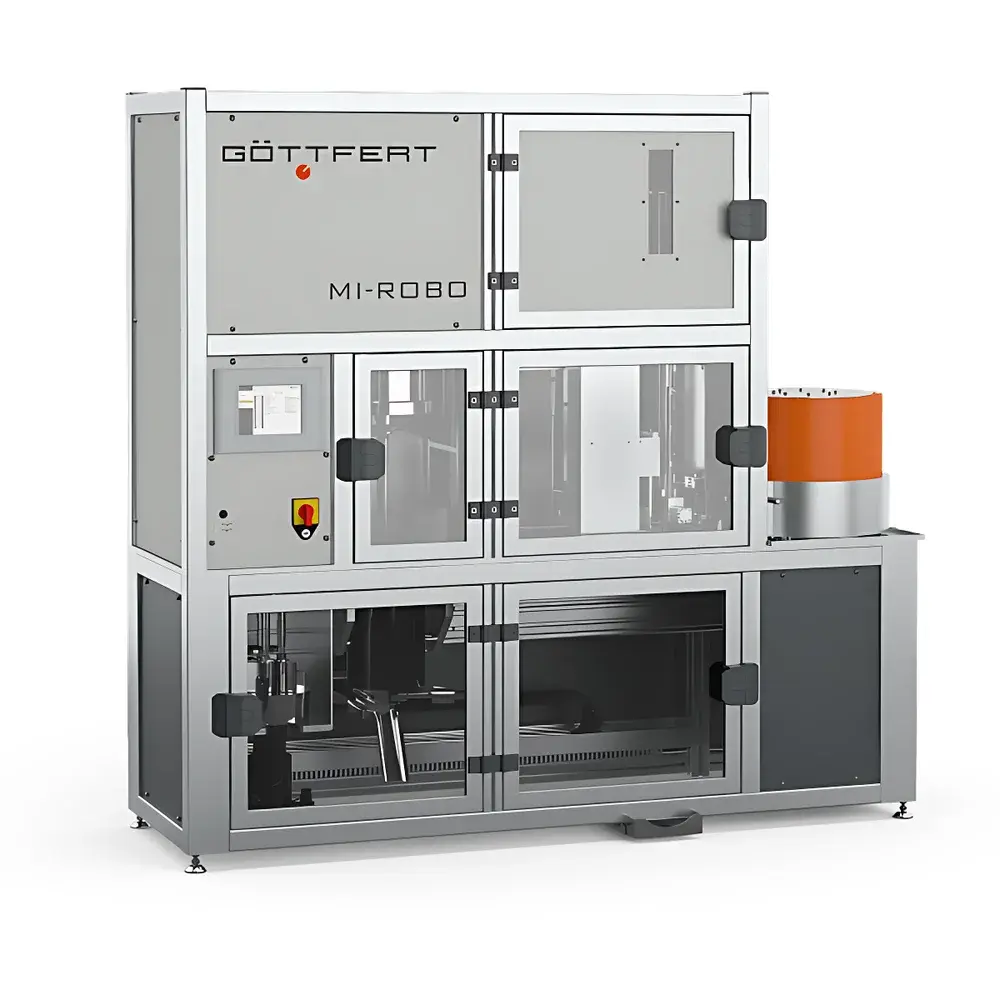
Goettfert MI-ROBO Automated Melt Flow Indexer
| Brand | Goettfert |
|---|---|
| Origin | Germany |
| Model | MI-ROBO |
| Temperature Range | 60.00–400.00 °C (optional to 500.00 °C) |
| Temperature Accuracy | ±0.1 °C |
| Temperature Resolution | 0.01 °C |
| Die Diameter | 2.095 ± 0.003 mm |
| Die Length | 8.00 ± 0.025 mm |
| Die Material | Tungsten Carbide |
| Piston Diameter | 9.48 ± 0.01 mm |
| Barrel ID | 9.555 ± 0.01 mm |
| Standard Weights | 1.200, 2.16, 3.8, 5.0, 10.0, 21.6 kg (±0.5 % tolerance) |
| Timer Resolution | < 0.001 s |
| Position Sensor Resolution | 0.012 mm/pulse |
| Test Capacity | Up to 30 consecutive tests |
| Display | 5.7" full-color LCD touchscreen |
| Software | MFR Professional with automated sequence programming, real-time monitoring, and GLP-compliant data export |
Overview
The Goettfert MI-ROBO Automated Melt Flow Indexer is a fully autonomous, ISO 1133-1/2 and ASTM D1238-compliant instrument engineered for precision determination of melt mass-flow rate (MFR) and melt volume-flow rate (MVR) of thermoplastic polymers. Unlike semi-automated or manual melt indexers, the MI-ROBO implements a closed-loop robotic architecture that executes sample loading (granules, powders, or flake-like materials), temperature stabilization, extrusion, melt cutting, piston displacement measurement, die exchange, and barrel/column cleaning—without operator intervention. Its core measurement principle relies on gravimetric or volumetric quantification of polymer melt extruded under defined load and temperature conditions through a standardized capillary die. This enables high reproducibility across extended test sequences and eliminates inter-operator variability inherent in conventional methods.
Key Features
- Fully automated testing cycle supporting up to 30 consecutive determinations per unattended run—including automatic sample feeding, die insertion/removal, piston actuation, melt cutting, and thermal cleaning of barrel and piston.
- Five-point independent temperature calibration with 0.01 °C resolution and ±0.1 °C accuracy across a standard range of 60.00–400.00 °C (extendable to 500.00 °C upon configuration).
- High-precision digital position sensing (0.012 mm/pulse) coupled with sub-millisecond timing (<0.001 s) for accurate volumetric flow calculation per ISO 1133-2 Annex A.
- Integrated 5.7-inch full-color touchscreen interface with password-protected access levels, real-time graphical display of melt displacement curves, temperature profiles, and status diagnostics.
- Modular die and barrel system featuring tungsten carbide dies (2.095 ± 0.003 mm × 8.00 ± 0.025 mm) and hardened steel barrels (ID 9.555 ± 0.01 mm, piston OD 9.48 ± 0.01 mm) for long-term dimensional stability and wear resistance.
- Configurable weight set compliant with international standards: 1.200 kg, 2.16 kg, 3.8 kg, 5.0 kg, 10.0 kg, and 21.6 kg (all certified to ±0.5 % tolerance).
Sample Compatibility & Compliance
The MI-ROBO accommodates diverse feedstock forms—including virgin pellets, regrind, masterbatch concentrates, and fine polymer powders—without pre-compaction or manual preheating. Its adaptive heating and dwell logic ensures uniform thermal history prior to extrusion, critical for heat-sensitive or shear-thinning resins. The system is validated for full compliance with ISO 1133-1 (mass-flow rate), ISO 1133-2 (volume-flow rate), ASTM D1238 (Procedure A and B), BS 2782-1, and NF T51-016. All calibration records, test logs, and parameter configurations are timestamped and stored with audit-trail capability, supporting GLP and GMP environments. Optional firmware modules enable 21 CFR Part 11-compliant electronic signatures and user-role-based access control.
Software & Data Management
MFR Professional software serves as the central control and analysis engine. It supports method-driven test sequencing: users define material-specific protocols—including preheat time, extrusion dwell, cut interval, cleaning temperature ramp, and post-test cooldown—via intuitive drag-and-drop workflow templates. Real-time data streaming includes piston displacement vs. time, melt temperature at die entry, and calculated MFR/MVR values with statistical summaries (mean, SD, CV%). Export options include CSV, PDF reports with embedded metadata, and XML for LIMS integration. All raw sensor data, event logs, and calibration certificates are archived with immutable timestamps and SHA-256 hash verification.
Applications
- Quality control laboratories performing routine MFR screening of polyolefins (PP, PE), engineering thermoplastics (PA, PC, POM), and high-performance polymers (PEEK, PSU).
- R&D departments evaluating batch-to-batch consistency, thermal degradation effects, or additive dispersion efficiency via multi-condition MVR profiling.
- Contract testing facilities requiring auditable, high-throughput throughput for certification under automotive (e.g., VDA 260), medical (ISO 10993), or packaging (ASTM D4292) specifications.
- Academic polymer science programs utilizing volumetric flow data to derive rheological parameters such as apparent viscosity and flow activation energy.
FAQ
Does the MI-ROBO support both MFR and MVR measurements?
Yes—it simultaneously acquires piston displacement and melt mass data, enabling concurrent calculation of both melt mass-flow rate (g/10 min) and melt volume-flow rate (cm³/10 min) per ISO 1133-2.
Can the system handle highly filled or abrasive compounds?
Yes—tungsten carbide dies and optional hardened barrels minimize wear; an optional automatic melt cutter with ceramic blades further enhances reliability for glass-filled or mineral-loaded formulations.
Is remote monitoring or integration with MES/LIMS possible?
Yes—Ethernet and RS232 interfaces support OPC UA and Modbus TCP protocols; MFR Professional includes configurable API endpoints for bidirectional data exchange.
What maintenance intervals are recommended?
Daily visual inspection of die and barrel; quarterly calibration of temperature sensors and position encoder; annual verification of weight set traceability against NIST-certified references.
How is method validation performed for new polymer types?
The system includes a method development wizard that guides users through preliminary extrusion trials, recommends optimal load/temperature combinations, and generates validation reports aligned with ISO/IEC 17025 clause 7.2.2.





