
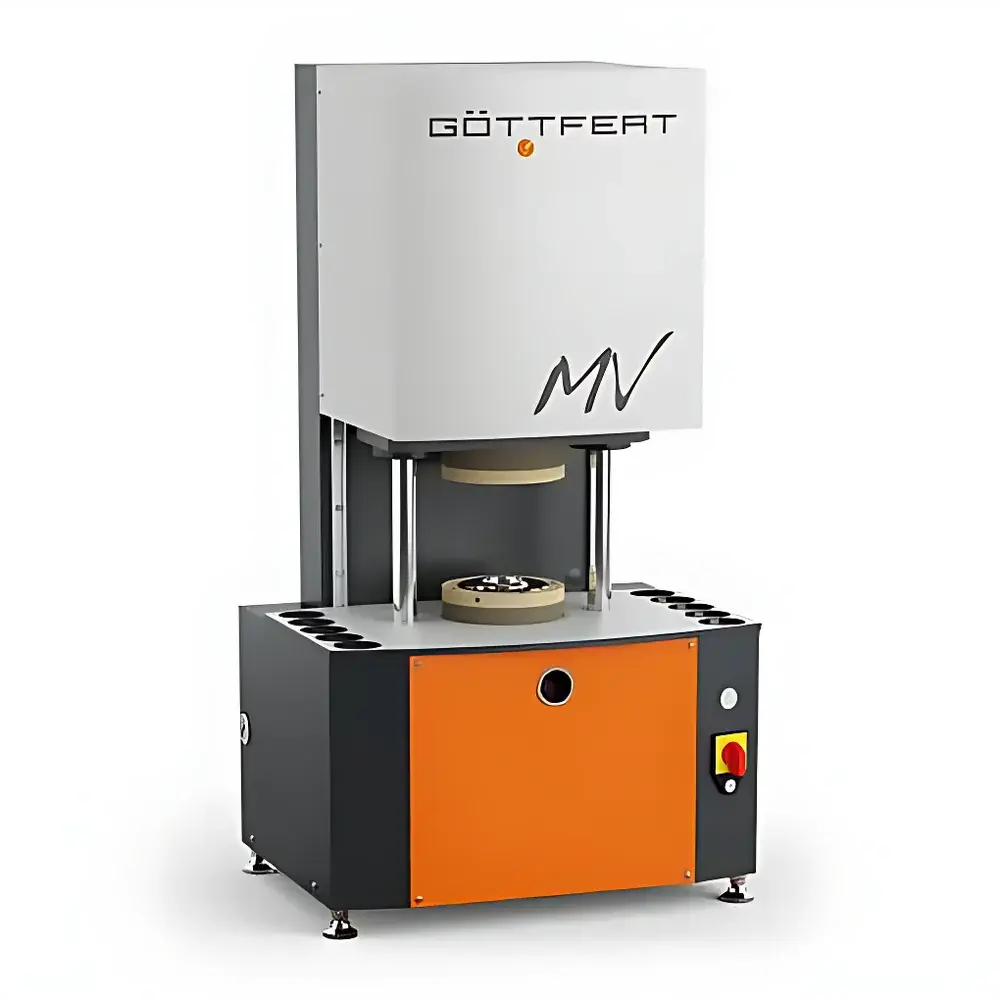
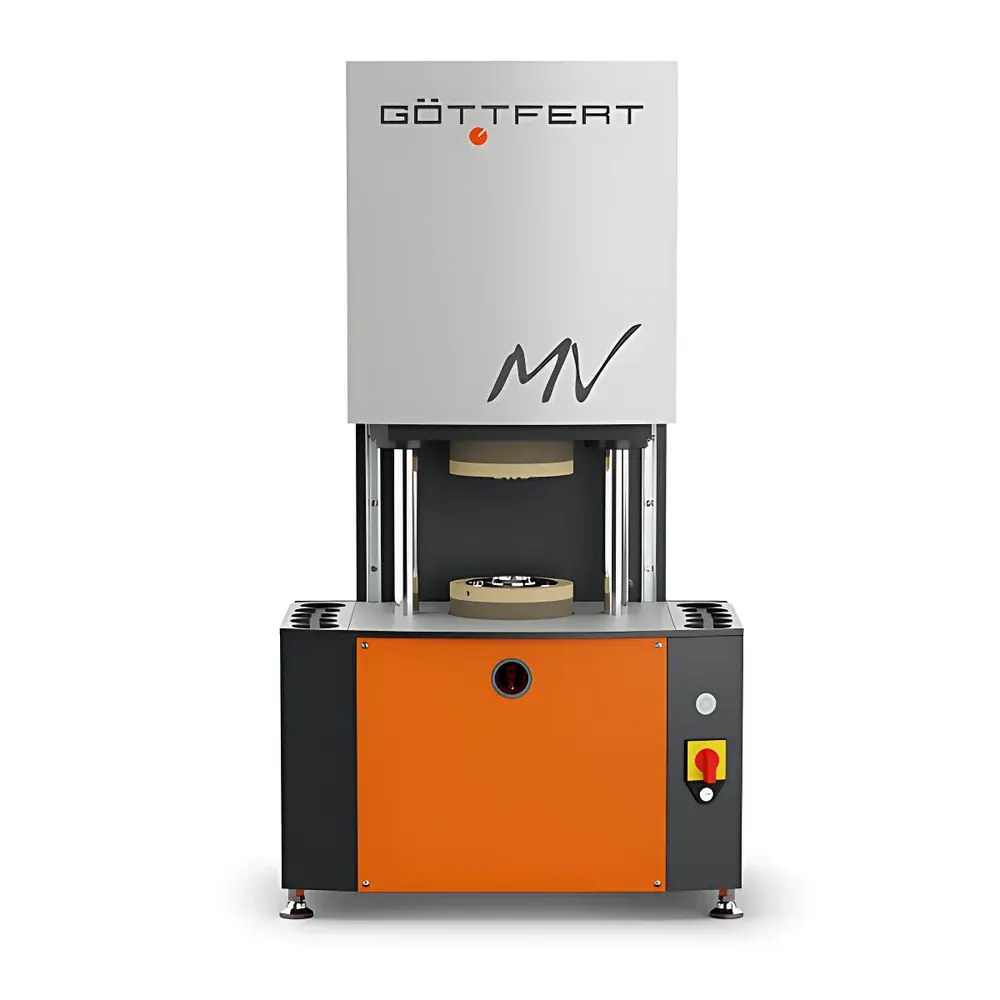
Goettfert MV Series Mooney Viscometer
| Brand | Goettfert |
|---|---|
| Origin | Germany |
| Model | MV |
| Torque Range | 200 ME |
| Temperature Range | 0–200.0 °C |
| Temperature Accuracy | ±0.1 °C |
| Temperature Stability | < ±0.2 °C |
| Standard Rotor Speed | 2 rpm (optional: 0.1–5 rpm) |
| Rotor Diameter | 38.1 mm / 30.84 mm |
| Rotor Thickness | 5.54 mm |
| Chamber Diameter | 50.9 mm |
| Chamber Height | 59 mm |
| Closing Force | 11.5 kN |
| Opening Distance | 110 mm |
| Compressed Air Supply | 5–10 bar |
| Weight | ~150 kg |
Overview
The Goettfert MV Series Mooney Viscometer is a precision-engineered instrument designed for the quantitative characterization of unvulcanized rubber compounds and raw elastomers. Based on the standardized Mooney viscosity principle—defined by rotational shear in a sealed cavity between a heated, stationary die and a rotating rotor—the MV system measures torque resistance as a function of time and temperature. This enables direct determination of Mooney viscosity (ML1+4, ML1+8), scorch behavior (t5, t35), stress relaxation (Mooney relaxation), and Delta Mooney values. The instrument operates under controlled thermal conditions, with dual-zone PT100 (1/3 DIN) temperature sensing and five-point calibration traceability, ensuring compliance with fundamental rheological testing requirements for quality control and formulation development in rubber compounding laboratories.
Key Features
- Compact benchtop architecture with integrated pneumatic rotor ejection for rapid sample loading and operator safety
- High-resolution torsional transducer calibrated to 200 Mooney Units (ME), delivering high reproducibility across low- to high-viscosity formulations
- Dual-heating-block system with independent PID control and ±0.1 °C absolute accuracy; stability maintained at < ±0.2 °C over full 0–200.0 °C operating range
- Precision stepper motor drive delivering nominal 2 rpm rotation (ISO/DIN/ASTM standard), with optional speed range from 0.1 to 5 rpm for specialized relaxation or low-shear characterization
- Interchangeable rotors (38.1 mm and 30.84 mm diameter, 5.54 mm thickness) compatible with ISO 289-1, ASTM D1646, and DIN 53523-1 test geometries
- Hydraulic-free mechanical closing mechanism applying consistent 11.5 kN force, ensuring repeatable cavity compression and minimal sample extrusion
Sample Compatibility & Compliance
The MV viscometer accommodates raw natural rubber (NR), synthetic elastomers (SBR, BR, EPDM, NBR, CR), and compounded stock—whether masterbatch, tread, sidewall, or innerliner formulations. All measurements conform to internationally recognized standards including ISO 289-1:2022 (determination of Mooney viscosity), ISO 289-2:2022 (scorch time), ISO 289-3:2022 (stress relaxation), and ISO 289-4:2022 (Delta Mooney). It also meets ASTM D1646–23 and DIN 53523–1 through –4 specifications. Instrument design supports GLP-compliant workflows: temperature calibration logs, torque sensor verification records, and test parameter metadata are retained within the RubberView database, enabling audit-ready documentation for internal QA and regulatory submissions.
Software & Data Management
RubberView software serves as the central interface for test configuration, real-time monitoring, and post-acquisition analysis. Users define test protocols—including temperature ramp profiles, rotor speed, preheat duration, and data sampling intervals—via intuitive graphical templates. Raw torque vs. time curves are auto-processed to extract standard indices (e.g., ML1+4, t5, relaxation slope), with optional derivative-based scorch onset detection. All datasets are stored in an ACID-compliant relational database with user-level access controls, timestamped audit trails, and export functionality to CSV, PDF, and XML formats. For regulated environments, RubberView supports 21 CFR Part 11–compliant electronic signatures and electronic record retention when deployed on validated IT infrastructure.
Applications
This instrument is routinely deployed in R&D labs for polymer selection and compound optimization; in production QC labs for incoming raw material verification and batch release testing; and in technical service centers for troubleshooting processing issues such as extrusion instability or calendering defects. Typical use cases include: monitoring polymer degradation during mastication, evaluating antioxidant efficacy via scorch delay, quantifying filler dispersion effects on compound stiffness, comparing cure inhibition between different accelerator systems, and establishing baseline viscosity specifications for customer-facing technical data sheets. Its robust mechanical architecture and thermally stable cavity make it suitable for continuous operation in high-throughput industrial settings.
FAQ
What standards does the Goettfert MV comply with?
It fully complies with ISO 289-1 to -4, ASTM D1646, and DIN 53523-1 to -4 for Mooney viscosity, scorch, relaxation, and Delta Mooney measurements.
Can the instrument perform tests at non-standard rotor speeds?
Yes—while 2 rpm is the default per ISO/ASTM, optional speed control allows continuous adjustment from 0.1 to 5 rpm for specialized research applications.
Is RubberView software validated for GMP environments?
RubberView includes features required for 21 CFR Part 11 compliance (e.g., electronic signatures, audit trail, role-based permissions); final validation must be performed by the end user per their site-specific SOPs.
How is temperature calibration verified?
The system supports five-point traceable calibration using certified reference thermometers; calibration reports are generated and archived within RubberView.
What maintenance is required for long-term torque accuracy?
Annual verification of the torsional transducer against NIST-traceable standards is recommended; Goettfert provides certified recalibration services and on-site support.




