
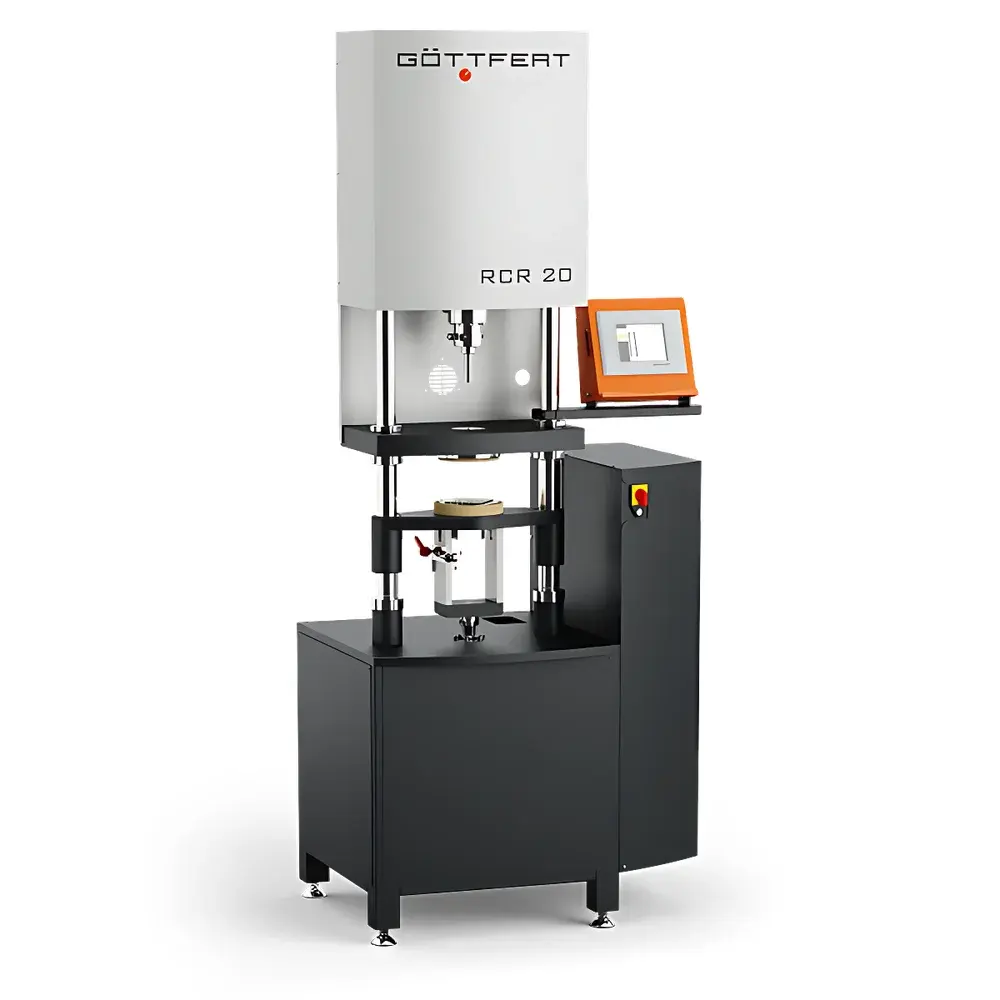
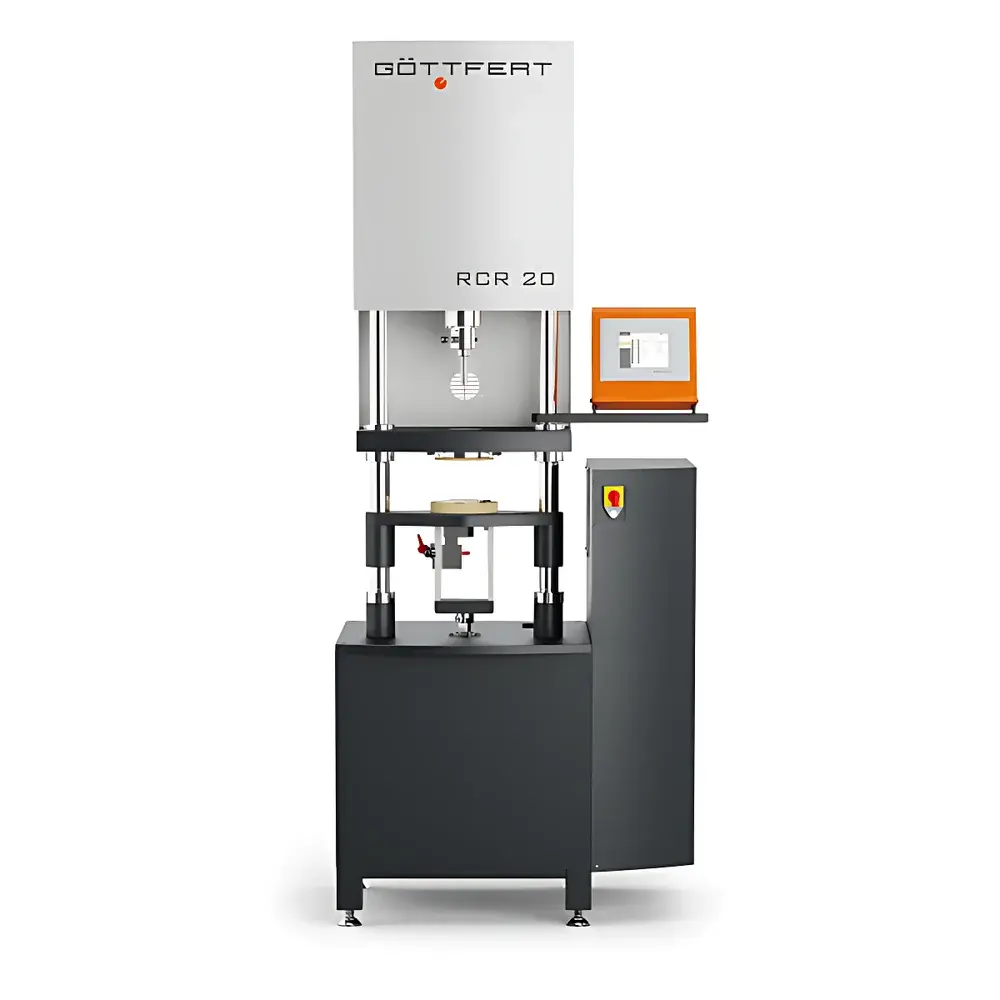
Goettfert RCR20 Capillary Rheometer for Rubber Testing
| Brand | Goettfert |
|---|---|
| Origin | Germany |
| Model | RCR20 |
| Maximum Force | 20 kN |
| Temperature Range | Ambient to 240 °C |
| Temperature Resolution | 0.01 °C |
| Temperature Stability | ±0.2 °C |
| Velocity Range | 5×10⁻⁵ mm/s to 15 mm/s |
| Velocity Resolution | 1.7×10⁻⁶ mm/s |
| Dynamic Rate Ratio | 1:300,000 |
| Capillary Die Ratio | 20:1 |
| Piston Diameter Options | 20 mm / 30 mm / 35 mm |
| Dimensions (Rheometry Mode) | 1130 mm × 650 mm × 1500 mm |
| Dimensions (Rheometry + Curing Mode) | 1130 mm × 650 mm × 2070 mm |
| Weight (Rheometry Mode) | 450 kg |
| Weight (Rheometry + Curing Mode) | 480 kg |
| Compliance | ASTM D5099, ISO 11443, GFT 014-02 |
Overview
The Goettfert RCR20 Capillary Rheometer is a high-precision, benchtop-capable instrument engineered specifically for the rheological characterization of uncured and compounded rubber materials under realistic processing conditions. Based on the capillary flow principle—where molten polymer is forced through a precisely dimensioned die under controlled temperature, pressure, and shear rate—the RCR20 enables quantitative determination of shear viscosity, extensional behavior, melt elasticity, and extrudate swell. Its dual-mode architecture supports both extrusion and injection simulation protocols, allowing users to replicate key industrial processes such as profile extrusion, calender feeding, and injection molding in a laboratory environment. The system’s 20 kN hydraulic actuation system delivers exceptional force stability and dynamic response, enabling accurate measurement across an ultra-broad shear rate range (up to 1:300,000), essential for capturing non-Newtonian behavior in highly filled elastomeric compounds.
Key Features
- 20 kN high-force hydraulic drive with <0.005% full-scale force accuracy and sub-millisecond response time (0–15 mm/s acceleration achieved in ≤0.35 s)
- Triple-piston diameter configuration (20 mm, 30 mm, 35 mm) optimized for variable sample volume and shear stress scaling
- Standard L/D = 20:1 capillary die geometry compliant with ISO 11443 and ASTM D5099 requirements
- High-resolution linear encoder with 1.7×10⁻⁶ mm positional resolution ensures precise displacement and velocity control
- Temperature-controlled barrel and die assembly with ±0.2 °C uniformity and 0.01 °C digital resolution, operating from ambient to 240 °C
- Modular hardware design supporting seamless transition between rheometric testing and integrated rheo-curing (vulcanization) analysis
- Quick-switch interface enabling operator-selectable extrusion or injection mode without mechanical reconfiguration
Sample Compatibility & Compliance
The RCR20 accommodates raw rubber compounds—including natural rubber (NR), synthetic polyisoprene (IR), styrene-butadiene rubber (SBR), ethylene-propylene-diene monomer (EPDM), nitrile rubber (NBR), and thermoplastic elastomers (TPEs)—in both unvulcanized and pre-vulcanized states. Its standardized test geometry and controlled boundary conditions ensure direct comparability with production-scale extrusion data. The instrument meets the metrological and procedural requirements of international standards including ASTM D5099 (Standard Test Method for Determining the Melt Flow Properties of Rubber Compounds Using a Capillary Rheometer), ISO 11443 (Plastics — Determination of the Melt Mass-Flow Rate and Melt Volume-Flow Rate of Thermoplastics), and GFT 014-02 (German Rubber Industry Standard for Capillary Rheometry). All calibration and verification procedures are traceable to national metrology institutes (e.g., PTB, NIST), and system validation reports support GLP/GMP audit readiness.
Software & Data Management
Control and analysis are executed via Goettfert’s proprietary WinRHEO software suite, a Windows-based platform compliant with FDA 21 CFR Part 11 requirements. It provides full electronic signature capability, user access levels (administrator/operator/auditor), and complete audit trail functionality—including timestamped parameter changes, raw data logging, and result export in CSV, PDF, and XML formats. Real-time visualization includes shear stress vs. shear rate curves, viscosity master curves, Bagley and Rabinowitsch corrections, and extrudate swell ratio calculations. Data can be exported directly into third-party statistical process control (SPC) or LIMS environments. Optional IQ/OQ documentation packages are available to support installation and operational qualification per ISO/IEC 17025 and internal quality management systems.
Applications
- Quantification of wall-slip effects and true shear viscosity in highly filled carbon-black or silica-reinforced compounds
- Evaluation of scorch safety and cure kinetics during simultaneous rheo-curing experiments
- Optimization of mixing parameters and filler dispersion efficiency via extrudate homogeneity assessment
- Development and QC of rubber compounds for automotive seals, tire treads, vibration dampers, and medical-grade elastomers
- Correlation of lab-scale capillary data with twin-screw extruder output and pressure drop profiles
- Root-cause analysis of surface defects (e.g., melt fracture, sharkskin) through critical shear rate mapping
FAQ
What distinguishes the RCR20 from general-purpose polymer capillary rheometers?
The RCR20 integrates specialized thermal management, high-force hydraulics, and rubber-specific die geometries to address the low thermal conductivity, high elasticity, and narrow processing windows typical of elastomers—features not optimized in standard thermoplastic rheometers.
Can the RCR20 perform both extrusion and injection tests on the same sample?
Yes—via software-controlled mode switching and synchronized piston motion profiling, the system executes sequential extrusion and injection cycles without manual intervention or hardware changeover.
Is the extrudate swell module compatible with real-time optical measurement?
The optional die swell unit includes standardized mounting interfaces for integration with high-speed CCD cameras and image analysis software for automated swell ratio quantification.
Does the system support automated cleaning protocols?
An optional automatic cleaning unit utilizes programmable solvent flush sequences and heated purge cycles to minimize cross-contamination and reduce downtime between samples.
How is force calibration maintained over extended operation?
The hydraulic load cell is factory-calibrated with NIST-traceable dead-weight standards; periodic verification is supported by integrated self-check routines and external reference load cells per ISO 7500-1.



