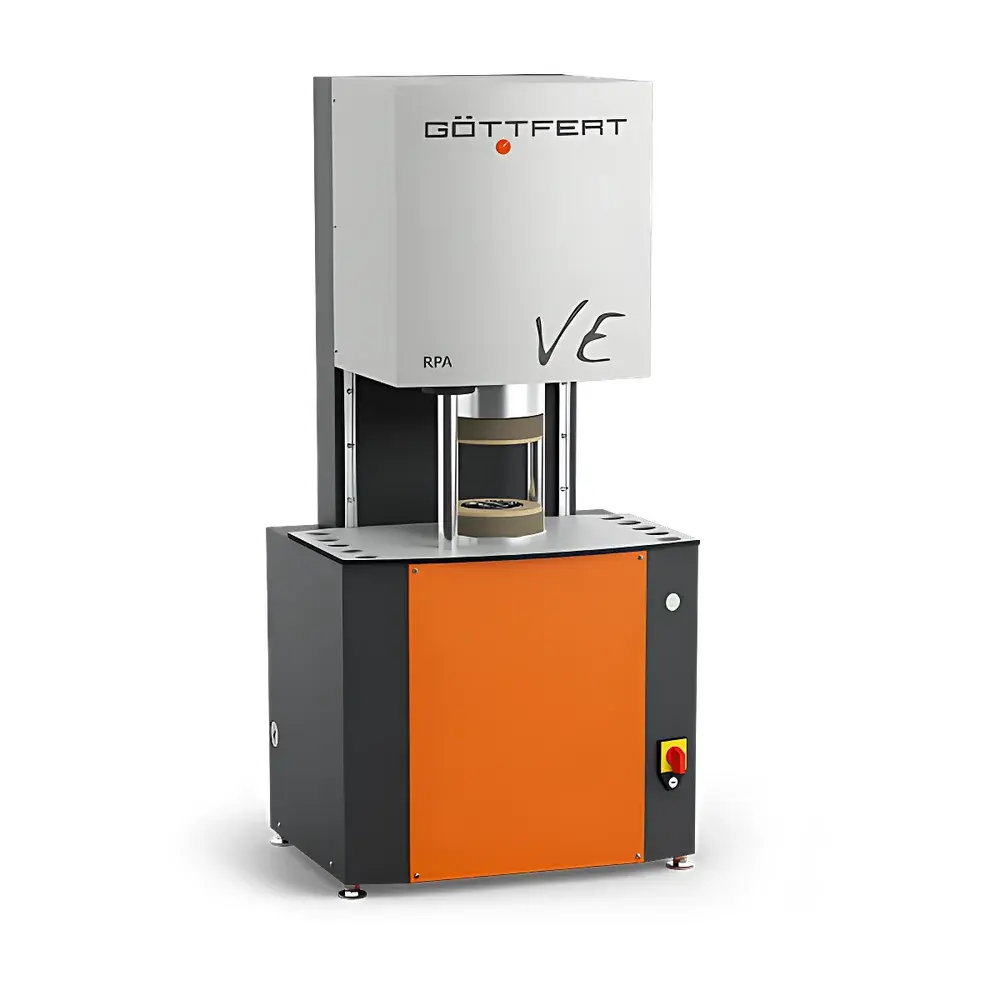
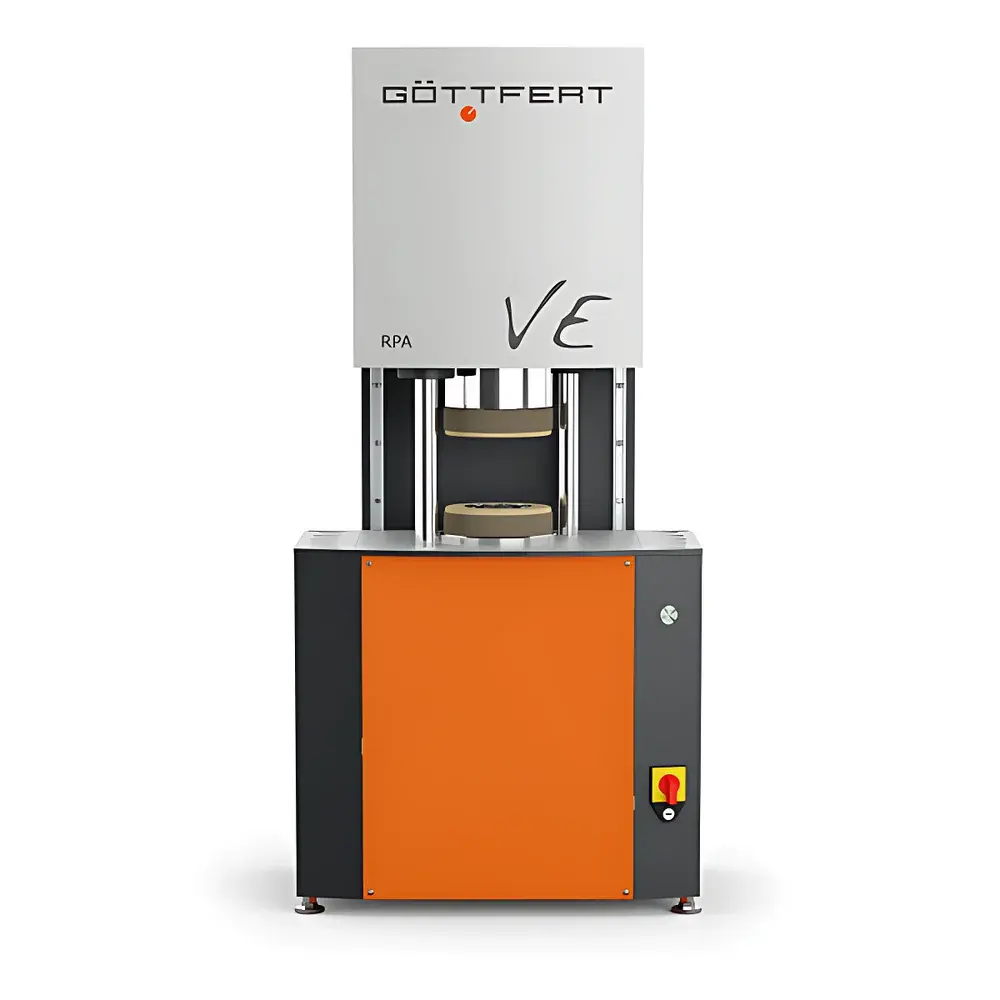
Goettfert VISCO-ELASTOGRAPH Rubber Processing Analyzer (VE)
| Brand | Goettfert |
|---|---|
| Country of Origin | Germany |
| Model | VISCO-ELASTOGRAPH |
| Temperature Range | 5–230 °C |
| Temp. Resolution | 0.01 °C |
| Temp. Stability | < ±0.2 °C over time |
| Temp. Uniformity (across cavity) | < 0.5 °C |
| Oscillation Frequency | 0.01–100 Hz |
| Angular Amplitude | ±0.01°–±90° |
| Relaxation Angle Range | 0–90° |
| Angular Resolution | 0.001° |
| Max. Torque | 20 Nm |
| Max. Normal Force | 10 kN |
| Closing Force | 12 kN |
| Dimensions (H×W×D) | 1145 × 540 × 410 mm |
| Weight | 175 kg |
Overview
The Goettfert VISCO-ELASTOGRAPH Rubber Processing Analyzer (VE) is a high-precision, benchtop rotational rheometer engineered specifically for the rubber and elastomer industry. It operates on the principle of controlled-strain or controlled-stress dynamic oscillatory testing within parallel-plate or cone-and-plate geometries, enabling quantitative characterization of viscoelastic behavior in both uncured and vulcanizing rubber compounds under realistic processing conditions. Unlike general-purpose rheometers, the VE integrates thermal control, mechanical actuation, and real-time torque/normal force measurement into a single platform compliant with international rubber testing standards. Its architecture supports continuous monitoring of complex modulus (G*, G′, G″), loss tangent (tan δ), viscosity (η*), and normal stress differences (N₁) across wide ranges of temperature, frequency, strain amplitude, and time—making it indispensable for compound development, quality assurance, and process simulation in tire, sealing, and industrial rubber manufacturing.
Key Features
- Built-in industrial PC with embedded real-time operating system for autonomous test execution, eliminating external computer dependency and minimizing signal latency.
- RubberView™ software suite providing full parametric control: up to 20 sequential test steps per protocol, each independently configurable for angular displacement (±0.01°–±90°), frequency (0.01–100 Hz), dwell time, ramp rate, and temperature profile.
- High-fidelity temperature control system with 0.01 °C resolution, long-term stability better than ±0.2 °C, and cavity surface uniformity maintained within ±0.5 °C—critical for reproducible vulcanization kinetics studies.
- Dual-sensor torque transduction (up to 20 Nm) and optional normal force measurement (up to 10 kN), enabling simultaneous acquisition of shear and extensional response during foaming, extrusion simulation, or filler dispersion analysis.
- Modular hardware design supporting field-upgradable options: integrated cavity cooling unit for post-cure quenching, LAOS (Large Amplitude Oscillatory Shear) module for nonlinear viscoelastic mapping, and automated dosing system for closed-loop compound loading.
Sample Compatibility & Compliance
The VISCO-ELASTOGRAPH accommodates raw rubber stocks, masterbatches, filled compounds, thermoplastic elastomers (TPEs), and silicone gels using standardized sample geometries per ASTM D6601 (oscillatory cure testing), ASTM D6204 (Mooney viscometry correlation), DIN 53529 (vulcanization behavior), ISO 13145 (dynamic mechanical analysis of rubber), ASTM D7050 (time–temperature superposition), ASTM D6048 (strain sweep), and ASTM D7605 (extensional rheology of uncured compounds). All thermal and mechanical calibrations are traceable to national metrology institutes; torque calibration adheres to ISO 17025 requirements and may be performed in-house using optional NIST-traceable calibration kits. The system supports GLP-compliant audit trails when configured with FDA 21 CFR Part 11–enabled software modules.
Software & Data Management
RubberView™ provides ISO/IEC 17025-aligned data handling: automatic metadata tagging (operator ID, batch number, ambient conditions), encrypted raw data storage in HDF5 format, and export to CSV, XML, or proprietary .rva files. Advanced analysis tools include time–temperature superposition (WLF and Arrhenius modeling), Payne effect quantification, Mullins effect tracking, and Fourier-transformed LAOS response (IT-FTS). Data integrity is enforced via electronic signatures, version-controlled method templates, and immutable audit logs recording all parameter changes, calibration events, and user actions—fully compatible with laboratory information management systems (LIMS) via RESTful API.
Applications
- Characterization of scorch safety, cure rate, and final crosslink density in sulfur- and peroxide-cured systems.
- Evaluation of filler networking (e.g., carbon black, silica) through strain-dependent modulus recovery and hysteresis loop analysis.
- Simulation of extrusion, calendering, and injection molding processes via frequency sweeps at elevated temperatures (up to 230 °C).
- Quantification of foam expansion kinetics and cell stabilization behavior using normal stress profiling during chemical blowing agent decomposition.
- Comparative assessment of bio-based elastomers, recycled rubber content, and novel curatives under accelerated aging protocols.
FAQ
What standards does the VISCO-ELASTOGRAPH support for rubber curing analysis?
It fully complies with ASTM D6601, ASTM D6204, DIN 53529, ISO 13145, and ASTM D7605 for dynamic vulcanization profiling, Mooney correlation, and extensional response validation.
Can the instrument perform both small-amplitude oscillatory shear (SAOS) and large-amplitude oscillatory shear (LAOS)?
Yes—standard SAOS operation is included; LAOS capability is available as an optional software/hardware package enabling nonlinear viscoelastic fingerprinting via Lissajous-Bowditch analysis and Chebyshev decomposition.
Is torque calibration traceable to international standards?
Torque transducers are factory-calibrated against NIST-traceable reference standards; optional in-lab calibration kits (with certified weights and lever arms) allow periodic verification per ISO 17025 requirements.
How is thermal uniformity validated across the test cavity?
Each unit undergoes cavity mapping using calibrated micro-thermocouples at nine spatial points; delivered reports confirm ΔT ≤ 0.5 °C across the entire plate surface at all setpoints from 5 °C to 230 °C.
What sample volume is required for standard testing?
Typical sample mass ranges from 0.8 g to 2.5 g depending on geometry (25-mm parallel plate vs. 25-mm cone); minimum thickness is 0.8 mm to ensure full gap filling without edge fracture.