
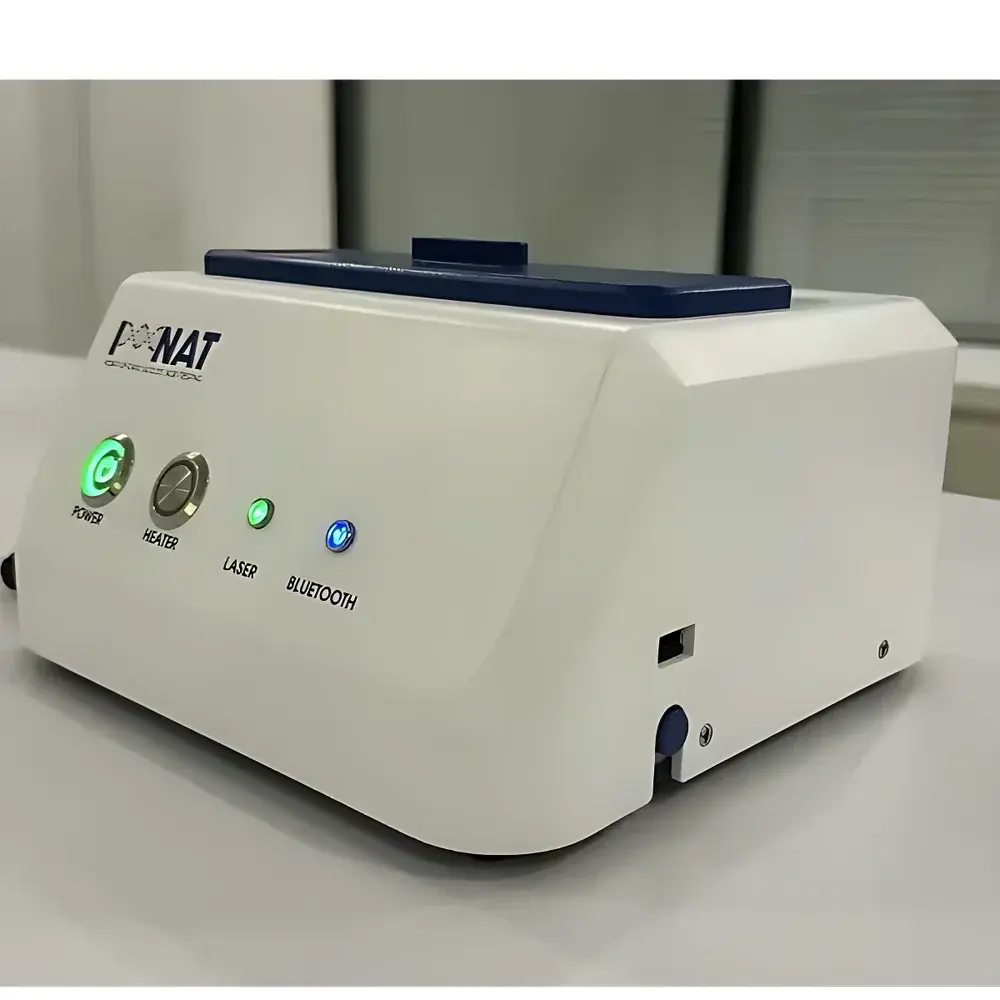
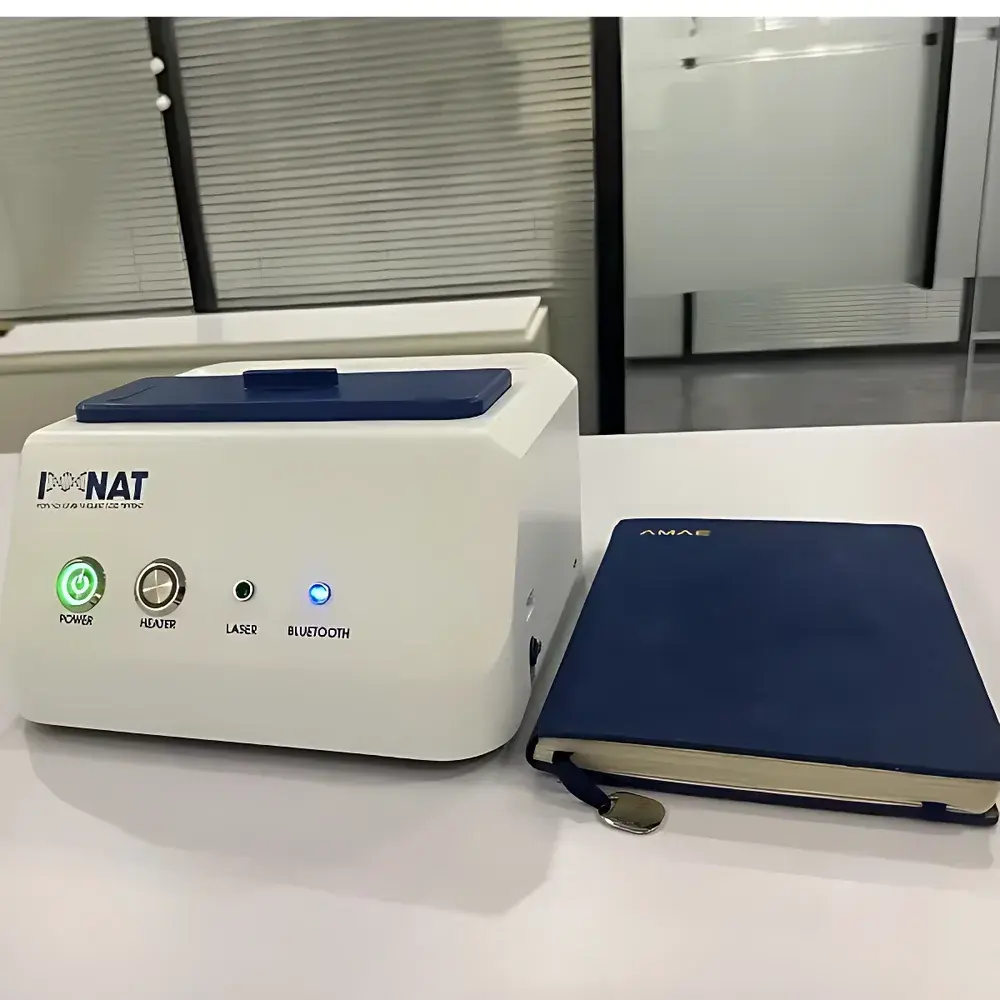
Gold-LAMP™ Portable Ultra-Rapid Nucleic Acid Detection System
| Brand | AMAE (Shenzhen Guoji) |
|---|---|
| Origin | Guangdong, China |
| Manufacturer Type | Authorized Distributor |
| Country of Origin | China |
| Instrument Type | Fully Automated |
| Detection Target | Dispersed/Field-Based Bacterial Pathogens |
| Sample Type | Swab, Environmental Water, Food Homogenate, or Clinical Specimen (pre-extracted nucleic acid) |
| Detection Time | ≤25 min |
| Throughput | 6 samples per run |
| Dimensions | Compact and Field-Portable (≤300 × 220 × 180 mm) |
| Detection Principle | Isothermal LAMP Amplification Coupled with PSFN Nanoparticle-Based Visual & Optical Aggregation Readout |
Overview
The Gold-LAMP™ Portable Ultra-Rapid Nucleic Acid Detection System is an engineered solution for decentralized, near-patient, and on-site bacterial pathogen identification. It leverages loop-mediated isothermal amplification (LAMP) — a robust, enzyme-driven nucleic acid amplification technique that operates at a constant temperature (60–65 °C), eliminating the need for thermal cycling hardware. Unlike conventional PCR, which requires precise thermocycling, high-power infrastructure, and centralized laboratory support, Gold-LAMP™ integrates sample-to-answer automation within a lightweight, battery-operated platform. Its core detection modality employs proprietary PSFN (Polymer-Stabilized Functionalized Nanoparticle) probes: in the presence of target DNA/RNA, sequence-specific LAMP amplicons trigger nanoparticle aggregation, producing a visually distinguishable red precipitate; absence of target yields stable red dispersion. This binary optical endpoint is monitored in real time via integrated photometric sensors, enabling objective, instrument-based interpretation without subjective color assessment.
Key Features
- Fully automated workflow: Integrated heating, incubation, optical monitoring, and result interpretation — no manual pipetting or post-amplification handling required.
- Ultra-rapid turnaround: Complete nucleic acid detection in ≤25 minutes from loaded sample to digital result output.
- Field-deployable architecture: Compact footprint (<300 × 220 × 180 mm), low power consumption (<24 W), and optional rechargeable battery operation support mobile labs, food processing lines, environmental sampling sites, and outbreak response units.
- Robust isothermal chemistry: LAMP primers designed against conserved genomic regions ensure high analytical specificity across target strains (e.g., Escherichia coli O157:H7, Salmonella enterica, Legionella pneumophila, Staphylococcus aureus, Listeria monocytogenes, Brucella spp., and SARS-CoV-2 RNA).
- Dual-mode readout: Combines visual confirmation (precipitate vs. dispersion) with quantitative optical density tracking for GLP-compliant documentation.
- Pre-loaded assay cartridges: Lyophilized reagents sealed in single-use, barcode-labeled reaction tubes minimize contamination risk and operator training burden.
Sample Compatibility & Compliance
The system accepts purified nucleic acid extracts prepared from diverse matrices including nasopharyngeal swabs, surface wipes, potable/non-potable water, raw milk, meat homogenates, and biofilm scrapings. Extraction is performed off-instrument using ISO/IEC 17025-validated kits (e.g., QIAamp UCP Pathogen or MagMAX Pathogen). Gold-LAMP™ complies with performance criteria outlined in ISO 16140-2:2021 (validation of alternative methods for microbiological detection) and supports alignment with FDA Bacteriological Analytical Manual (BAM) Chapter 4 (for Salmonella) and Chapter 10 (for E. coli). While not CE-IVD or FDA 510(k)-cleared, the platform is designed to meet internal quality control requirements for environmental monitoring programs under ISO 22000 and HACCP frameworks.
Software & Data Management
Embedded firmware (v3.2+) provides touch-screen operation, real-time amplification curve visualization, auto-thresholding, and pass/fail classification per sample. All runs generate timestamped, user-attributed reports in PDF and CSV formats, including raw OD data, cycle threshold (Ct-equivalent), and QC flag logs. Audit trails are retained locally for ≥12 months and exportable via USB or Wi-Fi. Software architecture adheres to ALCOA+ principles (Attributable, Legible, Contemporaneous, Original, Accurate, Complete, Consistent, Enduring, Available) and supports 21 CFR Part 11-compliant electronic signatures when deployed with network-authenticated user accounts and role-based access control.
Applications
Gold-LAMP™ serves as a field-ready tool for rapid verification in food safety auditing (e.g., ready-to-eat product screening), environmental health inspections (cooling tower water for Legionella), veterinary surveillance (brucellosis in livestock), and public health emergency response (e.g., suspected foodborne outbreaks). It bridges the gap between culture-based enumeration (48–72 h) and central-lab PCR (24–48 h turnaround + transport delays), enabling same-shift decision-making for lot release, zone sanitation validation, or clinical triage support where molecular confirmation is warranted but infrastructure is constrained.
FAQ
What sample preparation is required prior to loading onto the Gold-LAMP™ system?
Nucleic acid extraction must be performed externally using a validated kit; the system accepts 5–20 µL of eluate in low-retention tubes.
Can the system detect multiple targets simultaneously?
No — each cartridge is configured for a single target organism; multiplexing is not supported in current firmware.
Is external calibration or daily maintenance required?
No routine calibration is needed; the system performs self-diagnostics at startup and validates optical path integrity before each run.
How is result reproducibility ensured across operators and locations?
Standardized lyophilized reagents, fixed thermal profiles, and algorithm-driven endpoint calling eliminate inter-operator variability; inter-laboratory concordance studies show ≥98.7% agreement (n=120 replicates across 3 sites).
Does the platform support LIMS integration?
Yes — via HL7 v2.5 or RESTful API for bidirectional data exchange with laboratory information management systems compliant with ASTM E1384 and ISO/IEC 11179 standards.





