
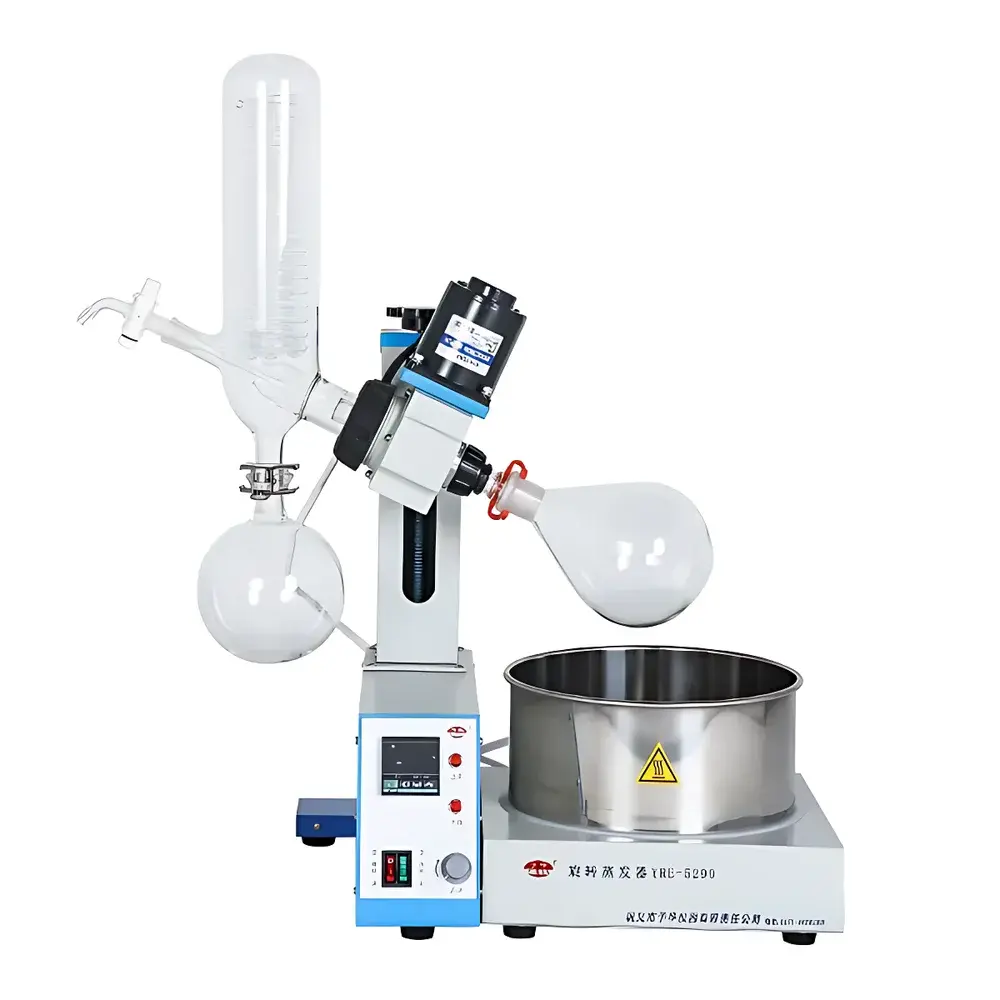
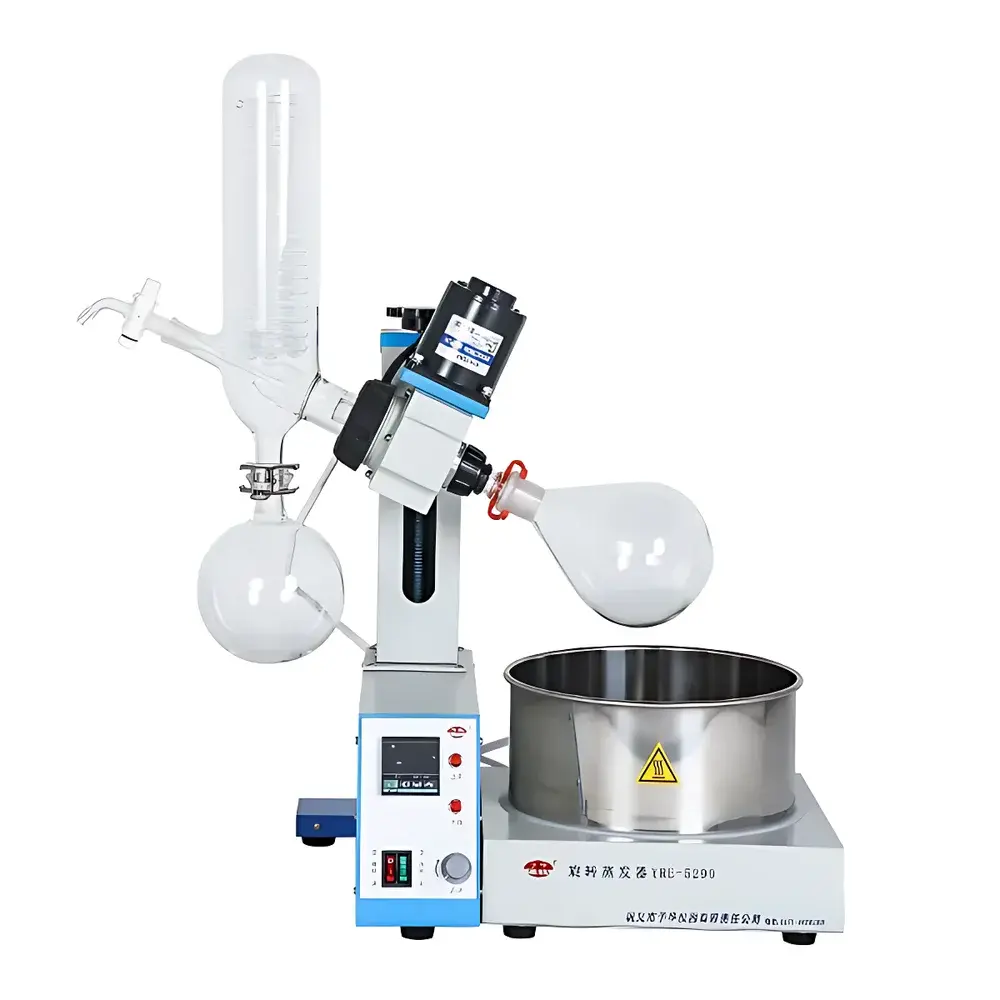
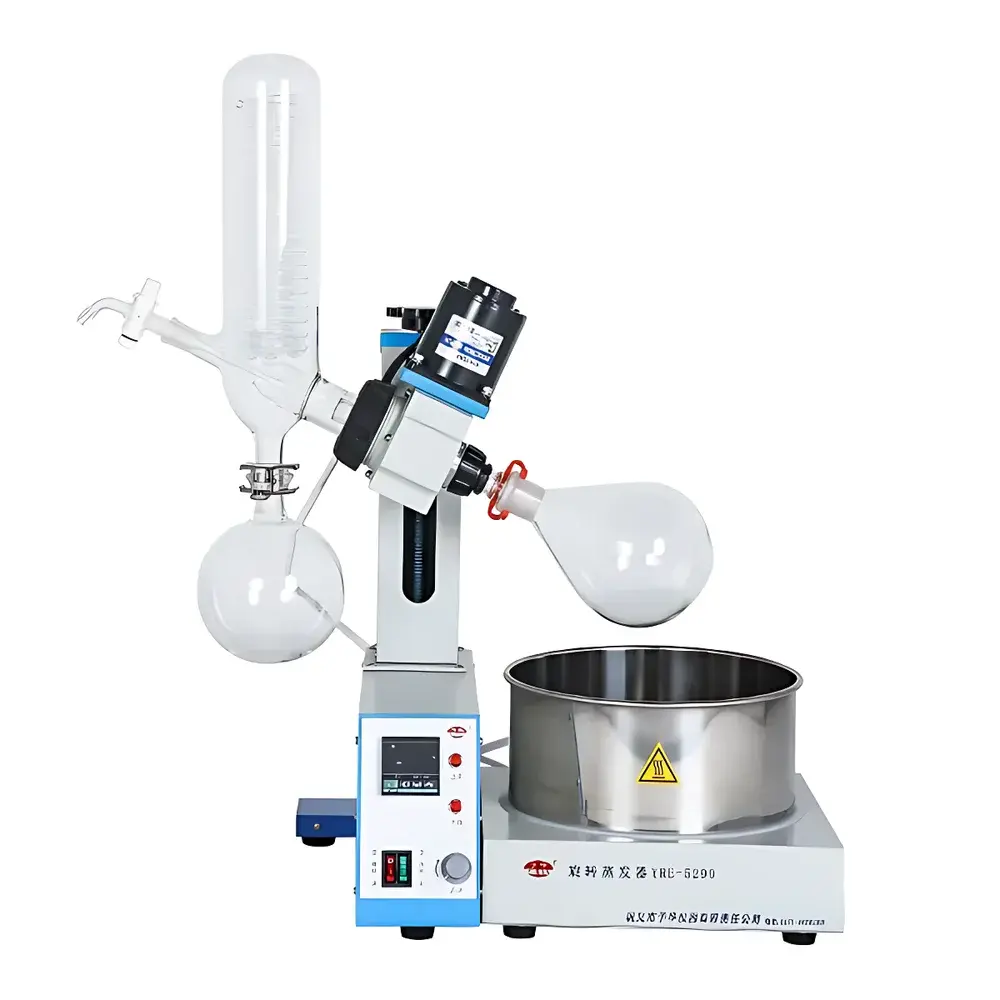
Gongyi Yuhua YRE-5299 Benchtop Rotary Evaporator
| Brand | Gongyi Yuhua Instrument |
|---|---|
| Origin | Henan, China |
| Model | YRE-5299 |
| Capacity | 1 L (standard), optional 2 L |
| Ultimate Vacuum | −0.098 MPa |
| Rotation Speed | 0–120 rpm (stepless) |
| Bath Temperature Range | Ambient to 99 °C |
| Temperature Control Accuracy | ±2 °C |
| Motor Power | 40 W |
| Total Power Consumption | 1000 W |
| Voltage/Frequency | 220 V / 50 Hz |
| Vertical Lift | 150 mm (motorized) |
| Condenser Type | Dual-layer vertical coil |
| Material of Contact Parts | High-borosilicate glass (3.3) and PTFE |
Overview
The Gongyi Yuhua YRE-5299 is a compact, benchtop rotary evaporator engineered for precision solvent removal, concentration, crystallization, and recovery under controlled vacuum and thermal conditions. It operates on the principle of thin-film evaporation: under reduced pressure (down to −0.098 MPa), a rotating evaporation flask spreads sample solution into a uniform, high-surface-area film along its inner wall; simultaneous heating via an intelligent thermostatic water or oil bath promotes rapid, gentle volatilization of low-boiling solvents. Vapor travels through a dual-layer vertical condenser—optimized for high thermal efficiency—and condenses into liquid phase before collection in a standardized 500 mL receiving flask. Designed specifically for R&D laboratories and pilot-scale purification workflows, the YRE-5299 prioritizes operational safety, material compatibility, and reproducibility across sensitive applications in pharmaceutical development, natural product isolation, polymer synthesis, and quality control testing.
Key Features
- Benchtop footprint with motorized vertical lift (150 mm travel) for precise, repeatable flask positioning and safe operation without manual adjustment.
- Stepless speed control (0–120 rpm) via intuitive front-panel knob, enabling optimal film formation across diverse viscosities—from aqueous buffers to viscous organic extracts.
- Thermostatic bath with ±2 °C temperature stability over 20–99 °C range; compatible with both water and silicone oil media for extended high-temperature operation.
- All fluid-contact components fabricated from DIN ISO 3585-certified borosilicate 3.3 glass and PTFE—resistant to thermal shock, strong acids/bases, and common organic solvents including chlorinated and aromatic compounds.
- Integrated vacuum sealing system with reinforced PTFE stopcocks and ground-glass joints (ISO K 29/32 standard), minimizing leakage and ensuring long-term vacuum integrity.
- Low-noise, brushless DC drive motor (40 W) delivering consistent torque and extended service life—designed for continuous operation up to 8 hours per session.
Sample Compatibility & Compliance
The YRE-5299 accommodates samples ranging from 100 mL to 2 L (with optional 2 L flask), supporting both small-volume analytical prep and early-stage process optimization. Its inert wetted path meets general requirements for GLP-compliant documentation environments when paired with external vacuum controllers and calibrated temperature probes. While not certified to ISO/IEC 17025 or FDA 21 CFR Part 11 out-of-the-box, the instrument’s mechanical design and material traceability support audit-ready installation qualification (IQ) and operational qualification (OQ) protocols. It complies with IEC 61010-1:2010 for laboratory electrical safety and CE-marked electromagnetic compatibility (EMC) standards. Routine use in environmental analysis (e.g., EPA Method 3510C), food extract concentration (AOAC 984.27), and pharmaceutical intermediate purification aligns with ASTM E2656 and USP guidance on solvent recovery systems.
Software & Data Management
The YRE-5299 is a standalone analog-controlled unit with no embedded digital interface or data logging capability. Temperature and rotation settings are manually adjusted and monitored via analog dials and visual indicators. For laboratories requiring electronic recordkeeping, integration with third-party vacuum controllers (e.g., Vacuubrand VRD/PC series) and PT100-compatible bath thermometers enables external data capture via USB or RS-485. Users implementing 21 CFR Part 11 compliance may deploy validated external acquisition software (e.g., LabVIEW-based SCADA or DeltaV modules) to log setpoints, runtime, and bath temperature profiles—provided hardware timestamps and user authentication layers are implemented at the system level.
Applications
- Concentration of heat-labile biomolecules (e.g., peptides, enzymes, nucleic acid fractions) without denaturation.
- Solvent exchange in synthetic chemistry workflows—removal of THF, dichloromethane, or ethyl acetate prior to lyophilization or column chromatography.
- Recovery and reuse of high-purity solvents in QC labs to reduce operational costs and hazardous waste generation.
- Preparative isolation of essential oils, flavonoids, and alkaloids from botanical extracts under mild vacuum and sub-boiling conditions.
- Drying of moisture-sensitive catalysts and metal-organic frameworks (MOFs) following solvent-assisted synthesis.
FAQ
What is the maximum recommended working volume for the standard YRE-5299 configuration?
The standard evaporation flask is rated for 1 L capacity, with optimal performance achieved at 40–60% fill level (i.e., 400–600 mL). Overfilling beyond 700 mL increases bumping risk and reduces film uniformity.
Can the YRE-5299 be used with corrosive solvents such as concentrated HCl or bromine-containing reagents?
While the borosilicate glass and PTFE components resist most organics and dilute mineral acids, prolonged exposure to fuming HCl, hydrofluoric acid, or halogenated oxidizers is not recommended. Always consult chemical compatibility charts for specific solvent–material interactions.
Is external vacuum regulation supported?
Yes—the unit includes a standard 10 mm vacuum port compatible with diaphragm pumps, oil-sealed rotary vane pumps, and programmable vacuum controllers equipped with analog feedback.
Does the instrument include a chiller connection for the condenser?
No. The vertical dual-layer condenser relies on ambient air cooling or optional external coolant circulation via 8 mm OD tubing ports (adapters sold separately).
What maintenance intervals are recommended for long-term reliability?
Inspect PTFE seals and ground-glass joints every 200 operating hours; lubricate with high-vacuum grease (e.g., Dow Corning HV 200). Calibrate bath temperature annually using a NIST-traceable thermometer.



