
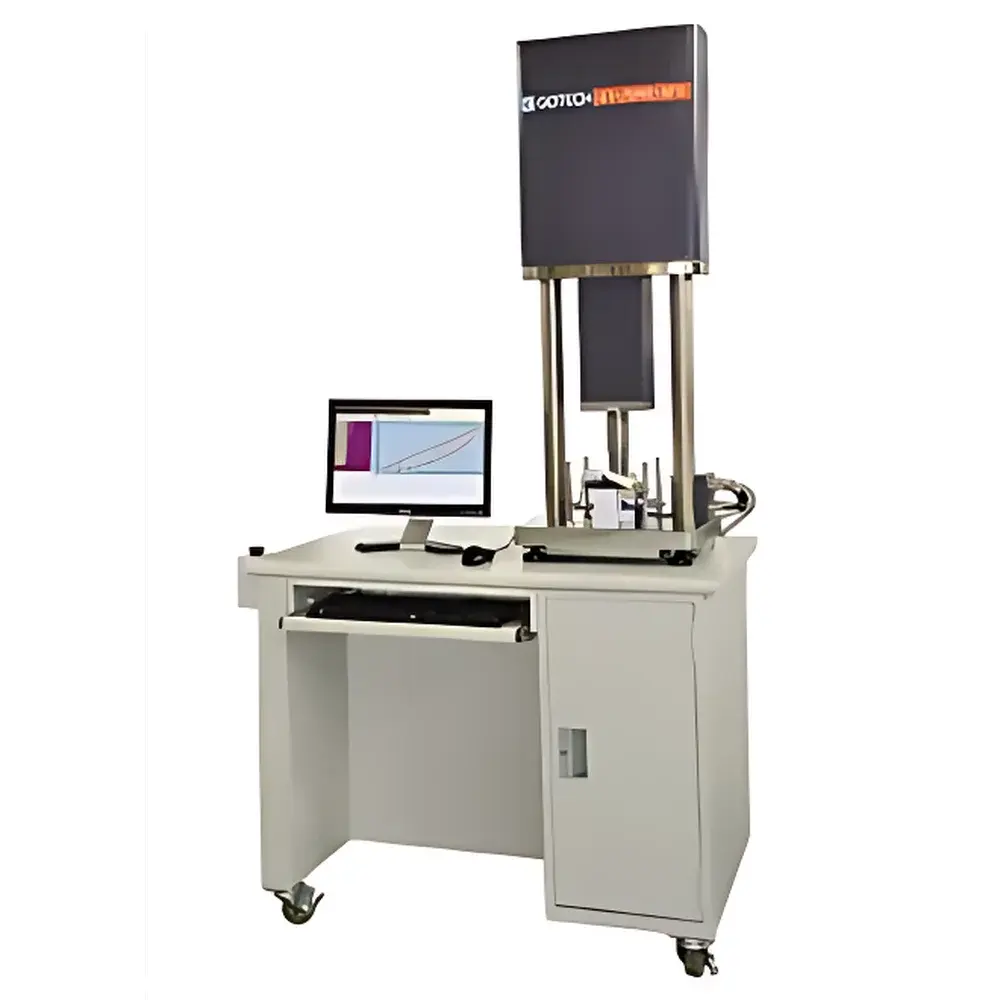
GOTECH GT-7042-AF2 Athletic Footwear Shock Absorption Testing Machine
| Brand | GOTECH TESTING MACHINES CO., LTD. |
|---|---|
| Origin | Guangdong, China |
| Manufacturer Type | OEM/ODM Manufacturer |
| Country of Origin | China |
| Model | GT-7042-AF2 |
| Pricing | Upon Request |
Overview
The GOTECH GT-7042-AF2 Athletic Footwear Shock Absorption Testing Machine is a precision-engineered dynamic impact tester designed to quantify the shock absorption performance of midsole materials used in competitive running footwear. It operates on the principle of controlled vertical drop-weight impact, measuring real-time force–displacement response under standardized high-speed loading conditions (typically 3–6 m/s impact velocity, simulating heel-strike kinetics during sprint or endurance running). The system captures transient mechanical behavior—including peak deceleration, energy dissipation ratio, rebound resilience, and hysteresis loop area—enabling objective evaluation of viscoelastic damping characteristics critical to injury prevention and athletic performance optimization. Engineered for reproducibility and traceable calibration, the GT-7042-AF2 supports compliance-driven testing protocols required by international sports equipment standards and quality assurance frameworks.
Key Features
- Programmable drop-mass impact system with adjustable mass (5–20 kg) and height (100–800 mm), enabling simulation of physiological loading ranges across athlete weight classes and gait phases.
- High-frequency force transducer (≥10 kHz sampling rate) integrated with low-latency data acquisition module for accurate capture of transient impact peaks and sub-millisecond deformation events.
- Non-contact displacement sensor (LVDT or laser triangulation) synchronized with force measurement to generate true force–displacement curves without mechanical interference.
- Rigid C-frame structural design with vibration-damped base and reinforced load-bearing columns, minimizing frame deflection and ensuring measurement stability under repeated high-energy impacts.
- Modular test fixture interface accommodating standardized midsole specimens (ASTM F1976-compliant dimensions) as well as whole-shoe configurations with adjustable foot-form mounting plates.
- Onboard digital display with real-time waveform visualization, configurable pass/fail thresholds, and automatic report generation per test cycle.
Sample Compatibility & Compliance
The GT-7042-AF2 accommodates a broad range of specimen formats including cut midsole slabs (100 × 100 × 25 mm), molded EVA/PU/TPE foam cores, and assembled footwear units mounted on anthropometric foot forms. It supports testing in accordance with ASTM F1976 (“Standard Test Method for Measuring the Shock-Absorbing Properties of Athletic Shoe Midsoles”), ISO 20344:2021 (Personal protective footwear — Test methods), and GB/T 3903.16–2017 (Footwear — Test methods for sole — Part 16: Shock absorption). All mechanical components are traceably calibrated using NIST-traceable reference masses and certified force standards. The system architecture permits integration into GLP-compliant laboratory environments, with optional audit trail logging and user access control for regulated QA/QC operations.
Software & Data Management
The GT-7042-AF2 is compatible with GOTECH’s proprietary WinTest Pro v4.x software suite, which provides advanced post-processing capabilities including hysteresis loop analysis, energy loss percentage calculation, damping coefficient derivation, and comparative overlay of multiple material batches. Raw time-series data (force, displacement, acceleration) are exported in CSV and MATLAB-compatible MAT formats. Software features include automated ISO/ASTM report templates, statistical process control (SPC) charts, and export-ready PDF documentation with embedded metadata (operator ID, calibration date, environmental conditions). For enterprise deployment, the system supports OPC UA connectivity and can be integrated into centralized LIMS platforms compliant with FDA 21 CFR Part 11 requirements when configured with electronic signature modules and audit trail enablement.
Applications
- Midsole material development: Comparative evaluation of novel foams (e.g., PEBA-based elastomers, nitrogen-infused EVA, thermoplastic polyurethane blends) for energy return and cushioning consistency.
- Quality control in footwear manufacturing: Batch-to-batch verification of shock absorption performance prior to final assembly and packaging.
- Sports science research: Correlation of mechanical damping metrics with biomechanical outcomes such as ground reaction force attenuation and tibial shock transmission.
- Regulatory certification support: Generation of test evidence for CE marking, CCC certification, and third-party conformity assessments by CNAS-accredited laboratories.
- Academic and governmental metrology labs: Reference testing for inter-laboratory proficiency studies and standard method validation programs.
FAQ
What standards does the GT-7042-AF2 comply with for athletic footwear testing?
It supports ASTM F1976, ISO 20344:2021, and GB/T 3903.16–2017, with hardware and software calibrated per ISO/IEC 17025 requirements.
Can the system test complete shoes, not just midsole samples?
Yes—using optional foot-form fixtures and adjustable clamping assemblies, it accommodates whole-shoe impact testing per ASTM F2569 and EN 13287 protocols.
Is the force transducer factory-calibrated and traceable?
All force sensors are supplied with NIST-traceable calibration certificates valid for 12 months; recalibration services are available through GOTECH’s authorized service centers.
Does the software meet regulatory requirements for electronic records?
When deployed with WinTest Pro v4.x in audit mode, it satisfies FDA 21 CFR Part 11 criteria for electronic signatures, audit trails, and data integrity controls.
What maintenance is required to ensure long-term measurement accuracy?
Routine verification includes annual transducer recalibration, periodic mechanical alignment checks, and biannual verification of drop-height repeatability using optical encoder feedback.



