
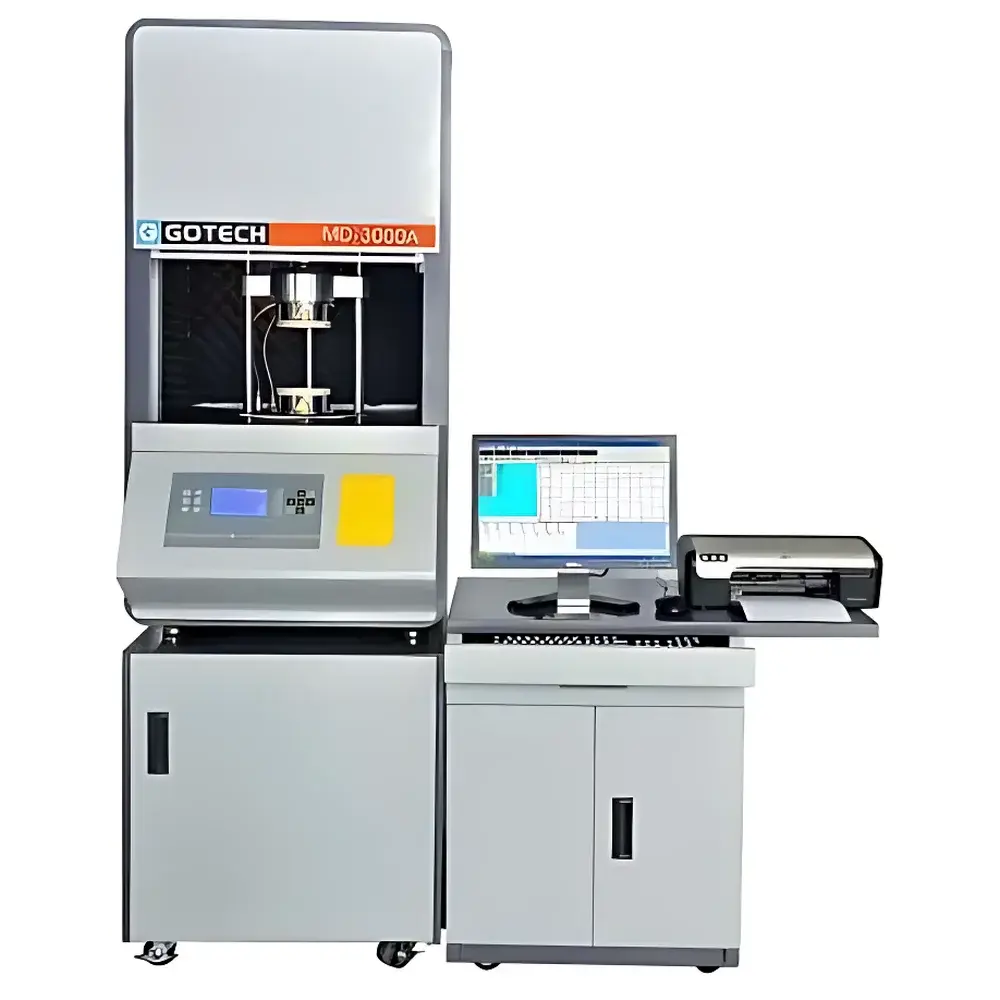
GOTECH MD-3000-A Direct-Drive Rotorless Rheometer
| Brand | GOTECH TESTING MACHINES CO., LTD. |
|---|---|
| Origin | Taiwan |
| Manufacturer Type | Authorized Distributor |
| Product Category | Domestic (China Market) |
| Model | MD-3000-A |
| Pricing | Upon Request |
| Standard Compliance | ASTM D5289, GB/T 16584, ISO 6502 |
| Temperature Range | Ambient to 230 °C |
| Torque Range (Elastic) | 1–200 lb-in |
| Torque Range (Viscous) | 0.3–200 lb-in |
| Torque Resolution | 0.001 unit (selectable unit: kg-cm, lb-in, N·m, dN·m) |
| Oscillation Frequency | 10–300 cpm |
| Oscillation Angle | ±0.2° to ±3.0° (0.001° digital resolution, software-defined) |
| Temperature Accuracy | ±0.3 °C |
| Temperature Readout Resolution | 0.1 °C |
| Heating Rate | 30 °C to 190 °C in <5 min 30 sec |
| Temperature Stabilization Time (post-closing) | ≤50 sec to ±0.3 °C |
| Die Configuration | Fully sealed cavity with O-ring isolation |
| Maximum Applied Force | 0–1000 kg |
| Actuation System | Direct-drive servo motor |
| Control Core | DSP-based real-time processor with DFT algorithm implementation |
| Power Supply | 1-phase AC 220 V ±10%, 50/60 Hz, 10 A |
| Dimensions (W×D×H) | 68 × 80 × 130 cm |
| Weight | 220 kg |
Overview
The GOTECH MD-3000-A Direct-Drive Rotorless Rheometer is a precision-engineered instrument designed for dynamic vulcanization characterization of uncured and partially cured rubber compounds. It operates on the principle of controlled oscillatory shear deformation within a sealed die cavity, measuring torque response as a function of time, temperature, and oscillation parameters. Unlike conventional cam-driven rotorless rheometers, the MD-3000-A employs a brushless direct-drive servo motor coupled to a high-resolution angular encoder, eliminating mechanical backlash, eccentricity-induced phase lag, and harmonic distortion inherent in linkage-based systems. This architecture ensures traceable angular displacement control down to 0.001° and enables true small-amplitude oscillatory shear (SAOS) analysis—critical for accurate determination of viscoelastic moduli (G′, G″), complex viscosity (η*), and cure kinetics parameters including scorch time (ts₁, ts₂), optimum cure time (t₉₀), and post-cure stability.
Key Features
- Direct-drive servo actuation system delivering zero-mechanical-play angular control and repeatable oscillation profiles across full frequency (10–300 cpm) and amplitude (±0.2°–±3.0°) ranges
- DSP-based real-time control architecture with discrete Fourier transform (DFT) computation engine for high-fidelity torque signal decomposition into elastic (S′) and viscous (S″) components
- Thermally isolated, O-ring-sealed die assembly ensuring minimal thermal leakage and consistent cavity temperature uniformity (±0.3 °C accuracy, ≤50 s stabilization post-closure)
- Multi-unit torque reporting (kg-cm, lb-in, N·m, dN·m) with 0.001-unit resolution and auto-ranging calibration verification
- Programmable multi-step temperature ramping profiles compliant with ASTM D5289, ISO 6502, and GB/T 16584 test protocols
- Integrated pneumatic clamping system (3.6 kgf/cm² / 0.36 MPa) for reproducible die closure force and gap consistency
- Robust industrial-grade chassis (220 kg mass) minimizing vibration coupling and enhancing measurement stability during long-duration cure monitoring
Sample Compatibility & Compliance
The MD-3000-A accommodates standard 38 mm diameter rubber specimens (ASTM D5289 geometry) and supports both natural rubber (NR), synthetic elastomers (SBR, BR, EPDM, CR, FKM), and filled compound systems—including carbon-black-, silica-, and nanofiller-reinforced formulations. Its sealed die design prevents volatile loss and oxidation during high-temperature cure profiling up to 230 °C. The instrument meets essential regulatory and quality framework requirements: full alignment with ASTM D5289 (Standard Test Method for Rubber Property—Vulcanization Using Rotorless Shear Rheometer), ISO 6502 (Rubber—Determination of Vulcanization Characteristics), and GB/T 16584 (Chinese national standard for rubber vulcanization testing). Data acquisition and storage support audit-ready timestamped records suitable for GLP-compliant laboratories and internal QA/QC workflows.
Software & Data Management
Bundled Windows-based control software provides intuitive test method configuration, real-time torque/temperature curve visualization, and automated parameter extraction (ts₁, ts₂, t₉₀, ΔS′, Mooney scorch index equivalents). Raw data export is supported in CSV and ASCII formats for integration with third-party statistical process control (SPC) platforms or LIMS environments. The system implements secure user-level access control, electronic signature logging, and full audit trail functionality—including operator ID, method version, calibration status, and environmental metadata—enabling compliance with FDA 21 CFR Part 11 requirements where applicable. All firmware and software updates are distributed via authenticated GOTECH technical support channels with version-controlled release notes.
Applications
- Quantitative evaluation of accelerator systems, sulfur donors, and ultra-accelerators in NR and SBR formulations
- Characterization of peroxide-cured elastomers and heat-resistant silicone compounds
- Assessment of filler dispersion efficiency and polymer-filler interaction dynamics via Payne effect analysis
- Process window definition for extrusion, calendering, and injection molding based on minimum viscosity (ML), maximum torque (MH), and scorch safety margin
- Accelerated aging studies through sequential isothermal holds at elevated temperatures
- Raw material qualification and batch-to-batch consistency verification in Tier-1 automotive and aerospace rubber component supply chains
FAQ
What standards does the MD-3000-A comply with for rubber vulcanization testing?
ASTM D5289, ISO 6502, and GB/T 16584 are fully supported through built-in test templates and certified calibration procedures.
Can the instrument perform both timed-cure and temperature-ramp experiments?
Yes—it supports isothermal, multi-step isothermal, and continuous ramp modes with programmable dwell times and rate limits.
Is remote diagnostics or firmware update capability available?
Firmware updates require local USB installation using GOTECH-provided signed binaries; remote desktop-assisted troubleshooting is available under service contract.
What is the recommended maintenance interval for the sealing O-rings and die surfaces?
O-rings should be inspected and replaced every 6 months or after 500 test cycles; die surfaces require cleaning with non-abrasive solvent after each test.
Does the system support integration with laboratory information management systems (LIMS)?
Yes—CSV/ASCII export, time-stamped metadata, and configurable file naming conventions enable seamless ingestion into common LIMS architectures.



