
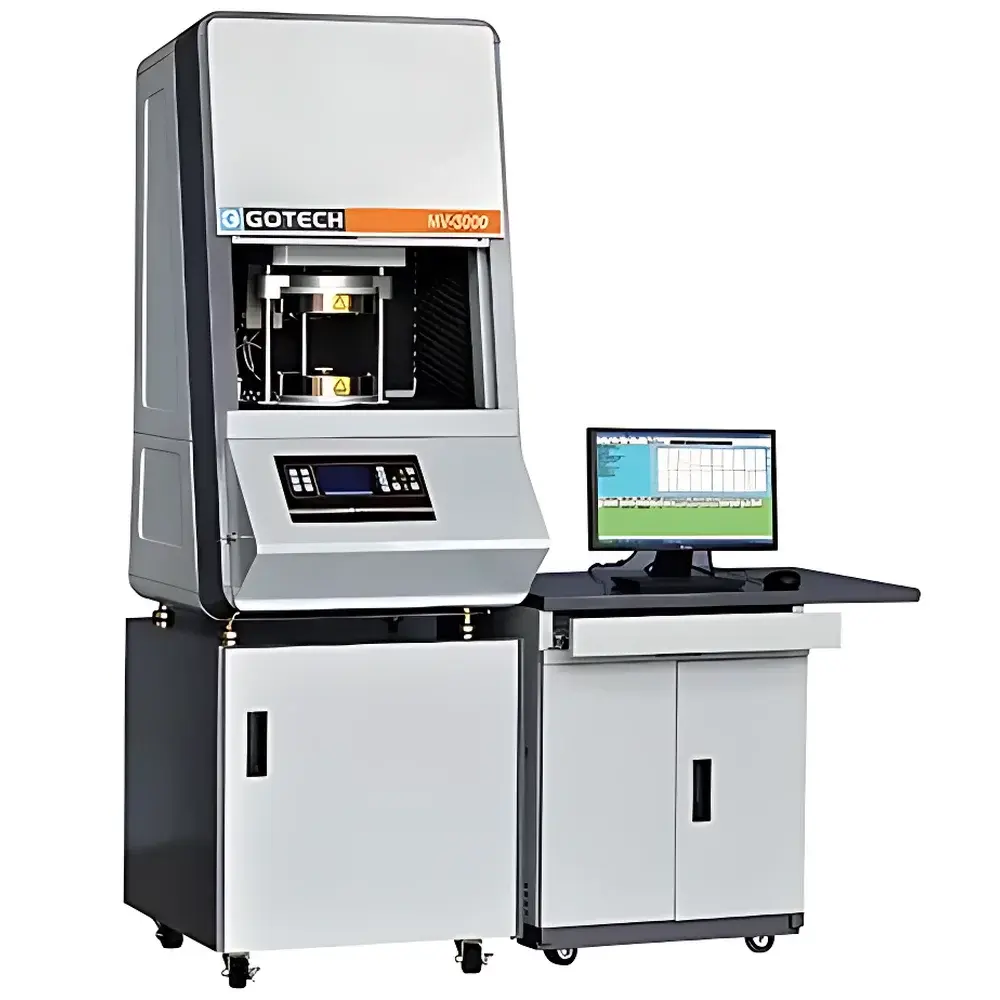
GOTECH MV-3000-A Mooney Viscometer
| Brand | GOTECH TESTING MACHINES CO., LTD. |
|---|---|
| Origin | Taiwan |
| Manufacturer Type | Authorized Distributor |
| Model | MV-3000-A |
| Standards Compliance | ASTM D1646, ISO 289, JIS K6300, GB/T 1232, GB/T 1233 |
| Temperature Control Range | Ambient to 200 °C (±0.3 °C accuracy, Class A sensor, 0.1 °C resolution) |
| Heating Rate | 30–100 °C in <5 min |
| Reheat Time | ≤60 s (from 100 °C to target) |
| Rotor Speed | 2 ± 0.02 rpm (standard) |
| optional variable-speed mode | 0.1–30 rpm (programmable auto-switching) |
| Mooney Range | 1–250 MU |
| Torque Resolution | 0.001 unit (selectable units: kg·cm, lb·in, N·m, dN·m, Mooney) |
| Rotor Types | Large (L) and Small (S) |
| Test Chamber Pressure | 3.6 kgf/cm² (0.36 MPa) |
| Dimensions (W×D×H) | 70 × 81 × 130 cm |
| Weight | 220 kg |
| Power Supply | 1-phase AC 220 V ±10%, 50/60 Hz, 10 A |
Overview
The GOTECH MV-3000-A Mooney Viscometer is a precision-engineered instrument designed for standardized determination of Mooney viscosity and Mooney scorch behavior in raw and compounded rubber compounds. It operates on the principle of rotational viscometry under constrained shear conditions, where a calibrated rotor rotates at a fixed speed (typically 2 rpm) within a sealed, heated cavity containing a defined mass of uncured elastomer. The resulting torque resistance—expressed in Mooney Units (MU)—is directly proportional to the compound’s resistance to deformation under specified thermal and mechanical conditions. This measurement serves as a critical process control parameter during rubber compounding, quality assurance, and formulation development. The MV-3000-A conforms strictly to international test standards including ASTM D1646, ISO 289, JIS K6300, and Chinese national standards GB/T 1232 and GB/T 1233, ensuring data comparability across global laboratories and manufacturing sites.
Key Features
- Integrated microprocessor-based control system with LCD touch interface for intuitive operation and real-time parameter monitoring.
- Automated self-calibration routine—initiated via single-button command—ensuring consistent torque baseline alignment without manual intervention.
- PID + SSR temperature regulation with Class A platinum RTD sensor, delivering ±0.3 °C stability across the full operating range (ambient to 200 °C).
- Dual-rotor compatibility (Large “L” and Small “S”) enables method flexibility per standard requirements or internal protocol adaptation.
- Variable-speed capability (0.1–30 rpm) supports advanced characterization beyond standard Mooney viscosity, including stress relaxation profiling and non-standard scorch kinetics studies.
- High-resolution torque detection (0.001 unit resolution) with multi-unit output (kg·cm, lb·in, N·m, dN·m, MU), facilitating seamless integration into diverse reporting environments.
- Pressurized test chamber (0.36 MPa) ensures uniform sample confinement and eliminates air entrapment artifacts during vulcanization onset detection.
Sample Compatibility & Compliance
The MV-3000-A accommodates natural rubber (NR), synthetic elastomers (SBR, BR, EPDM, NBR, CR), thermoplastic elastomers (TPEs), and masterbatch-loaded compounds. Its mechanical architecture and thermal management system are validated for use with both low-viscosity liquid polymers and highly filled, high-modulus stock formulations. All test procedures align with GLP-aligned laboratory practices; audit trails for calibration events, temperature setpoints, and test parameters are retained internally and exportable for regulatory review. The instrument meets essential electrical safety requirements per IEC 61010-1 and is compatible with laboratory environments operating under ISO/IEC 17025-accredited quality systems.
Software & Data Management
While the MV-3000-A operates autonomously via its embedded controller, it supports RS-232 or optional USB-to-serial connectivity for external data logging and centralized instrument fleet management. Raw torque vs. time datasets—including Mooney viscosity (ML1+4), scorch time (t5, t35), and stress relaxation decay profiles—are timestamped and structured for direct import into LIMS or statistical process control (SPC) platforms. Optional PC software provides graphical overlay, batch comparison, trend analysis, and customizable report generation compliant with FDA 21 CFR Part 11 requirements when paired with user-defined electronic signature workflows.
Applications
- Batch-to-batch consistency verification of incoming raw rubber and polymer feedstocks.
- Optimization of accelerator package selection and cure system design in R&D labs.
- Monitoring of polymer degradation during storage or thermal aging studies.
- Correlation of Mooney values with downstream processing performance (e.g., extrusion swell, calendering behavior, mold fill characteristics).
- Supporting technical documentation for customer specifications, material certifications (e.g., ISO/TS 16949), and supplier qualification audits.
- Teaching and demonstration of rheological fundamentals in polymer engineering curricula.
FAQ
Does the MV-3000-A support automated reporting to enterprise LIMS?
Yes—when connected via serial interface and configured with optional GOTECH DataLink software, test results can be transmitted in CSV or XML format with configurable metadata fields (operator ID, sample ID, lot number, timestamp).
Is rotor calibration traceable to national metrology institutes?
Standard calibration uses NIST-traceable torque reference standards; full calibration certificates (including uncertainty budgets) are available upon request and conform to ISO/IEC 17025 requirements.
Can the instrument perform stress relaxation tests per ASTM D1414?
Yes—the programmable variable-speed mode and high-torque sampling rate (≥10 Hz) enable execution of controlled-strain relaxation protocols with post-test decay curve fitting.
What maintenance intervals are recommended for long-term accuracy?
Daily visual inspection of rotor surfaces and cavity seals; quarterly verification of temperature uniformity and torque linearity; annual full recalibration recommended—or after any mechanical impact or firmware update.
Is the pressure system compatible with nitrogen purging for oxygen-sensitive compounds?
The standard pneumatic circuit is designed for compressed air; however, the chamber sealing interface accepts inert gas manifolds (e.g., N₂) when fitted with optional gas inlet adapters and pressure regulators meeting ISO 8573-1 Class 2 purity specifications.





