

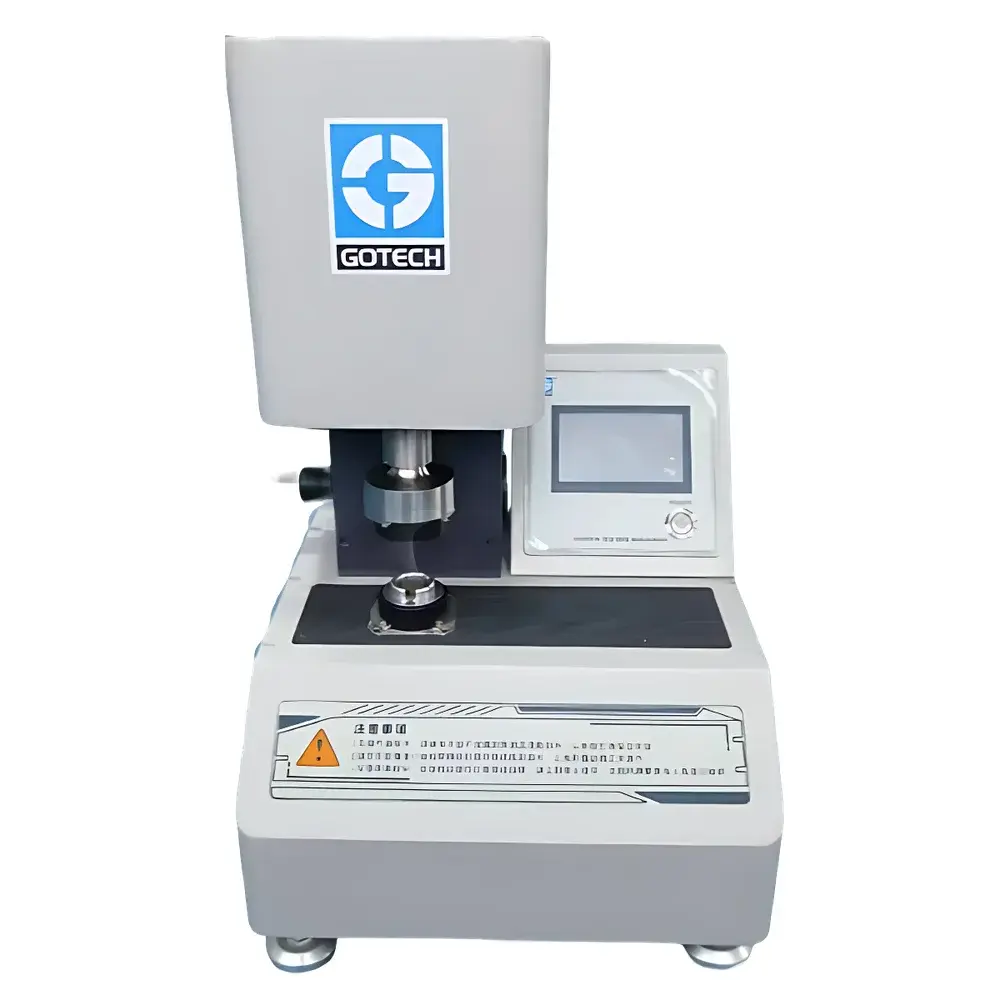
GOTECH Quick Plastometer for Rubber Testing
| Brand | GOTECH TESTING MACHINES CO., LTD. |
|---|---|
| Origin | Taiwan, China |
| Manufacturer Type | Direct Manufacturer |
| Product Category | Domestic (China-market supplied) |
| Model | Quick Plastometer |
| Pricing | Available Upon Request |
Overview
The GOTECH Quick Plastometer is a precision-engineered instrument designed for the standardized determination of plasticity and Plasticity Retention Index (PRI) in raw natural rubber and unvulcanized rubber compounds. It operates on the fundamental principle of compression deformation under controlled temperature and load conditions—specifically conforming to the international methodology defined in ISO 2007 and ASTM D926, and fully aligned with the Chinese national standard GB/T 3517–2022 *Natural Raw Rubber — Determination of Plasticity Retention Index (PRI)* and *Unvulcanized Rubber — Determination of Plasticity — Quick Plastometer Method*. The instrument applies a calibrated compressive force to a cylindrical rubber specimen held at a precisely regulated temperature (typically 100 °C ± 0.5 °C), measures the resulting thickness reduction after a defined dwell time (e.g., 15 min), and calculates plasticity values (P₀, P₁₀, PRI) based on dimensional change. Its robust architecture ensures high reproducibility across laboratories and compliance-ready operation in quality control environments governed by ISO/IEC 17025, GLP, or rubber manufacturing QA/QC protocols.
Key Features
- Fully automated execution of standardized test sequences per GB/T 3517–2022 and industry-adopted quick plastometer procedures
- Configurable reporting modes: single-value, median-value, or mean-value output for statistical consistency verification
- Multi-level precision display: resolution up to 0.01 mm for specimen thickness measurement, supporting traceable calibration documentation
- Real-time digital interface with integrated date/time stamping for audit-trail integrity
- Sample ID registration and embedded data tagging for full sample traceability within QC workflows
- Visual status indication via LED system: operational mode, thermal stabilization, load application, and fault alerts
- Semi-automatic 1 mm gap calibration routine with tactile feedback and on-screen confirmation
- Dual-point temperature verification and offset compensation capability for thermal accuracy validation
- Load calibration function compliant with force transducer traceability requirements (NIST-traceable reference weights optional)
- Built-in self-diagnostic routines covering sensor integrity, thermal uniformity, and mechanical actuation response
- Programmable audible and visual alarm triggers for out-of-spec conditions (e.g., temperature deviation > ±0.5 °C, incomplete compression cycle)
- Context-sensitive on-screen prompts guiding operators through setup, calibration, and test initiation steps
Sample Compatibility & Compliance
The GOTECH Quick Plastometer accommodates standard cylindrical specimens (16 mm diameter × 10 mm height) prepared from natural rubber (RSS, SMR, or equivalent grades) and synthetic unvulcanized elastomers including SBR, BR, and EPDM—provided they meet minimum green strength and thermal stability thresholds for reliable compression response. All test parameters—including preheating duration, compression load (typically 49.03 N ± 0.25 N), dwell time (15 min), and cooling protocol—are programmable to support method adaptation across material classes. The system meets structural and procedural requirements for ISO/IEC 17025-accredited testing laboratories and supports documentation necessary for internal audits, customer qualification, and regulatory submissions under IATF 16949 and APQP frameworks.
Software & Data Management
Equipped with embedded firmware supporting USB data export (CSV format), the instrument enables seamless integration into LIMS or ERP environments. Test records include timestamped metadata (operator ID, sample batch, environmental chamber temp, calibration certificate IDs), raw displacement readings, calculated P₀/P₁₀/PRI values, and pass/fail flags against user-defined specification limits. Audit trail functionality complies with FDA 21 CFR Part 11 principles where electronic records are deployed—supporting role-based access control, electronic signatures (via external authentication), and immutable log archiving. Optional PC-based software provides advanced statistical process control (SPC) charting, trend analysis across production lots, and automated report generation aligned with internal SOPs or customer-facing quality dossiers.
Applications
- Raw material acceptance testing of natural rubber bales and synthetic rubber stocks prior to mixing
- Batch-to-batch consistency monitoring during compound preparation and masterbatch development
- PRI evaluation for antioxidant efficacy assessment in R&D and formulation optimization
- Process validation for rubber drying, milling, and storage conditions affecting plasticity decay
- Supplier qualification and third-party certification testing per ISO 2007, GB/T 3517–2022, and JIS K 6218
- Technical support for rubber product manufacturers requiring documented plasticity profiles for tire treads, conveyor belts, and industrial hoses
FAQ
What standards does the GOTECH Quick Plastometer comply with?
It fully implements GB/T 3517–2022, ISO 2007, ASTM D926, and JIS K 6218, and was co-developed with input from national standardization committees.
Is temperature calibration traceable to national standards?
Yes—integrated PT100 sensors support two-point calibration using certified reference thermometers; calibration certificates are exportable and compatible with ISO/IEC 17025 documentation templates.
Can test results be exported directly to Excel or LIMS?
Yes—USB-host interface enables direct CSV export; no proprietary software required for basic data retrieval.
Does the instrument support multi-user operation with access levels?
Firmware supports operator-level password protection; full role-based permissions (admin/operator/auditor) require optional PC software module.
What maintenance intervals are recommended for long-term accuracy?
Load cell and thermal sensor verification every 6 months; mechanical gap check before each shift; annual full metrological recalibration advised for GLP/GMP environments.





