
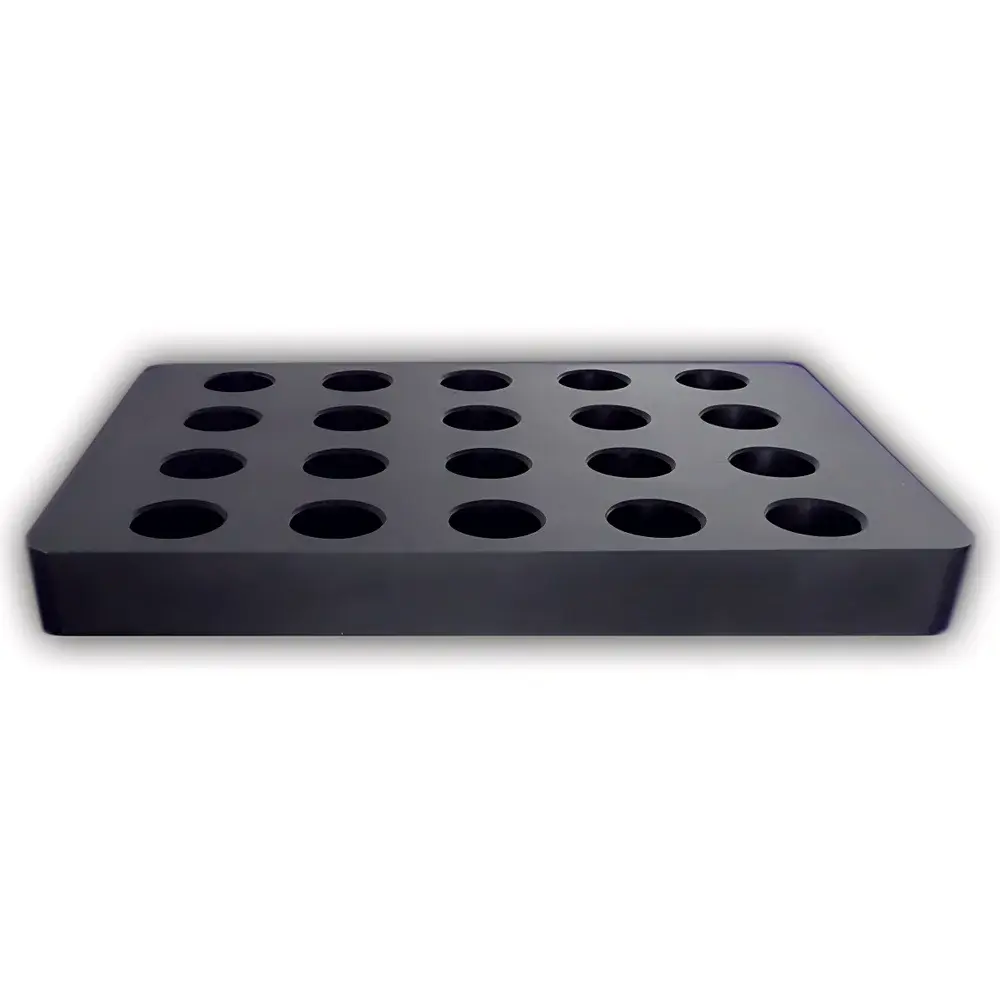
GP ED20 Electric Acid Evaporation Block
| Brand | GP |
|---|---|
| Origin | Sichuan, China |
| Manufacturer Type | Authorized Distributor |
| Country of Origin | China |
| Model | ED20 |
| Instrument Type | Electric Heating Acid Evaporation System |
| Heating Plate Compatibility | Designed for use atop standard laboratory electric hot plates |
| Sample Capacity | 20 positions |
| Well Diameter | 40 mm (custom diameters available) |
| Working Surface Dimensions | 280 × 300 mm |
| Heating Block Material Options | Anodized Aluminum or Graphite |
Overview
The GP ED20 Electric Acid Evaporation Block is a precision-engineered auxiliary device designed specifically for post-microwave digestion acid removal—commonly referred to as “acid evaporation” or “acid fuming”—in elemental analysis workflows. Unlike integrated electric digestion systems, the ED20 functions as a passive, modular heating platform that mounts directly onto existing laboratory electric hot plates. Its core purpose is to provide uniform, controllable thermal energy across multiple digestion vessels (e.g., Teflon®-lined PFA or quartz tubes, microwave digestion rotors) to accelerate the volatilization of residual nitric, hydrochloric, or hydrofluoric acids following closed-vessel microwave-assisted digestion. This step is critical prior to dilution and instrumental analysis by Atomic Absorption Spectroscopy (AAS), Inductively Coupled Plasma Mass Spectrometry (ICP-MS), or Inductively Coupled Plasma Atomic Emission Spectroscopy (ICP-AES). The ED20’s design emphasizes thermal stability, chemical inertness, and positional repeatability—ensuring consistent evaporation kinetics across all 20 sample wells without cross-contamination or hot-spot formation.
Key Features
- Modular 20-position configuration with standardized 40 mm well diameter—compatible with common microwave digestion tube formats (e.g., Milestone UltraWave, CEM Mars 6, Anton Paar Multiwave PRO rotors)
- Two material options: high-purity anodized aluminum (lightweight, rapid thermal response) or dense, low-outgassing graphite (superior thermal mass, enhanced acid resistance for aggressive HF/HNO₃ mixtures)
- Optimized working surface (280 × 300 mm) engineered for stable placement on standard 300 × 300 mm or larger electric hot plates; includes non-slip silicone feet and chamfered edges for safe handling
- No embedded electronics or power supply—eliminates electromagnetic interference risks near sensitive ICP or MS instrumentation
- Chemically resistant surface finish: hard-anodized aluminum meets ASTM B580 Class II specifications; graphite blocks undergo high-temperature graphitization and are certified for ≤10 ppt metal blank levels
- Interchangeable well inserts available (PTFE, quartz, borosilicate glass) to support method-specific vessel compatibility and contamination control
Sample Compatibility & Compliance
The ED20 supports a wide range of digestion vessel types used in accredited environmental, geochemical, clinical, and food testing laboratories—including EPA Method 3050B/3052, ISO 11466, and USP /. Its open architecture allows direct visual monitoring of evaporation endpoints, facilitating adherence to SOPs requiring endpoint determination by visual clarity or volume reduction ratio (e.g., final volume ≤ 0.5 mL per tube). When deployed in GLP- or GMP-regulated environments, the block may be included in equipment qualification protocols (IQ/OQ/PQ) alongside the host hot plate. While the ED20 itself carries no CE or UL certification (as it is a passive thermal interface), its material certifications—aluminum per RoHS Directive 2011/65/EU and graphite per ISO 8502-9 for soluble salt contamination—are documented in supplied material traceability reports.
Software & Data Management
As a hardware-only thermal interface, the ED20 does not incorporate onboard software, firmware, or digital connectivity. All process parameters—including ramp rate, hold temperature, and duration—are controlled externally via the connected electric hot plate’s interface. For labs operating under FDA 21 CFR Part 11 requirements, electronic records of evaporation conditions must be captured manually or via hot plate data logging systems (e.g., LabVIEW-integrated controllers or Mettler Toledo HX204 thermorecorders). Batch-level documentation—such as vessel ID mapping, acid removal time stamps, and final residue volume—is maintained in LIMS or ELN platforms using standardized templates aligned with ISO/IEC 17025 clause 7.5.2.
Applications
- Routine acid removal after microwave digestion of soil, sediment, and sludge samples per EPA 3052 for multi-element ICP-MS quantification
- Trace metal analysis in biological tissues (liver, kidney, blood) where low Hg, As, and Cd blanks are essential
- High-throughput preparation of geological reference materials (e.g., NIST SRM 2711a) requiring reproducible matrix removal
- Method development for hydride-generation AAS (e.g., As, Se, Sb) where incomplete acid removal causes signal suppression
- Supporting ISO 17294-2 compliant water analysis workflows involving pre-concentration steps
FAQ
Is the ED20 compatible with all microwave digestion systems?
Yes—the 40 mm well spacing and depth accommodate standard rotor tubes from CEM, Milestone, Anton Paar, and PerkinElmer platforms. Custom well patterns (e.g., 16-position hexagonal layout) are available upon request.
Can the ED20 be used with hydrofluoric acid (HF)?
Only when equipped with graphite heating blocks and PTFE or quartz inserts. Aluminum blocks are not recommended for HF exposure due to corrosion risk.
Does the ED20 require calibration?
No independent calibration is required; however, users must verify thermal uniformity across all 20 wells using calibrated PT100 probes per ISO/IEC 17025 Annex A.3 guidelines before first use and semiannually thereafter.
What safety precautions apply during operation?
Always operate within a certified fume hood rated for acid vapors. Use acid-resistant gloves and face shields. Never leave unattended during active evaporation of oxidizing acids.
Is technical support available for method transfer?
GP provides application notes and evaporation protocol templates for common matrices (soil, plant tissue, wastewater), including recommended hot plate temperature profiles and endpoint criteria.



