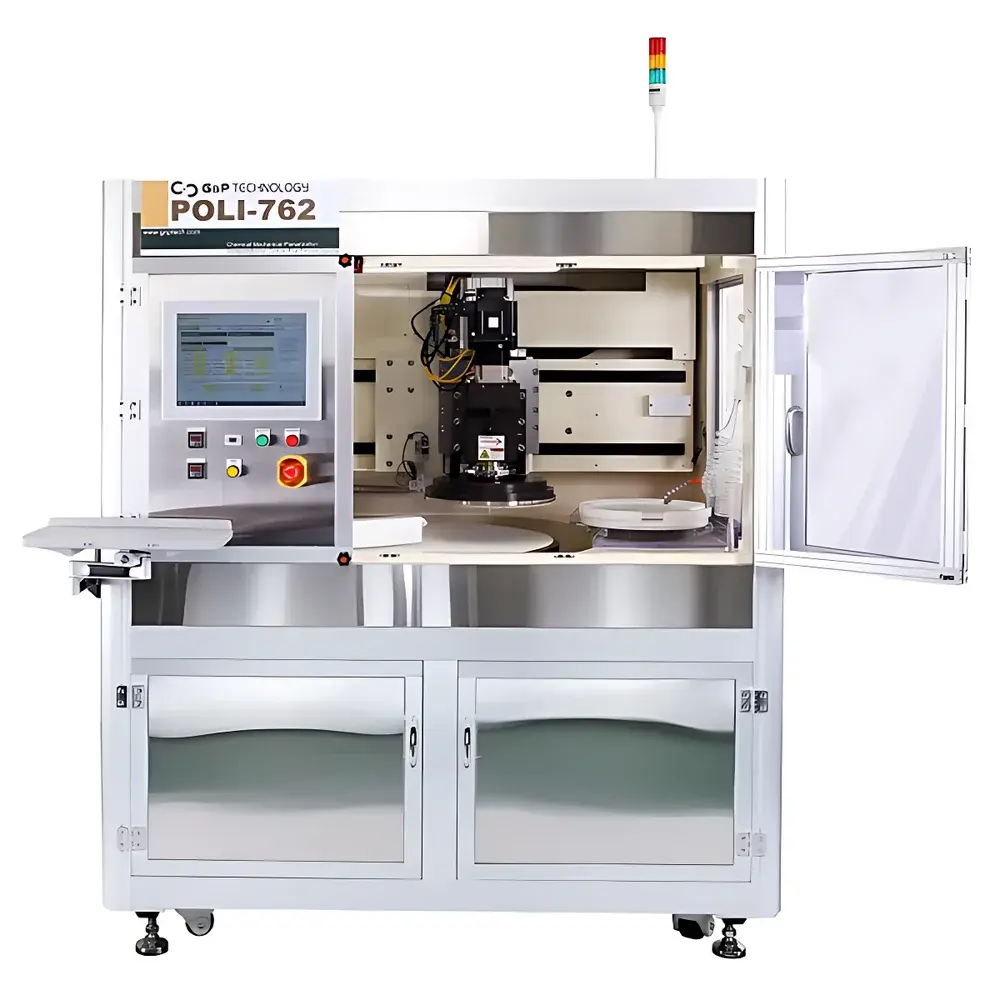
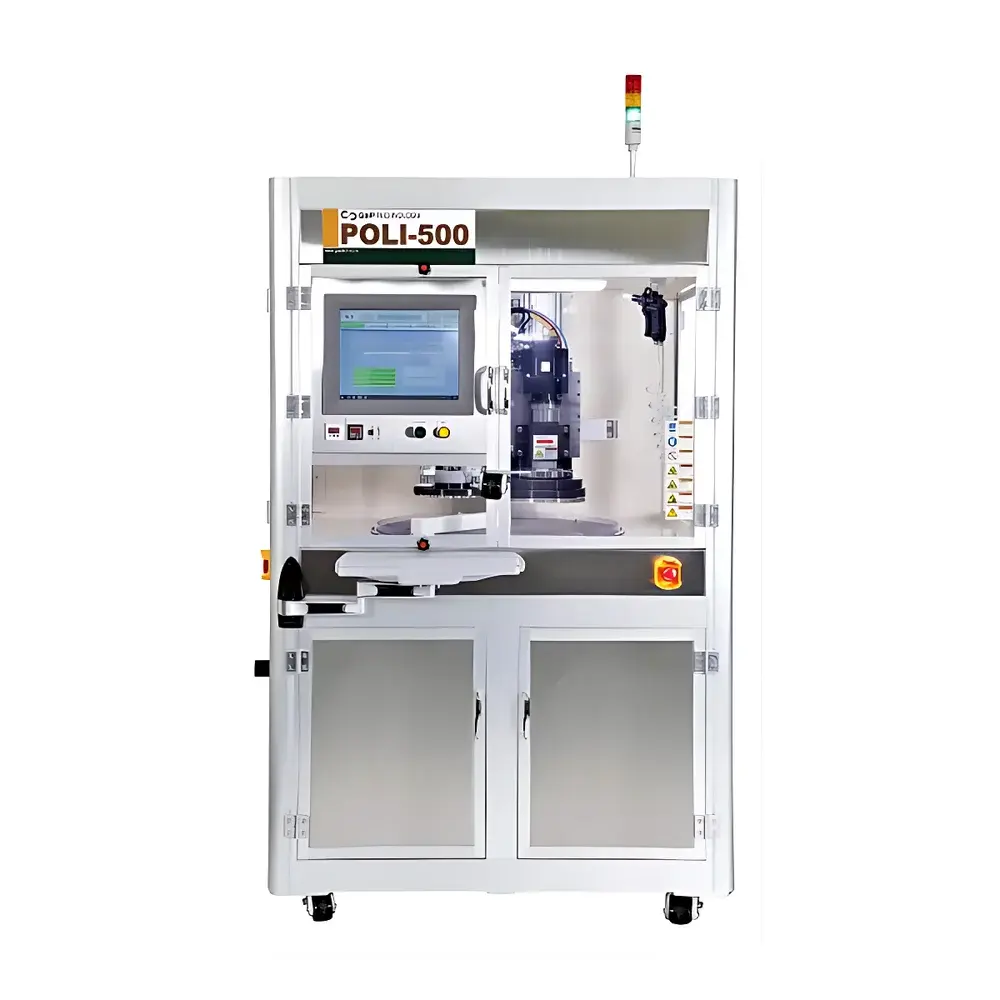
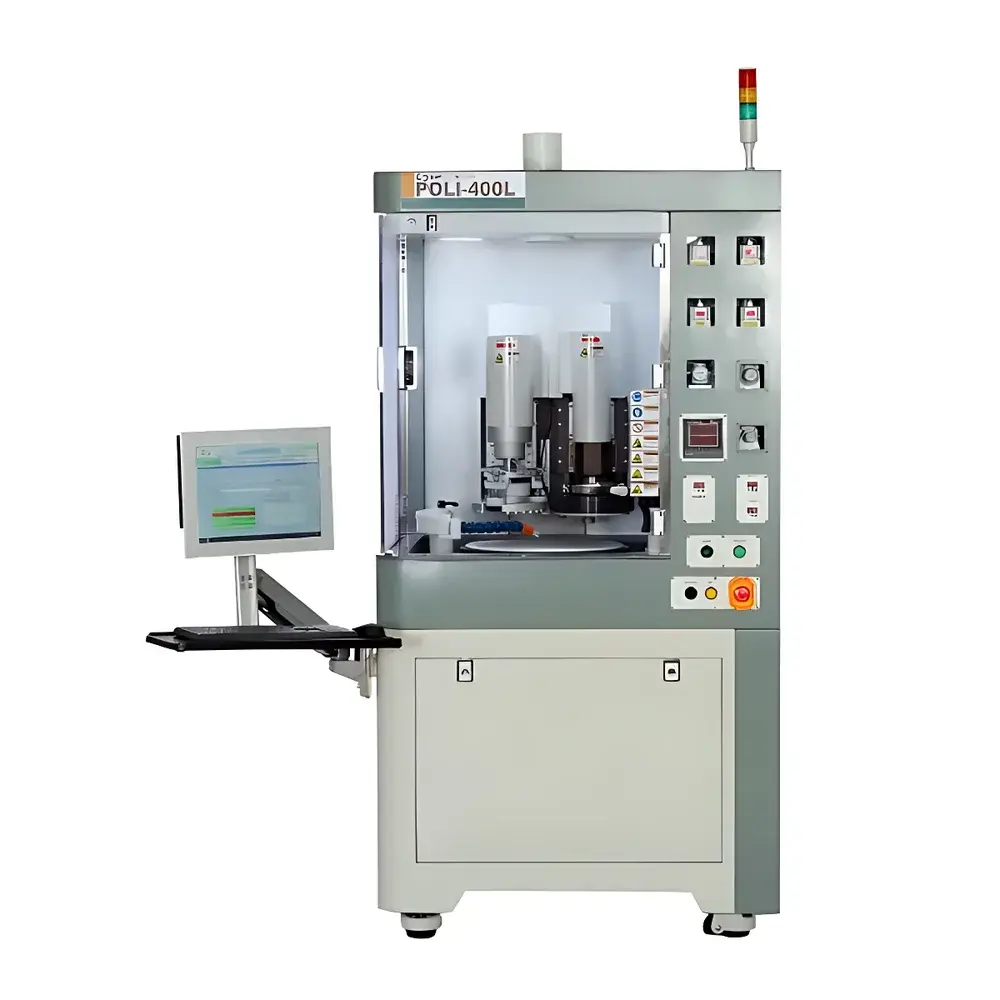
G&P GNP POLI Series Chemical Mechanical Polishing (CMP) Systems
| Brand | G&P |
|---|---|
| Origin | South Korea |
| Model | GNP POLI-762 / POLI-500 / POLI-400L |
| Platen Diameter | Φ762 mm (30″), Φ508 mm (20″), Φ406 mm (16″) |
| Platen Material | Anodized Aluminum (optional Teflon-coated) |
| Head & Table Rotation Speed | 30–200 rpm |
| Head Oscillation | ±15 mm |
| Downforce Range | 70–500 g/cm² (1–7.1 psi) |
| System Height | 1850–1960 mm |
| Process Mode | Automated Dry/Wet Sequential Operation |
| Wafer Compatibility | Up to 300 mm (12″), 200 mm (8″), or 150 mm (6″) |
| Compliance | Designed for GLP/GMP-aligned R&D and process qualification environments |
Overview
The G&P GNP POLI Series is a family of precision-engineered Chemical Mechanical Polishing (CMP) systems designed for semiconductor process development, materials evaluation, and production qualification across multiple wafer diameters. Leveraging proven Couette-flow-based slurry delivery, controlled downforce actuation, and synchronized rotational/oscillatory motion, these systems replicate the fundamental material removal mechanics of full-scale production CMP tools—enabling reliable correlation between lab-scale results and fab-line performance. The POLI platform supports both oxide and metal polishing chemistries (e.g., SiO₂, BPSG, TEOS, silicon nitride, tungsten, copper), as well as advanced applications including shallow trench isolation (STI), post-gate integration (PGI), and MEMS surface planarization. Each variant—POLI-762 (300 mm), POLI-500 (200 mm), and POLI-400L (150 mm)—is engineered for high reproducibility, mechanical stability, and modular scalability in R&D, substrate manufacturing, and consumables validation workflows.
Key Features
- Modular platen architecture with interchangeable anodized aluminum or optional PTFE-coated surfaces to minimize particle generation and enhance chemical resistance
- Precision-controlled pneumatic downforce system with real-time electronic regulation (70–500 g/cm², equivalent to 1–7.1 psi), enabling accurate replication of production-level pressure profiles
- Independent motor-driven rotation of both carrier head and platen (30–200 rpm), coupled with programmable ±15 mm linear oscillation of the conditioning head for uniform pad wear and slurry distribution
- Compact footprint design: POLI-400L occupies only 0.98 m²; POLI-500 and POLI-762 maintain standardized height (1960 mm) for ergonomic integration into cleanroom fume hoods or gloveboxes
- Open-control architecture supporting third-party sensor integration—including in-situ friction torque monitoring, real-time temperature profiling at the wafer–pad interface, and acoustic emission detection for endpoint estimation
- Automated dry/wet process sequencing with programmable step timing, slurry dispense volume, and rinse/dry cycles—fully compliant with ASTM F2639 and SEMI E157 standards for CMP equipment characterization
Sample Compatibility & Compliance
The GNP POLI Series accommodates standard silicon, SOI, compound semiconductor (GaAs, SiC), and glass substrates up to 300 mm diameter. Its mechanical and environmental specifications align with ISO 14644-1 Class 5 cleanroom operation when installed with appropriate exhaust and filtration. All models support wafer-level metrology integration (e.g., optical interferometry, eddy current, or laser profilometry) for post-CMP surface roughness (Ra, Rq), within-wafer non-uniformity (WIWNU), and dishing/erosion quantification. System firmware and data logging modules are structured to meet audit requirements under FDA 21 CFR Part 11 for electronic records and signatures—supporting full traceability of process parameters, operator ID, timestamped events, and calibration logs. Optional hardware upgrades include dual-head configurations and robotic load/unload interfaces compatible with SECS/GEM communication protocols.
Software & Data Management
Control and monitoring are managed via the POLI-Soft™ platform—a Windows-based application built on LabVIEW Real-Time architecture. It provides deterministic I/O response (<10 ms loop cycle), multi-axis trajectory planning, and synchronized data acquisition from up to 16 analog/digital channels. Process recipes are stored in encrypted XML format with version control and user-access permissions (admin/operator/technician tiers). Raw sensor streams (torque, temperature, pressure, position) are time-stamped and archived in HDF5 format for downstream analysis using MATLAB, Python (Pandas/HDF5 libraries), or JMP. Audit trails include all parameter modifications, login/logout events, and emergency stop triggers—retained for ≥12 months per GLP-compliant retention policies. Remote diagnostics and firmware updates are supported over TLS-secured Ethernet connections without compromising local network isolation.
Applications
- Slurry and pad formulation evaluation for Cu, W, Co, Ru, and low-k dielectric polishing
- Endpoint detection algorithm development using in-situ friction or acoustic signal analysis
- Wafer-scale uniformity mapping for STI and gate-last integration schemes
- MEMS device planarization on patterned quartz or silicon substrates
- Post-CMP defectivity assessment via automated optical inspection (AOI) integration
- Accelerated lifetime testing of polishing pads under controlled thermal and mechanical stress
- Qualification of recycled or reclaimed wafers in pilot-line process transfer studies
FAQ
What wafer sizes does the GNP POLI Series support?
The POLI-762 handles up to 300 mm (12″) wafers; the POLI-500 supports up to 200 mm (8″); and the POLI-400L is optimized for 100–150 mm (4″–6″) substrates—including patterned MEMS wafers and compound semiconductor blanks.
Is the system compatible with abrasive-free polishing chemistries?
Yes. The precise downforce control, low-vibration platen drive, and programmable oscillation enable stable operation with colloidal silica, ceria, and enzymatic slurries—critical for low-damage polishing of fragile low-k films and nanowire arrays.
Can the POLI platform be integrated into a fully automated process line?
All models feature SECS/GEM-ready I/O ports and Modbus TCP support. Optional robotic load ports, FOUP/SMIF interface kits, and MES connectivity modules are available for factory automation integration.
Does the system meet international safety and electromagnetic compatibility standards?
Each unit complies with CE marking requirements (EN 61000-6-2/6-4, EN 61000-3-2/3-3) and UL 61010-1 for laboratory equipment. Full electrical schematics and risk assessments are provided upon request for internal safety audits.
What documentation is supplied for regulatory submissions?
G&P provides IQ/OQ protocol templates, 21 CFR Part 11 compliance reports, traceable calibration certificates for all force/position/temperature sensors, and a complete Design History File (DHF) summary for qualified customers engaged in medical device or aerospace-grade semiconductor manufacturing.