
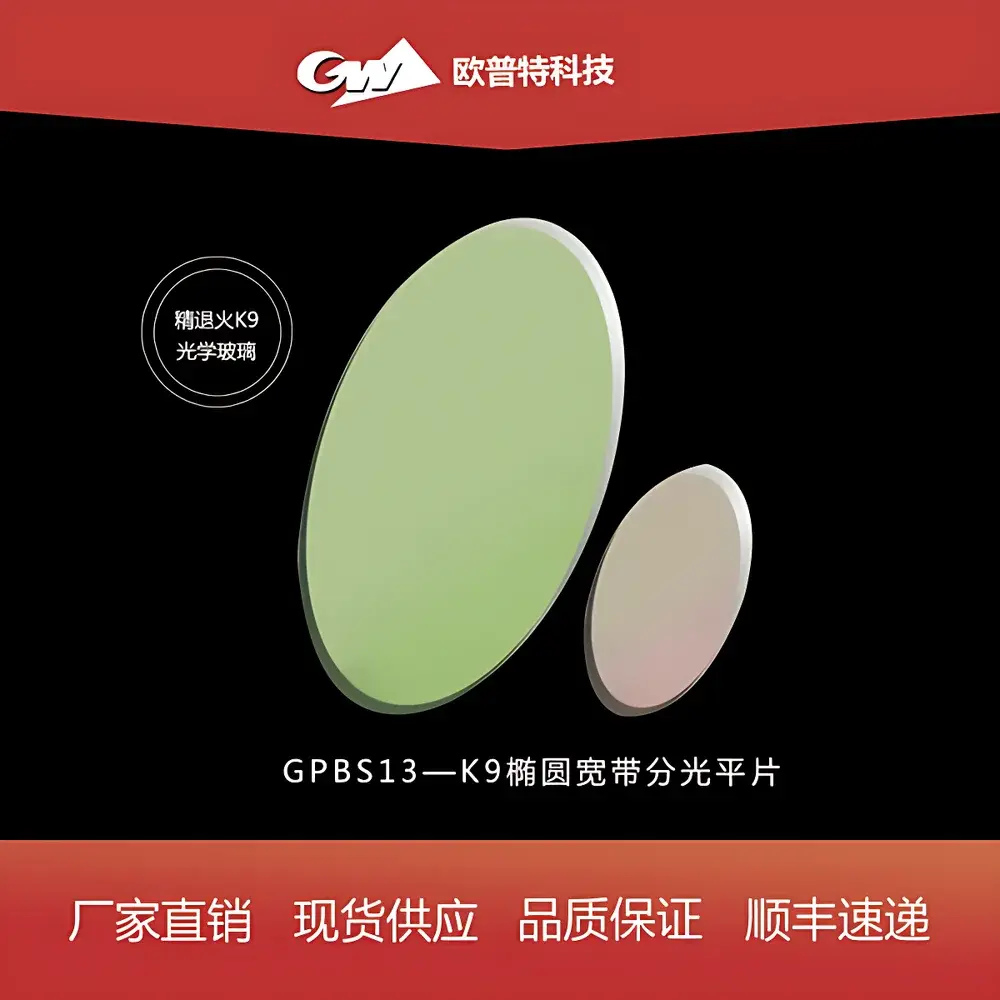
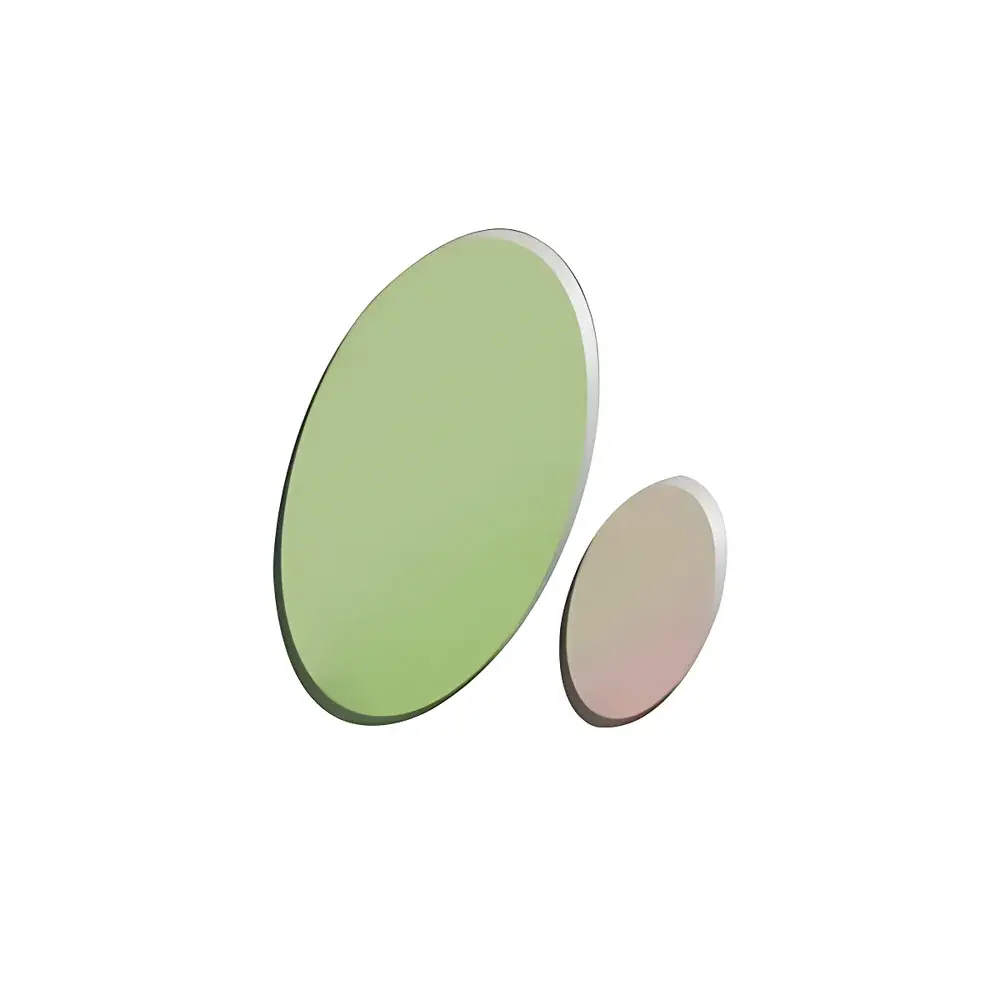
GPBS13-K9 Elliptical Broadband Beam Splitter Plate
| Material | Precision Annealed K9 Optical Glass |
|---|---|
| Surface Flatness | λ/4 @ 633 nm |
| Parallelism | < 30 arcsec |
| Surface Quality | 3–4 scratch-dig |
| Clear Aperture | +0.0 / −0.1 mm |
| Minor Axis Tolerance | 3 mm ± 0.2 mm |
| Thickness | 1.0 mm ± 0.1 mm |
| Edge Treatment | Protective 45° chamfer, 0.2–0.5 mm |
| S1 Coating | 45° AOI broadband splitting coating, R/T = 50:50 ± 10% (avg. over specified band) |
| S2 Coating | Broadband antireflection coating, Rₐᵥg < 1% (avg. over specified band) |
| Available AR Bands | 350–700 nm (VIS), 600–1100 nm (NIR), 900–1700 nm (SWIR) |
| Component Type | Optical Element |
Overview
The GPBS13-K9 Elliptical Broadband Beam Splitter Plate is a precision optical component engineered for stable, low-distortion beam division in free-space optical systems operating at 45° angle of incidence. Constructed from homogeneously annealed K9 borosilicate crown glass—certified to ISO 10110-3 standards for optical material uniformity—the plate leverages its elliptical geometry to accommodate asymmetric beam paths while maintaining minimal wavefront distortion. Unlike circular or rectangular splitters, the elliptical form factor enables compact integration into constrained optical layouts where beam height and width differ significantly, such as in multi-axis interferometers, polarization-resolved spectroscopy setups, or dual-path alignment systems. Its operational principle relies on thin-film interference: the front surface (S1) carries a dielectric multilayer coating optimized for 45° incidence across designated spectral bands, delivering nominally equal reflectance (R) and transmittance (T) with tight tolerance control. The rear surface (S2) features a matched broadband antireflection (AR) coating to suppress secondary reflections and ghost images—critical for high-dynamic-range applications including low-light fluorescence detection and time-resolved pump-probe configurations.
Key Features
- Precision elliptical geometry with minor axis tolerance of ±0.2 mm ensures repeatable mechanical registration in custom mounts and kinematic stages.
- λ/4 surface flatness @ 633 nm (verified via Fizeau interferometry) guarantees sub-wavelength wavefront fidelity for coherent applications including holography and laser cavity coupling.
- Surface quality rated 3–4 scratch-dig per MIL-PRF-13830B supports high-power CW and pulsed laser use up to 5 J/cm² (10 ns, 1064 nm), provided fluence remains below damage threshold limits.
- Controlled thickness tolerance (1.0 ± 0.1 mm) enables predictable optical path difference (OPD) in Michelson or Mach–Zehnder configurations requiring phase stability.
- Protective 45° edge chamfer (0.2–0.5 mm) mitigates chipping during handling and cleaning—essential for cleanroom-compatible assembly workflows.
- Three AR-coating variants (VIS, NIR, SWIR) allow spectral optimization without redesigning mechanical interfaces; all coatings meet ISO 9211-4 specifications for environmental durability (humidity, abrasion, adhesion).
Sample Compatibility & Compliance
The GPBS13 series is compatible with standard SM1 (1.035″-40) lens tubes, kinematic mirror mounts (e.g., Thorlabs KM100), and custom CNC-machined elliptical holders. All K9 substrates comply with RoHS Directive 2011/65/EU and REACH Annex XVII restrictions on heavy metals. Coating performance is validated per ISO 9211-3 for spectral uniformity and per ISO 15409 for laser-induced damage threshold (LIDT) reporting. While not certified to FDA 21 CFR Part 11, the component meets foundational requirements for inclusion in Class I and II optical subsystems subject to IEC 61000-4 electromagnetic compatibility testing and ISO 13485-aligned manufacturing traceability protocols when integrated into medical or analytical instrumentation.
Software & Data Management
As a passive optical element, the GPBS13 requires no embedded firmware or driver software. However, its spectral performance data—including measured R/T curves, phase shift vs. wavelength, and polarization-dependent loss (PDL)—are supplied in standardized ASCII format (.csv) and Zemax-compatible .DAT files for system-level modeling. Coating design files (layer stack, materials, thicknesses) are available under NDA for OEM integration into optical simulation pipelines (e.g., CODE V, FRED, LightTools). Traceability documentation includes individual serial-numbered calibration reports referencing NIST-traceable interferometric flatness measurements and spectrophotometric verification per ASTM E308-19.
Applications
- Laser beam conditioning in ultrafast Ti:sapphire and Yb-fiber oscillator-amplifier chains, where elliptical shape accommodates astigmatic correction optics.
- Broadband interferometric metrology, including white-light scanning interferometry and dispersion-compensated OCT light engines.
- Multi-spectral imaging systems combining visible and near-infrared channels using dichroic separation prior to sensor-specific filtering.
- Quantum optics experiments requiring polarization-insensitive splitting of entangled photon pairs in spontaneous parametric down-conversion (SPDC) sources.
- Industrial machine vision illumination modules where space constraints favor non-circular beam routing without sacrificing collimation integrity.
FAQ
Is the GPBS13 suitable for high-power laser applications?
Yes—when operated within specified LIDT limits and with proper beam homogenization. Maximum fluence must be verified against the selected AR band and pulse duration.
Can the elliptical shape be customized beyond standard minor axis dimensions?
Custom elliptical geometries are available upon request; minimum order quantity applies, and lead time increases by 4–6 weeks for substrate fabrication and coating validation.
Does the 50:50 split ratio hold across the full specified bandwidth?
The 50:50 ±10% specification represents the average R/T ratio across the nominal band; point-to-point variation may reach ±15% at band edges due to coating dispersion effects.
Are mounting fixtures included with the component?
No—mechanical mounting solutions are sold separately. Recommended accessories include elliptical kinematic mounts (e.g., CVI Melles Griot EM-25E) and vacuum-compatible retaining rings.
How is coating durability tested for environmental exposure?
All AR and splitting coatings undergo 96-hour damp heat testing (IEC 60068-2-30), 10-cycle thermal shock (−40°C to +70°C), and tape adhesion per ISO 2409 before release.



