
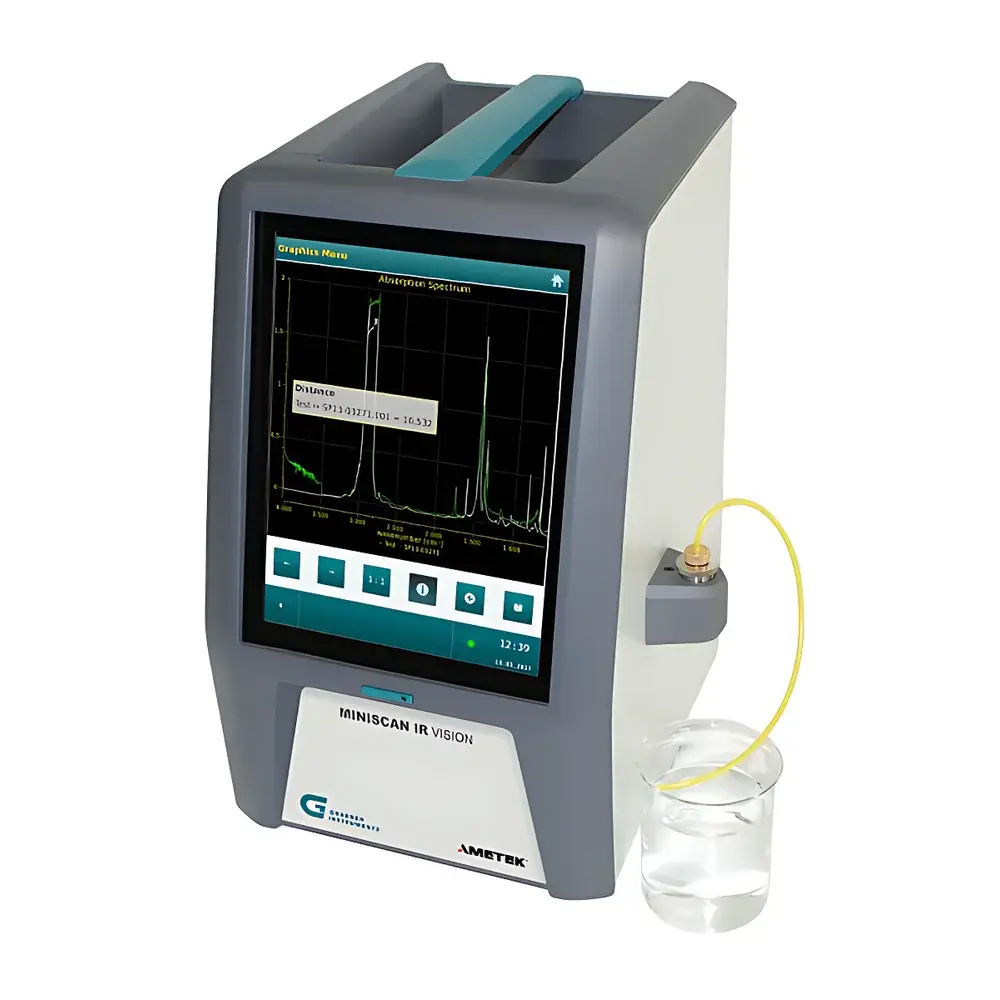
Grabner MINISCAN IR Vision Diesel Cetane Number Analyzer
| Brand | Grabner |
|---|---|
| Origin | Austria |
| Model | MINISCAN IR Vision Diesel |
| Portability | Portable |
| Measurement Parameter | Diesel Cetane Number |
| Measurement Range | 20–80 CN |
| Accuracy | ±1 CN |
| Analysis Time | 1 minute |
| Sample Volume | 10 mL |
| Compliance | ASTM D5845, ASTM D6277, EN 238, SH/T 0797, EN 14078, ASTM D7806, GB/T 23801, ASTM E1655, GB/T 29858 |
| Spectral Technology | FTIR with Dual Interferometer and Auto-Mirror Calibration |
| Chemometric Engine | PLS (Partial Least Squares) Multivariate Calibration |
| Database | SGS-Verified Real-Fuel Reference Library |
| Display | 10-inch Industrial Touchscreen |
| Power | 12 V DC Vehicle Adapter Compatible |
Overview
The Grabner MINISCAN IR Vision Diesel Cetane Number Analyzer is a portable, laboratory-grade Fourier Transform Infrared (FTIR) spectrometer engineered for rapid, non-destructive, and quantitative determination of diesel cetane number (CN) and over 20 additional fuel quality parameters. Based on the physical principle of mid-infrared absorption spectroscopy, the instrument captures full-spectrum transmission data (typically 4000–600 cm⁻¹) from a 10 mL sample in a temperature-stabilized quartz flow cell. Spectral features—particularly those associated with alkyl chain length, aromatic ring substitution patterns, and oxygenated functional groups—are resolved by a dual-beam Michelson interferometer with active mirror position feedback. These raw spectra are processed in real time using pre-validated Partial Least Squares (PLS) regression models calibrated against reference methods per ASTM E1655 and GB/T 29858. The system integrates a thermoelectrically regulated density sensor, enabling simultaneous measurement of fuel density at 15 °C—critical for volume-to-mass normalization in cetane prediction and compliance with EN 116 and ASTM D975.
Key Features
- Portable, ruggedized design certified to MIL-STD-810G for shock and vibration resistance—suitable for field deployment in refineries, depots, and mobile laboratories.
- Dual-interferometer architecture with automatic mirror alignment compensation, ensuring optical stability after transport over rough terrain or prolonged operation.
- Thermoelectric temperature control (±0.1 °C) applied independently to the sample cell, density module, and detector—minimizing thermal drift and improving repeatability of hydrocarbon composition quantification.
- Stainless-steel bubble-free sampling system validated by Grabner for high-viscosity diesel fractions and biodiesel blends up to B100.
- 10-inch sunlight-readable industrial touchscreen with glove-compatible interface and intuitive workflow navigation—designed for use in ambient temperatures from –10 °C to +50 °C.
- Integrated 12 V DC power input with automotive-grade filtering—enabling direct operation from vehicle batteries or portable power stations without inverters.
Sample Compatibility & Compliance
The MINISCAN IR Vision Diesel supports clear, homogenous liquid diesel fuels including ultra-low-sulfur diesel (ULSD), Fischer–Tropsch synthetic diesel, hydrotreated vegetable oil (HVO), fatty acid methyl ester (FAME) blends (B5–B100), and renewable diesel (HDRD). It excludes emulsified, highly contaminated, or water-bearing samples requiring prior filtration or dehydration. All predictive models are traceable to primary reference standards and verified against interlaboratory round-robin data per ISO/IEC 17025 requirements. Regulatory alignment includes ASTM D613 (reference CN method), ASTM D5845 (oxygen content), ASTM D6277 and EN 238 (benzene), EN 14078 and ASTM D7806 (FAME), and SH/T 0797 (aromatics). Instrument firmware and calibration files comply with GLP audit requirements, supporting electronic record retention and user-access logging.
Software & Data Management
The embedded software platform provides full CFR Part 11–ready functionality: role-based access control, electronic signatures, audit trail with timestamped event logs (method changes, calibration updates, result exports), and secure local database storage. Raw spectra, processed results, and metadata (operator ID, location tag, ambient conditions) are exportable in ASTM E1382-compliant .csv and .jdx formats. Custom model development is supported via Grabner’s IRSoft chemometrics suite, allowing users to build or refine PLS models using their own reference datasets—subject to validation per ICH Q2(R2) guidelines. Cloud synchronization (optional) enables centralized fleet monitoring and cross-site method harmonization.
Applications
This analyzer serves critical process and quality assurance functions across the petroleum value chain: real-time blend optimization in refinery tank farms; incoming inspection of crude-derived and bio-derived feedstocks; intermediate QC during hydrotreating and co-processing; custody transfer verification at terminals; and regulatory compliance screening for EN 590, ASTM D975, and China GB 19147. Automotive OEMs deploy it for fuel compatibility testing of advanced combustion engines, while third-party inspection agencies (e.g., SGS, Bureau Veritas) utilize its portability for unannounced site audits and forensic fuel analysis.
FAQ
What reference methods are used to validate the cetane number prediction models?
Models are cross-validated against ASTM D613 (ignition delay in CFR engine) and ASTM D6890 (derived cetane number via ignition quality tester), with root-mean-square error of prediction (RMSEP) ≤ 0.8 CN units across 500+ independent reference samples.
Can the instrument measure biodiesel content in diesel blends without separate FAME calibration?
Yes—the built-in FAME model (per EN 14078 and ASTM D7806) operates concurrently with cetane prediction and requires no manual mode switching or sample reprocessing.
Is temperature correction applied during density measurement?
Yes—density is measured at controlled 15 °C and automatically corrected to standard reference temperature per ISO 12185, with uncertainty < ±0.2 kg/m³.
How frequently must the instrument be recalibrated?
Factory calibrations remain stable for ≥12 months under normal use; annual verification using Grabner-certified reference oils is recommended for ISO/IEC 17025 compliance.
Does the system support remote diagnostics or firmware updates?
Yes—via encrypted USB or optional Wi-Fi module; all updates undergo cryptographic signature verification prior to installation.





