
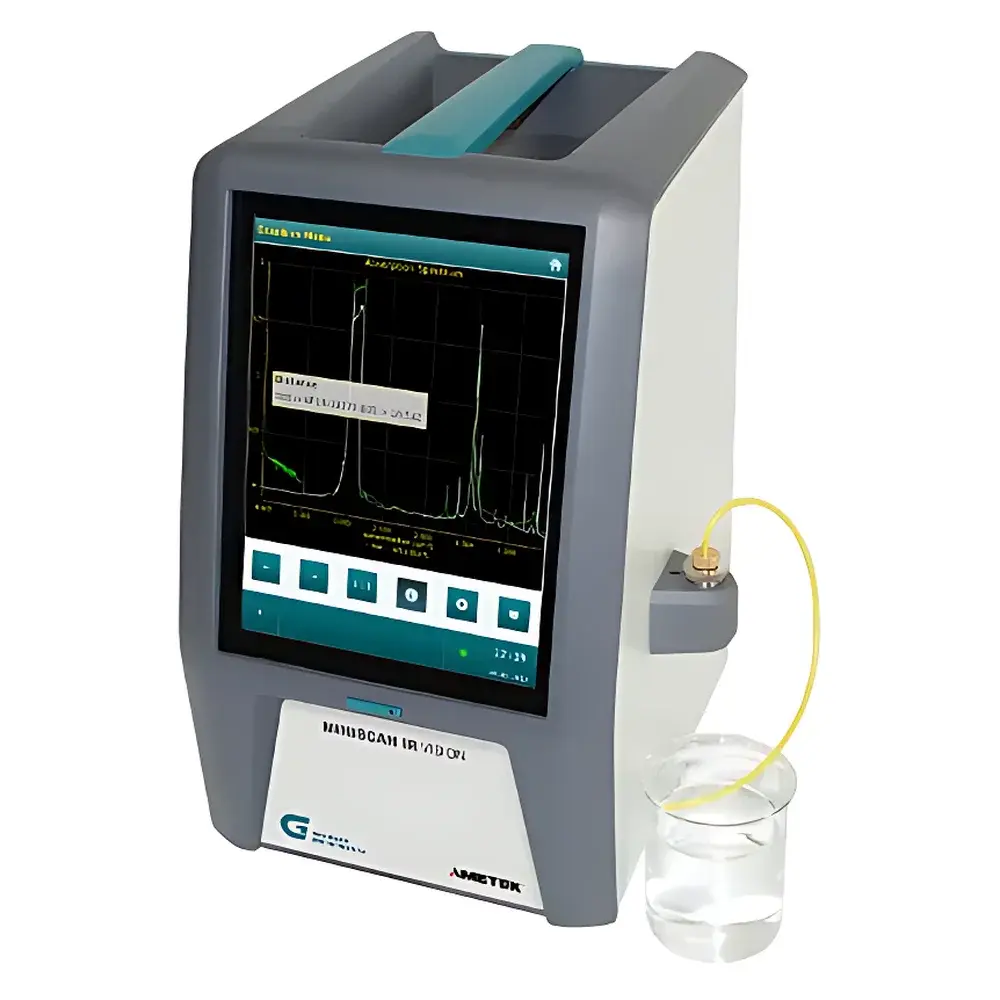
GRABNER MINISCAN IR Vision Gasoline Mid-Infrared Fuel Analyzer
| Brand | GRABNER |
|---|---|
| Origin | Austria |
| Model | MINISCAN IR Vision Gasoline |
| Portability | Portable |
| Measurement Range | 70–110 (RON/MON) |
| Accuracy | ±0.5 |
| Analysis Time | <80 s |
| Sample Volume | 6 mL |
| Compliance | GB/T 33648–2017, ASTM D5845, ASTM D6277, EN 238, SH/T 0797, ASTM E1655, GB/T 29858 |
| Spectrometer Type | Temperature- and Laser-Stabilized Dual Interferometer with KBr-coated Ge Beamsplitter |
| Sample Cell | Thermoelectrically Controlled 2+1 Smart Cell Design |
| Density Measurement | Integrated TE-Controlled Digital Density Meter (±0.0001 g/cm³) |
| Data Output Units | v%, m% |
| Display | 10-inch Industrial TFT Touchscreen |
| Connectivity | 2× USB, 2× LAN |
| Power | 100–264 V AC / 47–63 Hz / 130 W or 12 V DC via Vehicle Adapter |
| Dimensions | 293 × 390 × 280 mm |
| Weight | 12 kg |
Overview
The GRABNER MINISCAN IR Vision Gasoline is a field-deployable, mid-infrared (MIR) fuel analyzer engineered for precise, rapid, and fully automated quantitative analysis of gasoline composition. It operates on the principle of Fourier-transform infrared (FTIR) spectroscopy, acquiring full-spectrum absorbance data across the 4000–600 cm⁻¹ range with high signal-to-noise ratio and long-term photometric stability. Its dual-interferometer architecture—featuring laser-referenced path-length control and temperature-stabilized KBr-coated germanium beamsplitters—ensures spectral reproducibility under variable environmental conditions. The instrument is explicitly validated for compliance with GB/T 33648–2017 for detection of non-conventional additives in automotive gasoline, and supports regulatory testing per ASTM D5845 (oxygenates), ASTM D6277 and EN 238 (benzene), and SH/T 0797 (aromatics). All chemometric models are developed using partial least squares (PLS) regression in accordance with ASTM E1655 and GB/T 29858, trained exclusively on reference-grade, SGS-verified real-world gasoline samples.
Key Features
- Portable benchtop design (12 kg, IP54-rated enclosure) certified for shock and vibration resistance—suitable for mobile labs, refinery perimeters, depot inspection zones, and roadside verification.
- Thermoelectrically regulated 2+1 smart sample cell system: two dedicated cells for routine analysis and one purge/flush cell to eliminate cross-contamination between samples; all maintained at constant temperature to ensure volumetric and mass-based quantification accuracy.
- Integrated digital density meter with ±0.0001 g/cm³ resolution, independently temperature-controlled and traceable to NIST-certified standards.
- Automated bubble-free metal injection system, eliminating air entrapment artifacts common in capillary-based fuel handling.
- Self-calibrating optical train: real-time mirror alignment correction triggered by mechanical perturbation (e.g., transport over rough terrain), preserving interferogram fidelity without manual intervention.
- 10-inch industrial-grade capacitive touchscreen with high-brightness TFT panel (1000 cd/m²), glove-compatible interface, and configurable multi-language support (English, Chinese, German, Spanish).
- Onboard storage for >100,000 complete spectra + metadata; export formats include CSV, XML, and ASTM-compliant .spc files compatible with LIMS and enterprise QA/QC systems.
Sample Compatibility & Compliance
The MINISCAN IR Vision Gasoline accepts unstabilized, unfiltered gasoline samples (including reformulated, oxygenated, and bio-blended fuels) with minimal pretreatment. It quantifies over 70 parameters—including RON/MON, total aromatics, total olefins, benzene, toluene, ethylbenzene, xylenes (BTEX), methanol, ethanol, MTBE, ETBE, TAME, diethyl ether, methylal, dimethyl carbonate, and sec-butyl acetate—directly from 6 mL aliquots. Calibration models are traceable to primary reference materials and verified against independent GC-FID, GC-MS, and densitometric methods. Instrument validation meets ISO/IEC 17025 requirements for testing laboratories, and software operation supports audit trails compliant with FDA 21 CFR Part 11 when deployed in GLP/GMP-regulated environments.
Software & Data Management
The embedded GRABNER VisionOS firmware provides intuitive workflow navigation, method selection, calibration management, and real-time spectral visualization. Chemometric model libraries are locked and digitally signed to prevent unauthorized modification. All measurement events—including raw interferograms, processed spectra, prediction residuals, density readings, and environmental sensor logs (temperature, humidity)—are timestamped and stored with immutable audit trails. Remote access is enabled via secure HTTPS or VPN-connected LAN; users may initiate analyses, retrieve reports, or push firmware updates from centralized IT infrastructure. Data export supports direct integration with laboratory information management systems (LIMS) and enterprise resource planning (ERP) platforms through standardized API endpoints.
Applications
This analyzer serves as a primary tool for process analytical technology (PAT) in gasoline blending terminals, where it enables closed-loop feedback control of octane index and oxygenate dosing. It supports quality assurance in bulk distribution terminals, third-party inspection agencies (e.g., SGS, Bureau Veritas), and national petroleum product supervision centers. In automotive R&D, it facilitates rapid screening of alternative fuel formulations and additive compatibility studies. Field deployment scenarios include customs border inspections, fuel fraud investigations, and emergency response to suspected adulteration incidents—where turnaround time (<80 s/sample) and operational independence from external gas supplies or chilled coolant are critical.
FAQ
Does the MINISCAN IR Vision require external calibration standards during daily operation?
No—factory-loaded PLS models are self-validating; only periodic performance qualification (PQ) using certified check standards (e.g., NIST SRM 2720) is required per ISO 8295 or internal QA protocols.
Can the same instrument analyze both gasoline and diesel?
Yes—the MINISCAN IR Vision Professional variant supports gasoline, diesel, and jet fuel (Jet A-1) with application-specific model packs; the Gasoline-dedicated unit may be upgraded in-field via authorized firmware and license activation.
Is spectral data export compatible with third-party chemometric software?
Yes—full-resolution interferograms (.ifg) and absorbance spectra (.spc) are provided in open-format ASCII or binary structures, fully interoperable with Unscrambler®, Pirouette®, and MATLAB-based modeling environments.
What environmental conditions limit operational use?
Operating range: 5–40 °C ambient, 20–80% RH non-condensing; extended-range thermal management allows stable performance even during vehicle-mounted transit or outdoor summer deployments.
How is data integrity ensured during power interruption?
The system employs write-cached journaling file system with automatic rollback; all active measurements are preserved in volatile memory and committed upon safe shutdown or resume after brief outages (<2 s).




