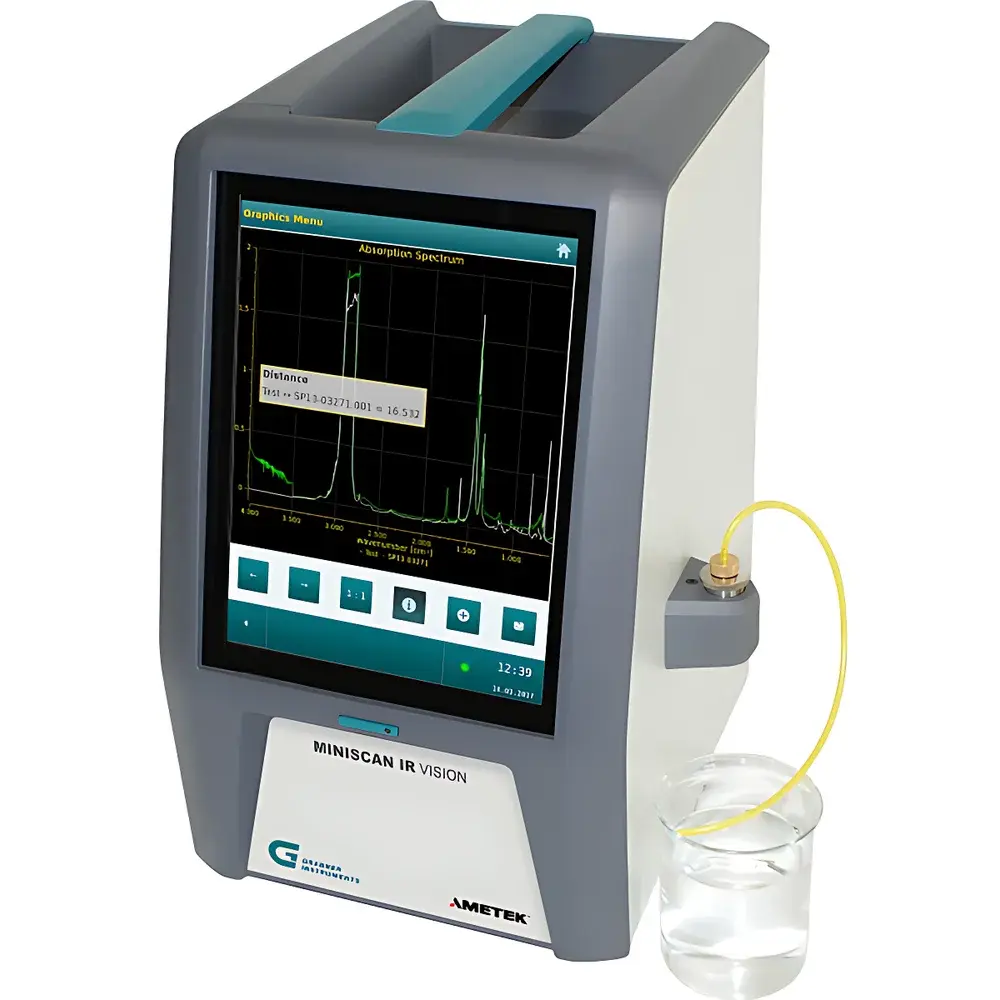
GRABNER MINISCAN IR Vision Gasoline Octane Analyzer
| Brand | GRABNER |
|---|---|
| Origin | Austria |
| Model | MINISCAN IR Vision Gasoline |
| Portability | Portable |
| Measurement Range | 70–110 (RON/MON) |
| Accuracy | ±1 ON |
| Analysis Time | 1 min |
| Sample Volume | 10 mL |
| Spectral Range | Mid-IR (KBr-coated Ge beam splitter) |
| Density Measurement | Integrated thermostatted densitometer, resolution ±0.0001 g/cm³ |
| Data Output Units | v%, m% |
| Display | 10-inch industrial-grade full-color touchscreen |
| Compliance | ASTM D5845, ASTM D6277, EN 238, SH/T 0797, ASTM E1655, GB/T 29858, GB/T 33648-2017 |
| Chemometric Engine | PLS (Partial Least Squares) with validated multivariate calibration models |
| Connectivity | 2× USB, 2× LAN |
| Power | 100–264 V AC, 47–63 Hz, 130 W |
| Dimensions | 293 × 390 × 280 mm |
| Weight | 12 kg |
Overview
The GRABNER MINISCAN IR Vision Gasoline Octane Analyzer is a portable, mid-infrared (MIR) spectrometer engineered for rapid, field-deployable quantification of gasoline composition and performance parameters—including research octane number (RON), motor octane number (MON), total aromatics, total olefins, oxygenates (e.g., ethanol, MTBE, methanol), benzene, total oxygen content, and illicit additives such as dimethyl carbonate or sec-butyl acetate. Operating on the principle of Fourier-transform infrared (FTIR) spectroscopy, the instrument acquires full-spectrum absorbance data across the mid-IR region (typically 4000–600 cm⁻¹), enabling high-fidelity multivariate regression via Partial Least Squares (PLS) algorithms. Its optical architecture incorporates a dual-interferometer design with automatic mirror alignment compensation—ensuring spectral stability after mechanical shock or thermal drift. The system complies with ASTM E1655 (Standard Practices for Infrared Multivariate Quantitative Analysis) and GB/T 29858 (General Principles for Molecular Spectroscopic Multivariate Calibration), establishing metrological traceability for routine QC and regulatory screening.
Key Features
- Portable, ruggedized platform certified for shock and vibration resistance (IEC 60068-2 series), suitable for refinery lanes, fuel terminals, and roadside inspection.
- Integrated thermostatted densitometer (±0.0001 g/cm³ resolution) co-located with the sample cell and injection manifold to ensure volumetric and mass-based concentration accuracy under ambient temperature fluctuations.
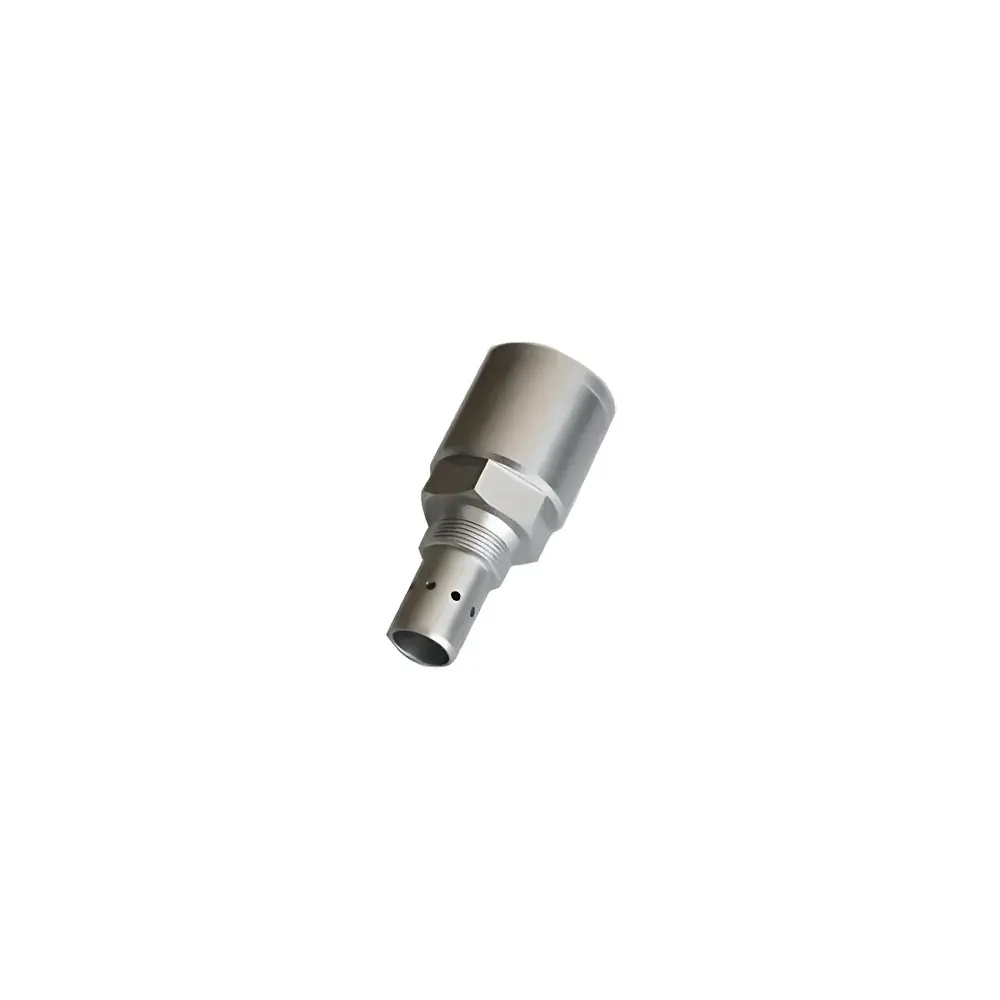
- Patented 2+1 metal sample cell design eliminates bubble formation and enables reproducible pathlength control for high-precision transmission spectroscopy.
- Automated laser-controlled interferometer with real-time intensity correction—maintains photometric integrity after transport over uneven terrain.
- 10-inch industrial-grade capacitive touchscreen with oversized UI elements, glove-compatible operation, and multi-language support (English, Chinese, German).
- Onboard chemometric library pre-calibrated using >10,000 real-world gasoline samples sourced from SGS global reference databases—fully aligned with ASTM D5845 (oxygen), ASTM D6277 (benzene), EN 238, and SH/T 0797.
- Comprehensive parameter reporting in both volume % (v%) and mass % (m%), with automated unit conversion and uncertainty propagation per ISO/IEC 17025 guidelines.
Sample Compatibility & Compliance
The MINISCAN IR Vision accepts undiluted, unfiltered gasoline samples (10 mL volume) without pretreatment. It is validated for use with conventional gasoline, oxygenated blends (E10, E15, MTBE-modified), and reformulated fuels containing bio-derived components. Regulatory compliance extends to GB/T 33648-2017 for detection of non-conventional additives, ensuring suitability for customs inspection, commercial quality arbitration, and refinery process control. All calibration models undergo periodic revalidation per ASTM D6708 (Standard Practice for Statistical Assessment of Predictive Models) and are documented with full audit trails for GLP/GMP environments. Instrument firmware supports 21 CFR Part 11-compliant electronic signatures and user-access logging when interfaced with LIMS.
Software & Data Management
The embedded GRABNER IRVision software provides full spectral acquisition, PLS model selection, real-time prediction, and raw interferogram storage. Each measurement saves complete absorbance spectra (1 cm⁻¹ resolution), metadata (temperature, density, operator ID), and uncertainty estimates. Data export supports CSV, XML, and ASTM E2711-compliant formats for integration into enterprise QA/QC systems. Remote access is enabled via secure HTTPS web interface—allowing off-site calibration review, method updates, and instrument diagnostics. Local storage retains ≥50,000 full-spectrum records; external backup via USB or network share is supported. Audit trail functionality logs all user actions, method changes, and calibration events with timestamps and digital signatures.
Applications
- Real-time octane verification during gasoline blending and custody transfer at refineries and terminals.
- Field screening for adulteration and illegal additive presence (e.g., formaldehyde dimethyl acetal, methyl tert-butyl ether surrogates) in compliance with national fuel specifications.
- In-process monitoring of aromatic/olefin balance to optimize FCC and hydrotreating unit yields.
- Regulatory enforcement testing by petroleum inspection agencies and customs laboratories.
- Automotive OEM fuel qualification—rapid assessment of combustion-relevant parameters prior to engine mapping trials.
- Contract laboratory analysis supporting ASTM round-robin studies and interlaboratory validation programs.
FAQ
Does the MINISCAN IR Vision require daily recalibration?
No. The dual-interferometer architecture and internal reference laser enable drift-free operation for up to 30 days between performance verifications using NIST-traceable hydrocarbon standards.
Can it analyze diesel or jet fuel?
The MINISCAN IR Vision Gasoline variant is optimized for gasoline-range volatility and composition. For diesel or aviation turbine fuel, the MINISCAN IR Vision Diesel or Professional configuration must be selected—each equipped with fuel-specific PLS models and thermal management tuned to respective boiling point distributions.
Is method validation documentation provided?
Yes. GRABNER supplies full validation reports per ISO/IEC 17025, including linearity, LOD/LOQ, repeatability (RSD <1.2% for RON), intermediate precision, and robustness testing against matrix effects.
How is spectral data secured for regulatory audits?
All raw spectra and processed results are cryptographically hashed and timestamped. The system maintains immutable audit logs compliant with FDA 21 CFR Part 11 and EU Annex 11 requirements when configured with role-based user authentication.
What maintenance is required beyond routine cleaning?
Annual optical alignment verification and interferometer purge gas (dry air or nitrogen) filter replacement are recommended. No consumables (e.g., lamps, detectors) require replacement within the first five years of operation.