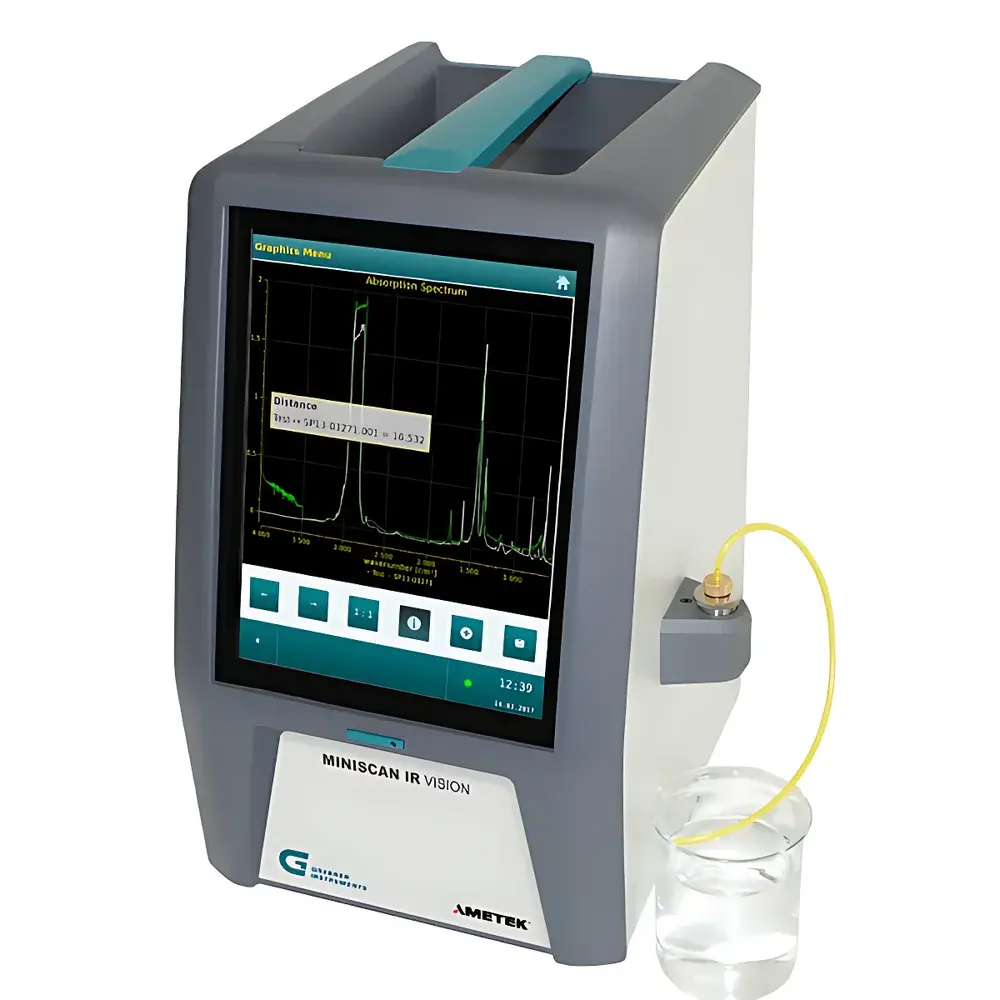
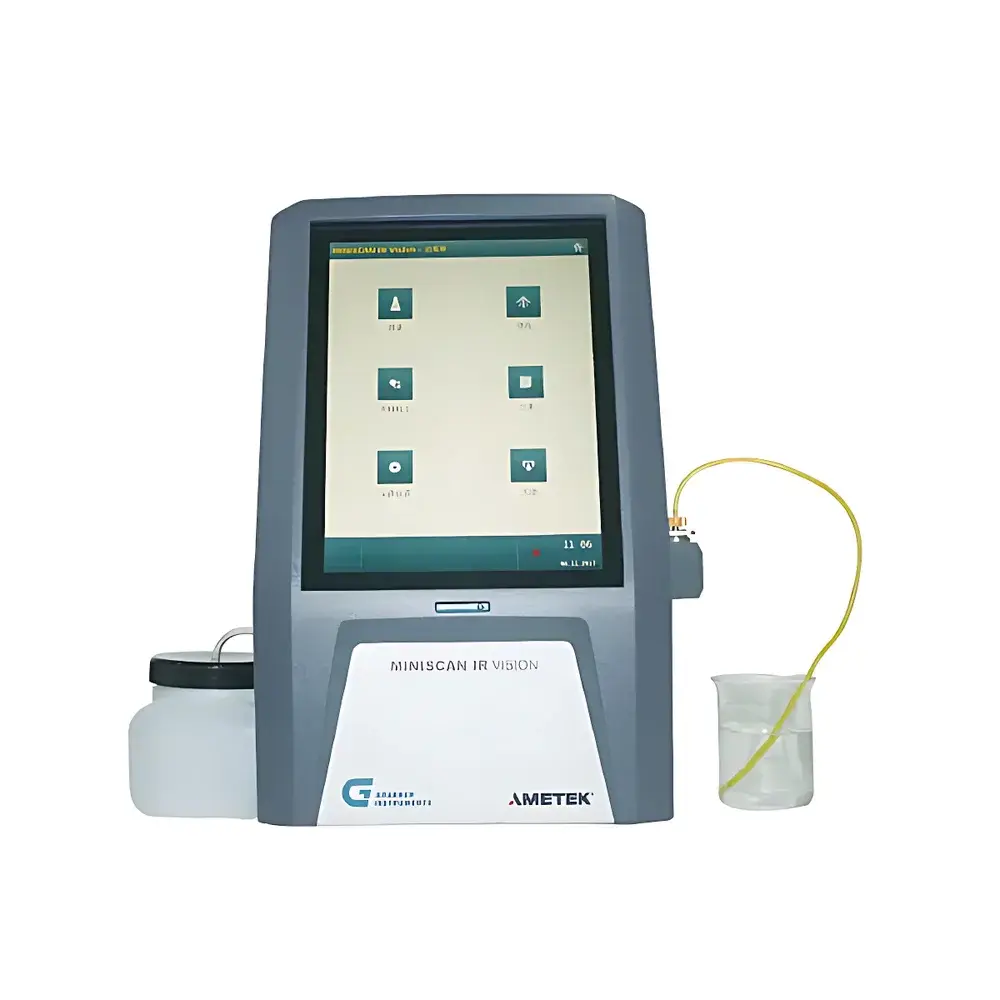
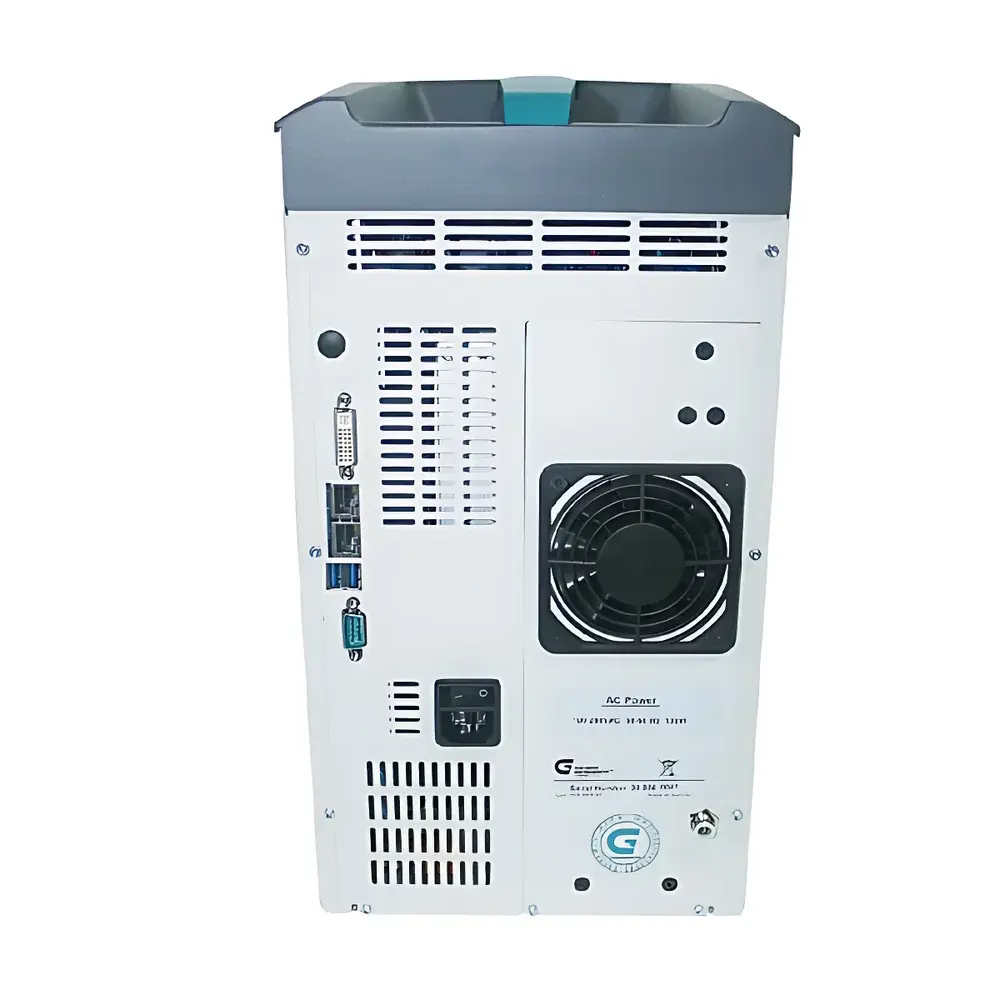
Grabner MINISCAN IR VISION Portable Mid-Infrared Fuel Analyzer
| Brand | Grabner |
|---|---|
| Origin | Austria |
| Model | MINISCAN IR VISION |
| Portability | Portable |
| Measurement Principle | Fourier Transform Infrared (FT-IR) Spectroscopy |
| Measurement Range | Octane Number (RON) 65–110, Cetane Number 20–80 |
| Optical Resolution | Better than 2 cm⁻¹ |
| Analysis Time | <30 s (single scan), ≤80 s (multi-scan averaging) |
| Sample Volume | 6 mL |
| Compliance | ASTM D5845, D6277, D7777, D7806, EN 238, EN 14078, ISO 15212 |
Overview
The Grabner MINISCAN IR VISION is a field-deployable, high-performance mid-infrared (MIR) Fourier transform spectrometer engineered for quantitative and qualitative analysis of liquid petroleum fuels. Operating on the principle of FT-IR spectroscopy, it captures full spectral data across the 4000–600 cm⁻¹ range with optical resolution better than 2 cm⁻¹—enabling robust multivariate calibration modeling via Partial Least Squares (PLS) regression. Unlike conventional single-wavelength or narrow-band instruments, the MINISCAN IR VISION leverages thousands of spectral data points to compute fuel properties directly from raw interferograms, eliminating reliance on empirical correlations or surrogate physical measurements. Its core application domain spans gasoline, diesel, aviation turbine fuel (Jet A-1), biodiesel (FAME/FAEE), and blended fuels—supporting real-time verification of compositional compliance at terminals, depots, retail forecourts, and mobile inspection units.
Key Features
- Portable benchtop architecture (12 kg, 293 × 390 × 280 mm) with IP65-rated industrial enclosure, validated for shock and vibration per MIL-STD-810G
- Dual-beam FT-IR optical path with self-aligning mirror system and Ge-coated KBr beam splitter for long-term wavelength stability under thermal and mechanical stress
- Thermoelectrically controlled measurement cell, sample inlet, and U-tube oscillating density module—maintaining temperature stability within ±0.1 °C for volumetric/mass-based quantification
- Integrated high-precision density determination (r.s.d. = 0.0005 g/cm³) using ASTM D4052-compliant oscillating U-tube technology
- 10-inch sunlight-readable industrial touchscreen with glove-compatible interface and context-sensitive soft keys
- Onboard PLS chemometric engine compliant with ASTM E1655 for model development, validation, and uncertainty estimation
- Secure remote diagnostics and firmware updates via encrypted VPN tunnel, supporting global technical support without local intervention
Sample Compatibility & Compliance
The MINISCAN IR VISION supports direct analysis of undiluted, unfiltered fuel samples (6 mL volume requirement) including gasoline, diesel, jet fuel, ethanol/gasoline blends (E10–E85), biodiesel blends (B5–B100), and oxygenated additives. All quantitative calibrations are traceable to internationally recognized reference standards and validated against primary methods. Regulatory compliance includes ASTM D5845 (oxygenates), ASTM D6277/EN 238 (benzene), EN 14078 (biodiesel), ASTM D7777 (cetane index), and ASTM D7806 (multicomponent hydrocarbon typing). The instrument’s analytical output meets data integrity requirements for GLP and GMP environments, with audit-trail-enabled software supporting FDA 21 CFR Part 11 compliance when deployed with appropriate IT infrastructure.
Software & Data Management
The embedded VisionOS operating system provides intuitive workflow navigation, automated calibration verification, and batch report generation in PDF/CSV formats. Chemometric models are stored as encrypted, version-controlled files with metadata including training set origin, cross-validation statistics (RMSECV, R²), and prediction uncertainty bands. Data export supports USB mass storage and dual Gigabit Ethernet interfaces for integration into LIMS or refinery MES systems. All user actions—including method selection, sample ID entry, and result approval—are timestamped and logged with operator ID, satisfying ALCOA+ principles (Attributable, Legible, Contemporaneous, Original, Accurate, Complete, Consistent, Enduring, Available).
Applications
- Real-time verification of gasoline octane rating (RON/MON/AKI) and diesel cetane number at fuel distribution hubs
- Quantitative detection of regulated components: benzene, MTBE, ETBE, TAME, FAME, FAEE, alcohols, and nitro-compounds
- Monitoring of blending accuracy and adulteration in downstream logistics and retail supply chains
- Support for fuel specification enforcement (e.g., EN 228, EN 590, ASTM D4814, D975) during customs inspections or quality audits
- Field-based R&D for alternative fuel formulation, including synthetic hydrocarbons and hydrogenated esters
- On-site troubleshooting of refinery off-spec batches prior to tank farm release
FAQ
Does the MINISCAN IR VISION require external calibration standards for daily operation?
No—its internal laser wavelength reference and thermally stabilized interferometer eliminate routine external calibration. Daily verification uses built-in polystyrene film standard per ASTM E1421.
Can the instrument analyze fuels containing suspended particulates or water droplets?
It requires homogenous, optically clear samples. Free water or >5 µm particulates must be removed via filtration or centrifugation prior to analysis to avoid scattering artifacts.
Is method transfer possible between different MINISCAN IR VISION units?
Yes—chemometric models are hardware-independent and portable across units via encrypted USB key; inter-unit reproducibility is maintained within ±0.3 ON/CN units under identical environmental conditions.
What is the minimum detectable concentration for benzene per EN 238?
The limit of detection (LOD) is 0.1 vol% for benzene in gasoline matrices, verified using certified reference materials and ICH Q2(R2)-aligned validation protocols.
How is temperature control implemented during density and IR measurement?
All fluidic modules—including the U-tube density sensor, sample loop, and transmission cell—are independently regulated via Peltier elements, ensuring isothermal conditions across the entire measurement chain.