
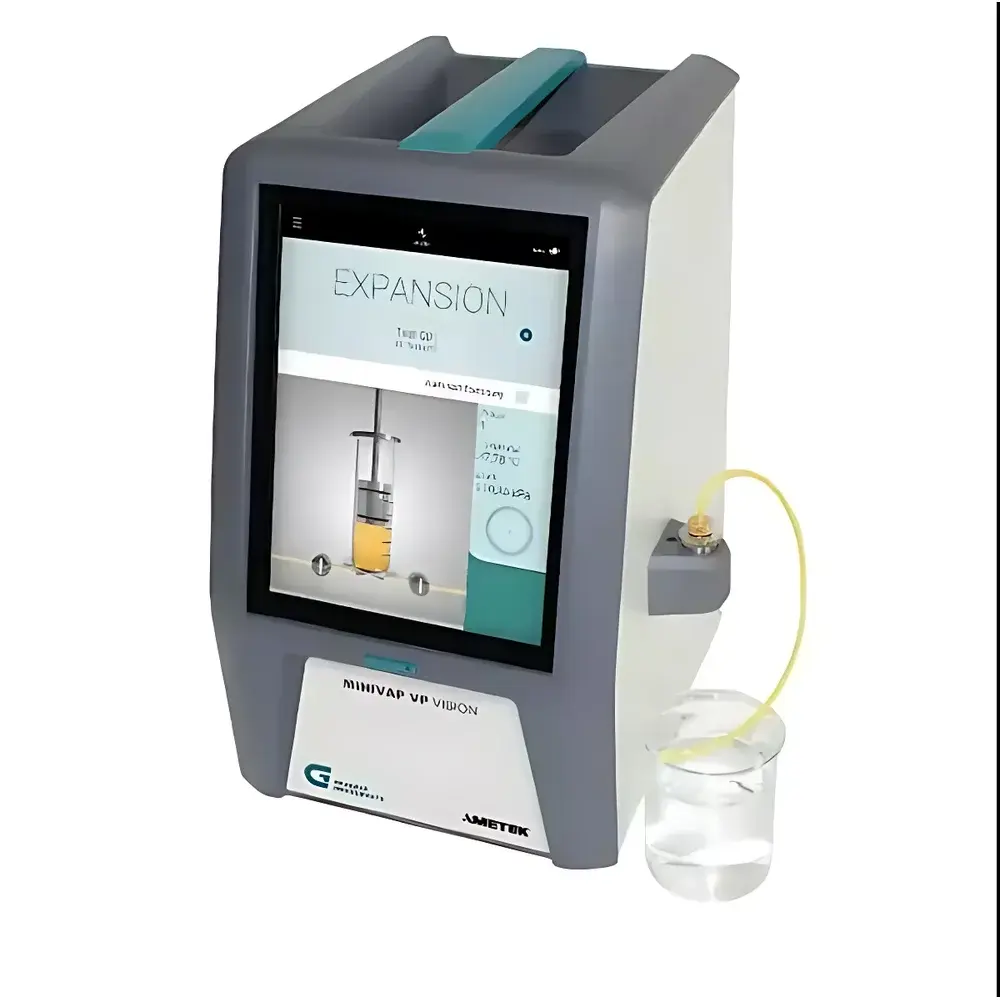
GRABNER MINIVAP VP Vision Automated Micro Vapor Pressure Analyzer
| Brand | GRABNER |
|---|---|
| Origin | Austria |
| Model | MINIVAP VP Vision |
| Analysis Method | Triple Expansion Method |
| Pressure Range | 0–2000 kPa |
| Temperature Range | 0–120 °C |
| Repeatability | ≤ 0.2 kPa (pure substance @ 37.8 °C) |
| Reproducibility | ≤ 0.5 kPa (pure substance @ 37.8 °C) |
| Sample Volume | 1 mL |
| Test Time | ~5 min (method-dependent) |
| Display | 10-inch industrial-grade touchscreen |
| Compliance | ASTM D5191, D6377, D6378, D6897, D5188, EN 13016-1+2, IP 394/409/481, JIS K2258-2, GOST 52340, SH/T 0769, SH/T 0794, GB/T 11509, GB/T 8017-2012 |
Overview
The GRABNER MINIVAP VP Vision is an automated micro vapor pressure analyzer engineered for high-precision, trace-volume measurement of vapor pressure in volatile petroleum and chemical products. It operates on the internationally validated triple expansion method—a thermodynamic equilibrium technique that sequentially expands a fixed sample volume across three calibrated chambers to determine true vapor pressure without reliance on external vacuum systems or solvent conditioning. This principle ensures compliance with EPA-regulated methodologies codified in 58 Fed. Reg. 14478 (March 17, 1993), and serves as the technical foundation for ASTM D6378 (standard test method for determination of vapor pressure of petroleum products using a miniaturized automatic apparatus) and ASTM D6377 (for gasoline and naphtha). The instrument is explicitly recognized by regulatory frameworks including EU REACH Annex XIV, GHS classification criteria for flammability and volatility, and China’s SH/T 0769–2005 standard for vapor pressure testing of refined products. Its core architecture integrates Grabner’s proprietary Cockpit™ platform for networked laboratory integration and Sampling Pro™ valve technology to eliminate carryover between samples—critical for sequential analysis of high-value or hazardous materials.
Key Features
- Triple expansion methodology with piston-driven volumetric control—eliminates need for vacuum pumps, inert gas purging, or sample pre-conditioning.
- 2D-Correction™ calibration across 273 reference points ensures linearity and accuracy across the full 0–2000 kPa range, validated at trace levels (±0.01 kPa resolution).
- Integrated oscillation module enables rapid phase equilibration for crude oil, LPG, and high-viscosity feedstocks—supporting TVP (True Vapor Pressure) and bubble point determination per ASTM D6897 and D5188.
- Patented Sampling Pro™ valve with metal-reusable filter inserts minimizes cross-contamination; validated over >10,000 cycles under EN 60068-2-27 shock testing.
- Self-lubricating central lubrication system—no field maintenance required; eliminates downtime associated with manual greasing or seal replacement.
- Fast Mode™ method combines ASTM D5191 and D5188 protocols to reduce test time to ≈5 minutes while maintaining metrological integrity.
- 10-inch capacitive touchscreen with glove-compatible UI, multilingual support (English, Chinese, German, French, Russian, Japanese), and intuitive template-based method creation.
- Ruggedized chassis certified to EN 60068-2-1 (cold), EN 60068-2-78 (damp heat), and EN 60068-2-14 (thermal cycling)—rated for operation from 0–50 °C ambient, <93% RH non-condensing.
- Onboard data storage (>100,000 full-result records with pressure/temperature curves), exportable as CSV or PDF with embedded plots.
- Modular hardware interfaces: dual LAN (one configurable as DVI-I), dual USB, RS-232, and optional 12 V DC converter for mobile or field deployment.
Sample Compatibility & Compliance
The MINIVAP VP Vision is validated for vapor pressure analysis of gasoline, jet fuel (Jet A-1, JP-8), crude oil, liquefied petroleum gas (LPG), naphthas, hydrocarbon solvents, and oxygenated blends (e.g., ethanol-gasoline mixtures). Its 1 mL sample requirement supports regulatory-compliant testing where material scarcity or hazard classification limits handling volumes. All methods are preloaded per ASTM, EN, IP, JIS, GOST, and SH/T standards—including D323 (Reid Vapor Pressure), D4953 (saturated vapor pressure of liquefied petroleum gases), and D2879 (vapor pressure of volatile liquids by isoteniscope). Instrument firmware and calibration certificates comply with GLP and GMP requirements, supporting 21 CFR Part 11–enabled audit trails when integrated with Cockpit™ software. Environmental certification includes IEC 60721-3-2 Class 2M2 for mechanical robustness in mobile labs, military transport, or offshore platforms.
Software & Data Management
Cockpit™ PC software provides centralized management of distributed MINIVAP VP Vision units across global sites. Through secure VPN or local LAN, lab managers configure instruments, push firmware updates, monitor real-time status, retrieve raw datasets, and generate compliance-ready reports—including calibration history, user access logs, and method versioning. The software enforces role-based user permissions (administrator, operator, viewer) and supports LIMS integration via ASTM E1384-compliant ASCII or HL7 messaging. All measurements include timestamped metadata (operator ID, method ID, calibration ID, ambient conditions), enabling full traceability for FDA, ISO/IEC 17025, or CNAS audits. Backup archives preserve full calibration matrices, correction curves, and audit logs—retained indefinitely unless manually purged.
Applications
This analyzer is deployed in refinery QC laboratories for real-time gasoline blending control, in petrochemical R&D for vapor pressure modeling of novel biofuels, and in regulatory testing labs for REACH dossier submissions. Its portability and battery-ready design make it suitable for upstream crude assay at wellheads, marine bunker fuel verification, and emergency response screening of hazardous cargo. In academic research, it supports thermodynamic studies of vapor–liquid equilibrium (VLE) in multi-component hydrocarbon systems, particularly where low vapor pressure (100 °C) is required. The extended temperature range (–100 to +300 °C extrapolation capability) enables modeling of reservoir fluid behavior under downhole conditions.
FAQ
Does the MINIVAP VP Vision require external cooling or heating equipment?
No. Its integrated Peltier-based thermal control system maintains ±0.01 °C stability across 0–120 °C without auxiliary chillers or ovens.
Can it measure True Vapor Pressure (TVP) of crude oil?
Yes—using the built-in oscillation module and programmable gas-to-liquid ratio (0.02:1 to 100:1), it conforms to ASTM D6897 for TVP and bubble point determination.
Is remote diagnostics supported?
Yes—Cockpit™ software enables secure remote login for firmware updates, error log review, sensor diagnostics, and calibration validation.
What safety certifications does it hold for hazardous area use?
While not intrinsically safe (ATEX/IECEx certified), its EN 60068-2-6/27-rated mechanical construction and sealed electronics permit use in Zone 2/Class I Division 2 environments when installed per local electrical codes.
How is calibration traceability maintained?
Each unit ships with NIST-traceable calibration certificates; 2D-Correction™ matrices are stored onboard and exportable for third-party verification.





