
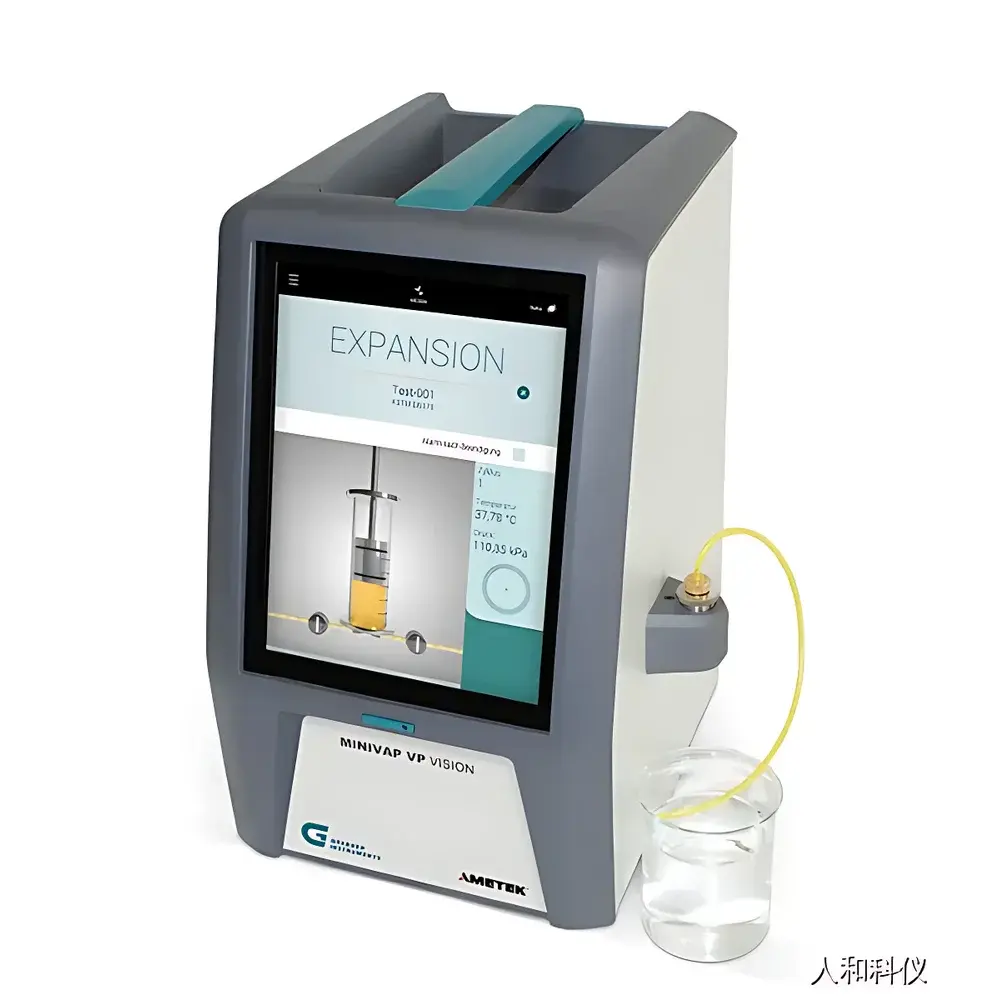
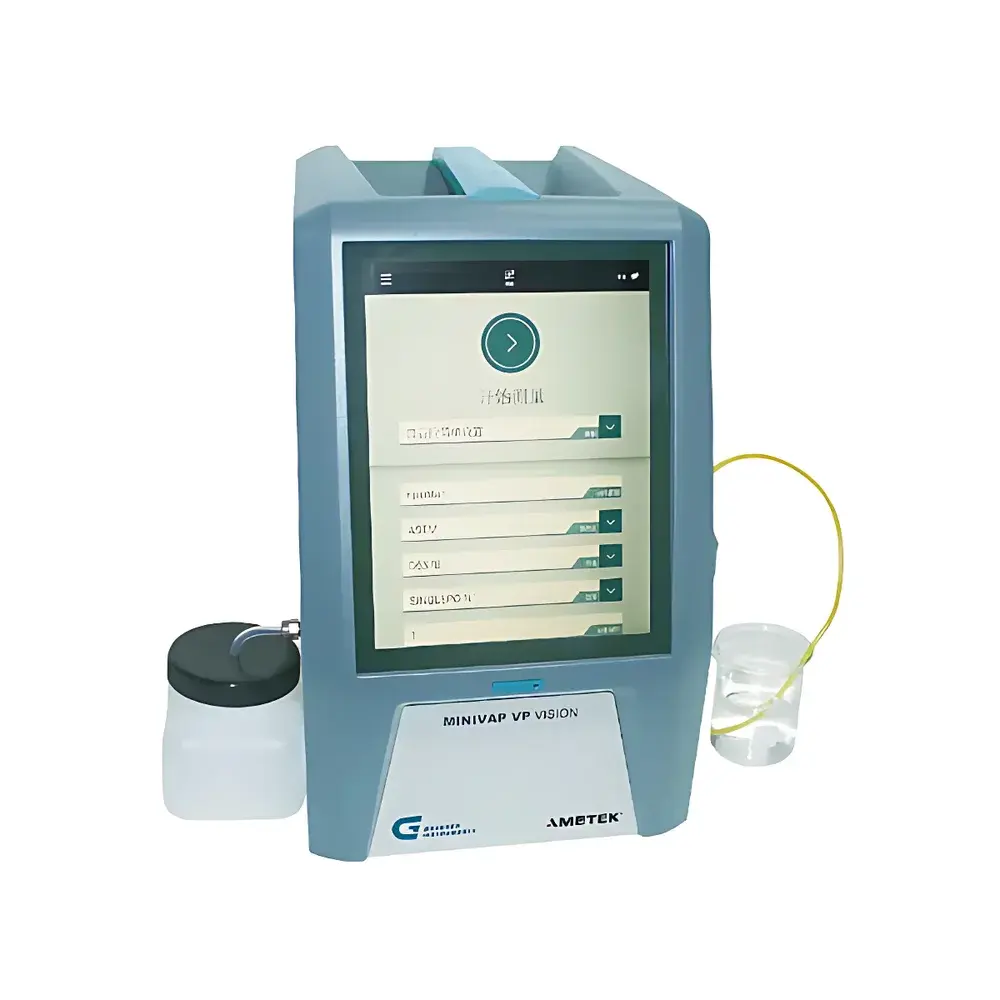
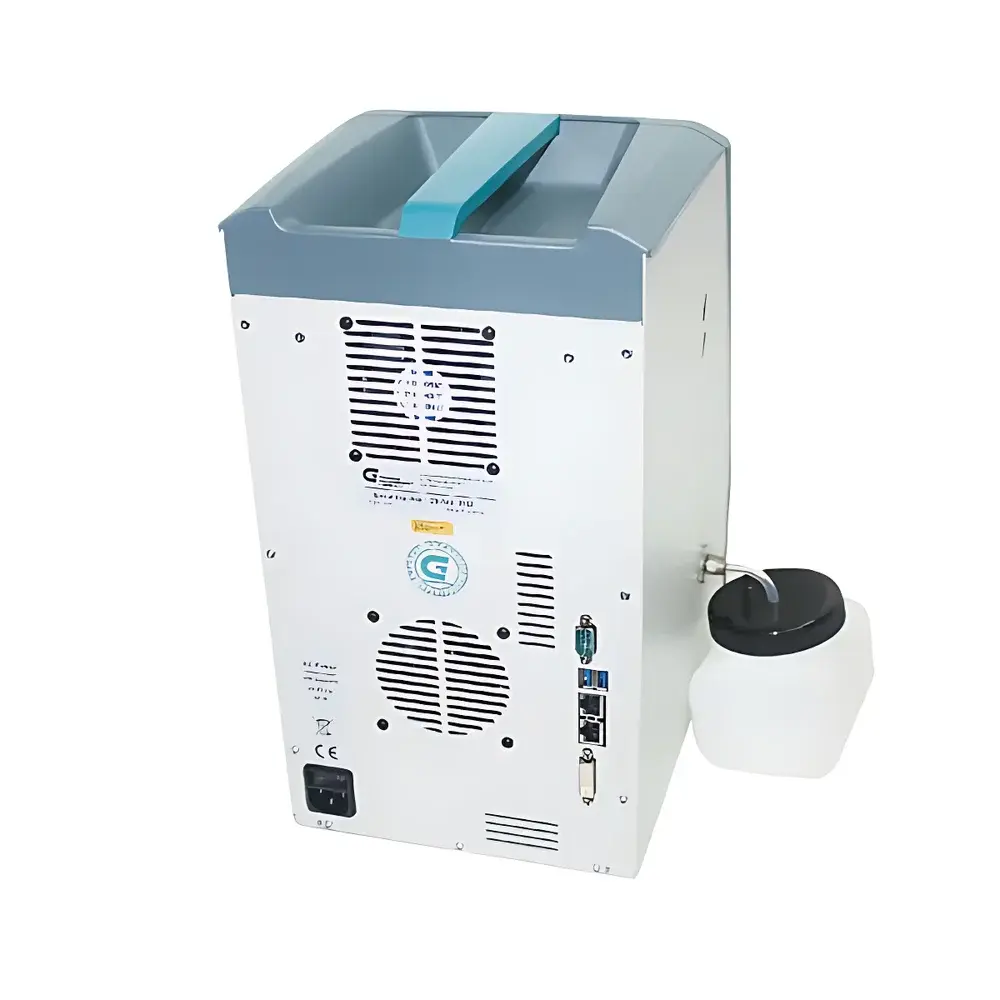
Grabner MINIVAP VP VISION Portable Vapor Pressure Analyzer
| Brand | Grabner |
|---|---|
| Origin | Austria |
| Model | MINIVAP VP VISION |
| Analysis Method | Three-Stage Expansion Method |
| Pressure Range | 0 to 2000 kPa |
| Temperature Range | −100 to 300 °C |
Overview
The Grabner MINIVAP VP VISION is a next-generation portable vapor pressure analyzer engineered for precision, robustness, and global regulatory compliance in petroleum product testing. It operates on the internationally validated three-stage expansion principle—where a precisely metered liquid sample undergoes controlled thermal equilibration and sequential expansion into a known vapor volume—enabling accurate determination of true vapor pressure (TVP), Reid vapor pressure (RVP), and equilibrium vapor pressure (EVP) across volatile hydrocarbon matrices. Designed as the direct successor to the MINIVAP VPXpert platform, the VP VISION extends operational capability to extreme pressure ranges (0–2000 kPa) while maintaining sub-0.2 kPa repeatability—verified over >10,000 consecutive test cycles under ISO/IEC 17025-accredited laboratory conditions. Its thermally stabilized measurement chamber, coupled with patented 2D-Correction™ calibration across 273 reference points, ensures traceable accuracy across the full temperature spectrum from cryogenic (−100 °C) to high-temperature (300 °C) applications.
Key Features
- Patented Grabner Sampling Pro™ piston valve system with self-lubricating ceramic seals—validated for >50,000 actuations with <0.05% carryover between samples, eliminating cross-contamination in high-throughput fuel labs.
- 10-inch industrial-grade capacitive touchscreen running Microsoft Windows® Embedded OS—supporting multi-language UI (English, German, French, Spanish, Portuguese, Italian, Russian, Arabic, Chinese, Japanese) and intuitive template-based method configuration.
- Integrated Intel® Industrial PC with 24-bit ADC and real-time thermal compensation—delivering pressure resolution of 0.01 kPa and temperature stability of ±0.01 °C at setpoint.
- Modular vibration-assisted equilibration module—optimized for crude oil and heavy distillates requiring rapid phase homogenization prior to expansion.
- Ruggedized mechanical architecture certified to EN 60068-2 environmental stress standards—including shock (EN 60068-2-27), vibration (EN 60068-2-6), humidity (EN 60068-2-78), and thermal cycling (EN 60068-2-14)—suitable for field deployment, mobile labs, and military logistics environments.
Sample Compatibility & Compliance
The MINIVAP VP VISION is validated for gasoline, jet fuel (Jet A-1, JP-8), crude oil, LPG, naphthas, solvents, and oxygenated blends—including ethanol-gasoline (E10–E85) and biodiesel blends (B5–B20). It fully supports all major international standard methods: ASTM D5191 (TVP), D5188 (RVP correction), D6377 (crude oil EVP), D6378 (low-volatility fuels), D6897 (VOC emissions); EN 13016-1+2; IP 394, 409, 481; JIS K2258-2; SHT 0769; GOST 52340. Instrument firmware includes built-in equivalence algorithms for legacy methods (ASTM D323, D1267, D2879, D4953, D5482) and fuel specification compliance checks per ASTM D910, D1655, D1835, D4814, D6227 and EN 228. All measurements are timestamped, user-logged, and audit-trail enabled—fully compliant with GLP, GMP, and FDA 21 CFR Part 11 requirements when used with Cockpit™ software’s electronic signature and role-based access control.
Software & Data Management
Grabner Cockpit™ PC software serves as the central management interface for instrument configuration, remote diagnostics, firmware updates, and data aggregation across distributed lab networks. It enables automatic device discovery over secure VPN or local LAN, real-time instrument health monitoring (pressure sensor drift, thermal stability, valve cycle count), and synchronized method deployment across fleets. Test results—including raw pressure/temperature curves, statistical summaries, and graphical overlays—are stored internally (≥60,000 tests with embedded PNG plots) and exportable in CSV and PDF formats with customizable report templates. Seamless LIMS integration is achieved via ASTM E1384-compliant HL7 messaging or direct ODBC connectivity. Cockpit™ also provides automated calibration verification logs, preventive maintenance scheduling, and remote technician support initiation—reducing mean time to repair (MTTR) by up to 73% versus traditional service models.
Applications
- Refinery quality control: Real-time RVP/TVP verification during gasoline blending and cut-point optimization.
- Aviation fuel certification: EN 228 and ASTM D1655-compliant testing of Jet A-1 volatility at −20 °C to 50 °C.
- Crude assay laboratories: High-pressure EVP profiling (up to 2000 kPa) for reservoir fluid characterization and transport safety assessment.
- Regulatory compliance labs: Multi-method execution for EPA, CARB, and EU REACH reporting—especially for VOC emission modeling using D2879-correlated indirect methods.
- Field inspection units: Battery-operated DC/AC converter option enables on-site testing at terminals, pipelines, and marine loading facilities without fixed power infrastructure.
FAQ
What vapor pressure standards does the MINIVAP VP VISION natively support?
It executes ASTM D5191, D5188, D6377, D6378, D6897; EN 13016-1+2; IP 394/409/481; JIS K2258-2; SHT 0769; and GOST 52340 out-of-the-box—with firmware-upgradable support for emerging regional specifications.
Can the instrument measure ultra-low volatility samples such as vacuum gas oils?
Yes—using the integrated vibration module and extended temperature range (up to 300 °C), it achieves reliable equilibrium for samples with initial boiling points >350 °C, validated per ASTM D6377 Annex A3.
Is remote calibration and validation possible?
Cockpit™ software supports remote calibration certificate generation, pressure transducer zero/span verification, and temperature sensor validation using NIST-traceable reference fluids—all logged with digital signatures and version-controlled audit trails.
How is data integrity ensured for regulated environments?
All measurements include immutable metadata (operator ID, instrument serial, method revision, ambient conditions), encrypted storage, and tamper-evident PDF reports compliant with 21 CFR Part 11 Subpart C requirements.
What is the minimum sample volume required for analysis?
Only 1.0 mL of neat liquid sample is required for standard operation; 2.2 mL total volume (including wash cycle) ensures full system purging and contamination control.





