
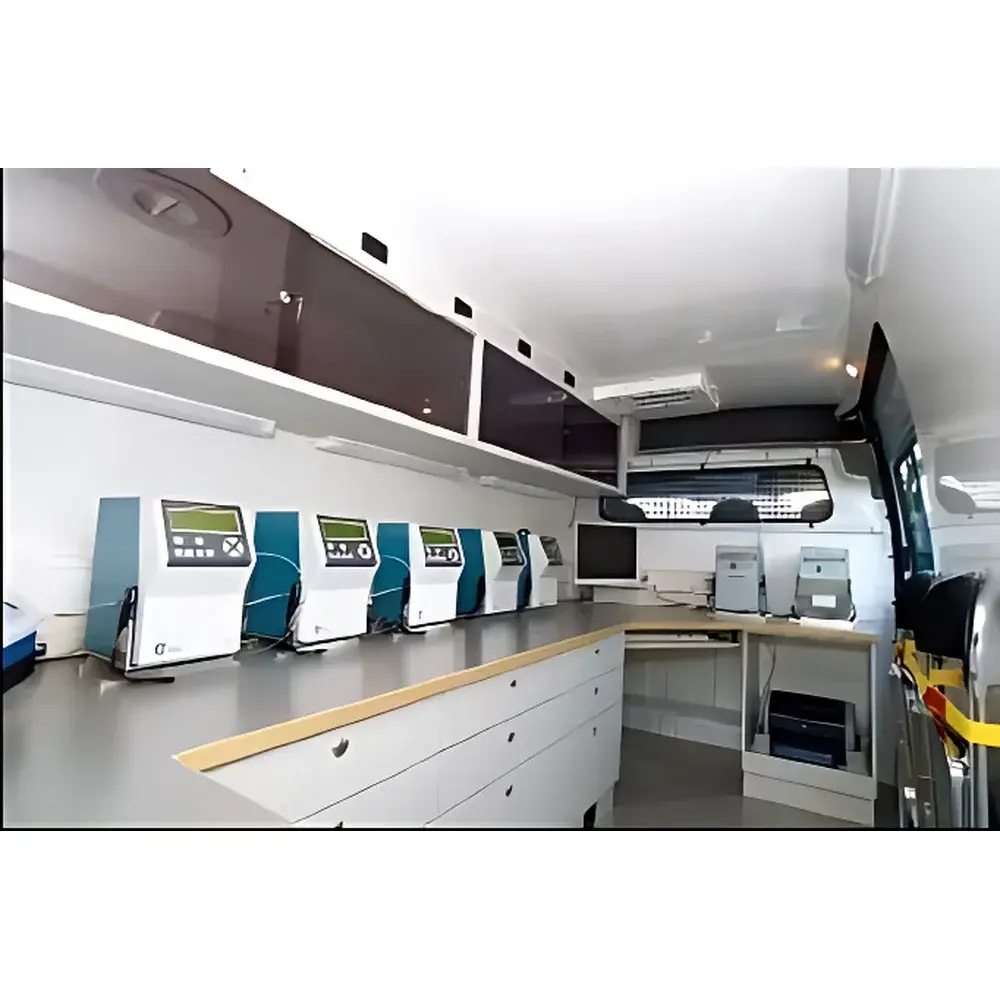
Grabner Mobile LAB Onboard Fuel Analysis Laboratory
| Brand | Grabner |
|---|---|
| Origin | Austria |
| Model | Mobile LAB |
| Vehicle Integration | Custom Chassis Options |
| Power Supply | Dual-mode (110/240 V AC + Rechargeable Battery) |
| Environmental Control | Independent HVAC with 20 air changes/hour |
| Safety | Seismic-grade instrument mounting, anti-slip flooring, fire extinguisher, dedicated waste/fresh water tanks |
| Data Infrastructure | Integrated LAN, optional GPS, printer, and PC |
| Compliance | Designed for ASTM D975, D3948, D4865, EN 590, ISO 4214, and USP <1058> analytical instrument qualification frameworks |
Overview
The Grabner Mobile LAB is a fully integrated, road-certified mobile fuel analysis laboratory engineered for real-time, on-site testing of petroleum-based fuels—including diesel, gasoline, jet fuel (Jet A-1, JP-8), biodiesel (FAME), and synthetic hydrocarbons—under field conditions. Unlike portable benchtop analyzers, the Mobile LAB implements a systems-level architecture grounded in regulatory-grade analytical workflows: it combines standardized sample handling, temperature-controlled instrumentation environments, and traceable data acquisition to support compliance with ASTM, ISO, and EN fuel specification standards. Its core operational principle centers on enabling *in situ* execution of critical quality control tests—such as flash point (ASTM D93), distillation range (ASTM D86), water content (ASTM D6304), sulfur content (ASTM D7039), and oxidation stability (ASTM D2274)—without requiring sample transport to fixed laboratories. This eliminates time delays, thermal degradation risks, and chain-of-custody uncertainties inherent in offsite analysis.
Key Features
- Modular vehicle integration: Configurable across multiple chassis platforms (e.g., Mercedes-Benz Sprinter, Ford Transit, or MAN TGE), selected based on regional road regulations, payload requirements, and terrain profile.
- Seismically isolated instrumentation platform: All analytical instruments—including Grabner MINIFLASH FP Vision flash point testers, DISTILLATION MASTER units, and XRF sulfur analyzers—are mounted on vibration-dampened, lockable steel workbenches compliant with DIN 12921-2 mechanical stability requirements.
- Dual-power redundancy: Simultaneous operation via onboard 110/240 V AC inverters (powered by deep-cycle lithium-iron-phosphate batteries) and external grid connection, ensuring uninterrupted analysis during extended deployments.
- Controlled environmental envelope: Independent HVAC system delivers ≥20 air exchanges per hour, maintaining ISO Class 8 (100,000) cleanroom-equivalent particulate control and active vapor extraction per OSHA 1910.1200 and ATEX Directive 2014/34/EU requirements.
- Regulatory-ready infrastructure: Pre-wired LAN backbone supports time-stamped, audit-trail-enabled data logging; optional FDA 21 CFR Part 11-compliant software modules available for electronic signatures and user access controls.
Sample Compatibility & Compliance
The Mobile LAB accommodates liquid fuel samples ranging from low-volatility heavy fuel oil (HFO) to highly volatile aviation gasoline (AVGAS), with dedicated containment pathways for hazardous vapors and aqueous waste streams. All fluid-handling components—including stainless-steel freshwater reservoirs (≥50 L), polyethylene waste collection tanks (≥80 L), and chemical-grade drainage conduits—meet EN 14015 and API RP 2016 material compatibility specifications. The system supports full lifecycle compliance with ISO/IEC 17025:2017 for testing laboratories, including documented instrument calibration histories, environmental monitoring logs, and preventive maintenance records. Optional third-party IQ/OQ/PQ documentation packages are available to satisfy GLP and GMP validation protocols required by refinery QA departments and aviation fuel suppliers.
Software & Data Management
Instrument control and data aggregation are centralized through Grabner’s LABNET software suite—a Windows-based application supporting simultaneous communication with up to 12 networked analyzers. LABNET enforces automated metadata tagging (GPS coordinates, operator ID, ambient temperature/humidity, sample ID), generates PDF reports compliant with ASTM E29 and ISO/IEC 17025 Annex A.2, and exports structured CSV/Excel files for LIMS integration. Audit trails record all user actions—including method modifications, result overrides, and calibration events—with immutable timestamps and digital signatures. Optional cloud synchronization enables remote data review and trend analysis via secure TLS 1.3–encrypted channels.
Applications
- Fuel quality verification at pipeline terminals, marine bunkering facilities, and airport refueling depots.
- On-the-fly contamination detection during emergency response operations (e.g., pipeline rupture, tanker spill).
- Field validation of biofuel blend ratios (B5–B20) per EN 14214 and ASTM D7467 specifications.
- Regulatory compliance auditing for fuel distributors operating across multi-jurisdictional markets (EU, US EPA, ICAO).
- Research-grade kinetic studies of fuel oxidation and deposit formation under controlled thermal cycling.
FAQ
Can the Mobile LAB be certified for use in Zone 1 hazardous areas?
Yes—when equipped with ATEX-certified instrumentation, intrinsically safe power distribution, and explosion-proof lighting, the Mobile LAB meets IEC 60079-0 and EN 60079-10-1 requirements for Zone 1 deployment.
Is remote diagnostics supported?
All Mobile LAB units include embedded Ethernet and optional 4G/LTE modems, enabling Grabner-certified engineers to perform secure remote firmware updates, sensor diagnostics, and calibration verification.
What is the typical lead time for vehicle customization?
Standard configurations ship within 12 weeks; chassis-specific adaptations (e.g., off-road suspension, cold-climate HVAC upgrades) require 16–20 weeks from order confirmation.
Are training and method transfer services included?
Comprehensive on-site operator training (2 days), SOP development support, and ASTM/EN method validation assistance are provided as part of the commissioning package.
How is instrument calibration maintained during transit?
Each analyzer undergoes factory calibration prior to installation; onboard reference standards (flash point calibrants, sulfur check standards) and automated self-diagnostic routines ensure measurement continuity between scheduled recalibrations every 90 days.



