
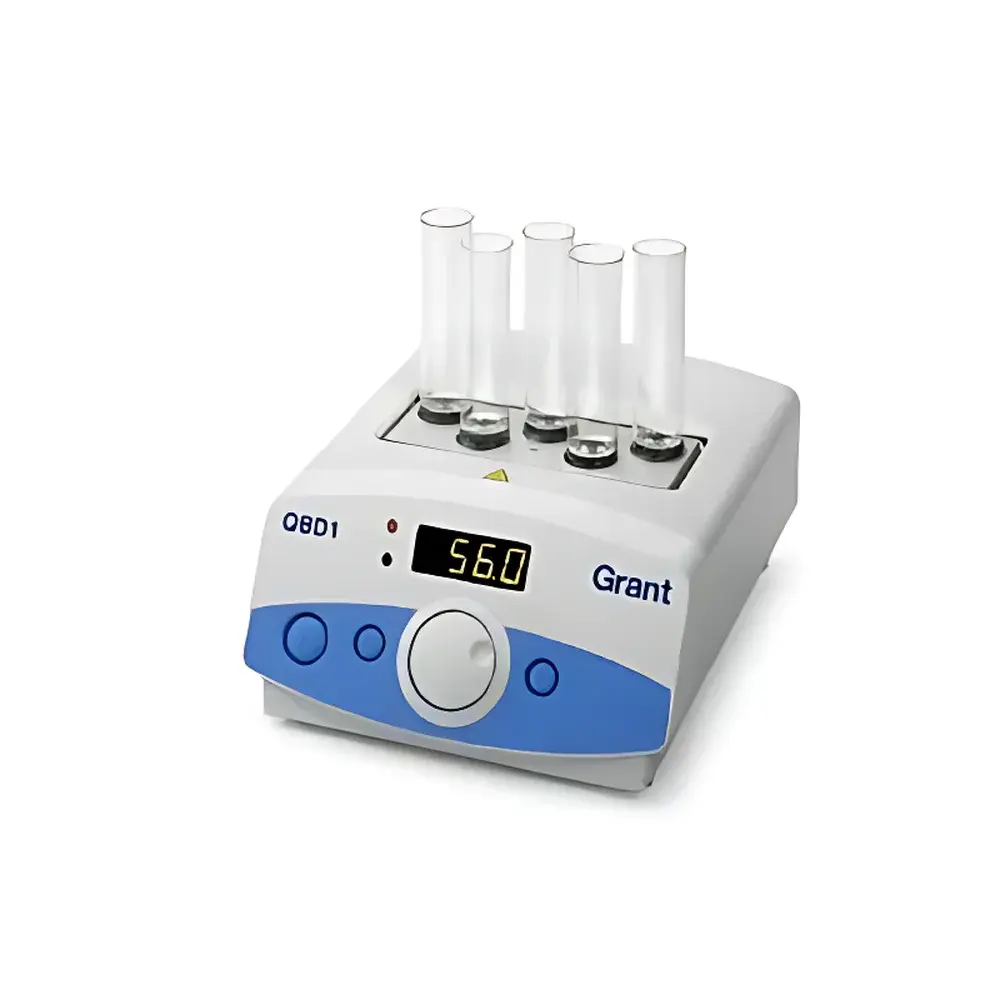
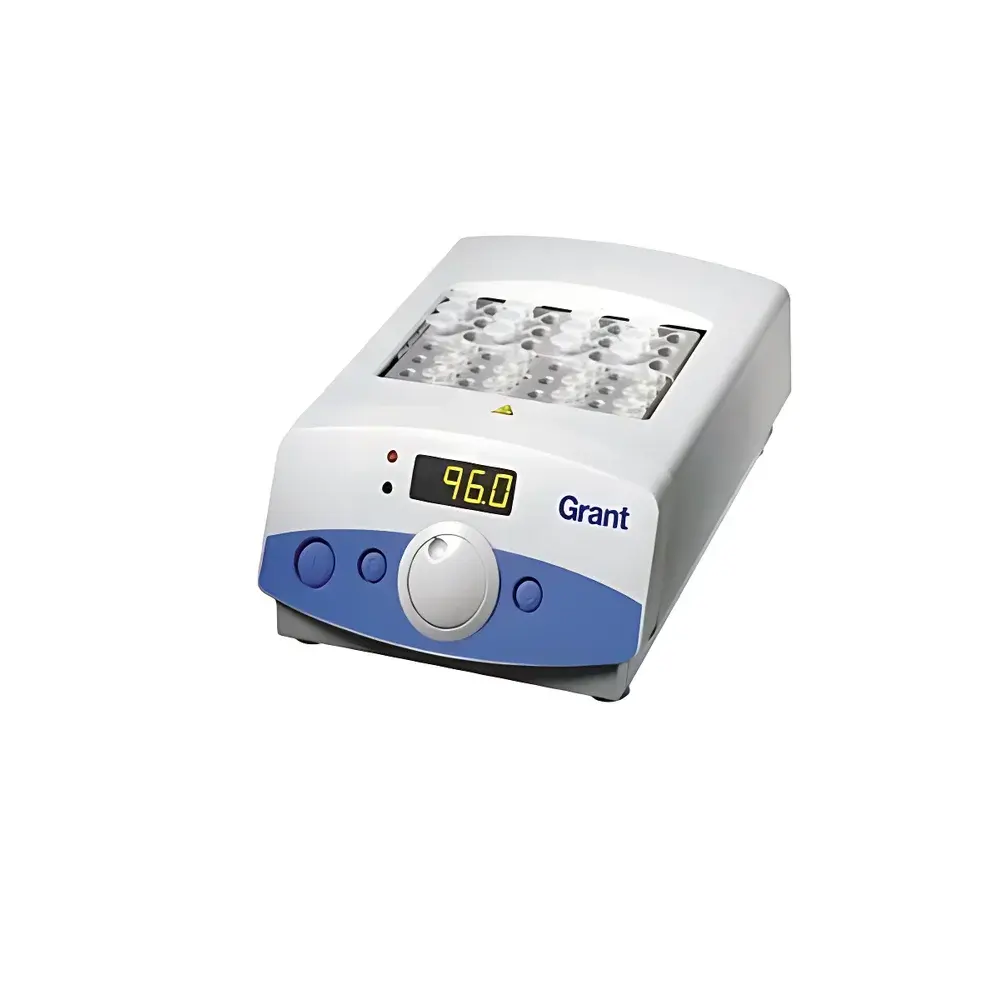
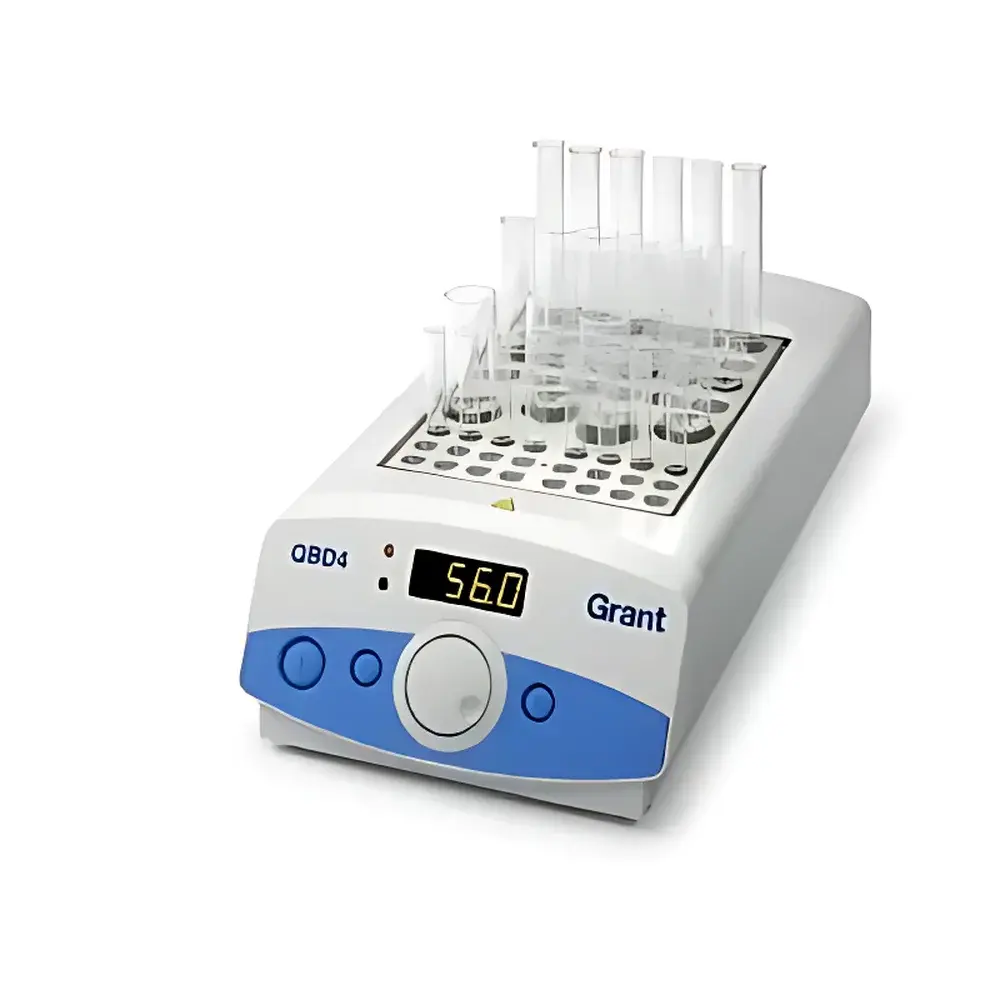
Grant QBD1 Digital Metal Bath with Programmable Temperature Control
| Brand | Grant Instruments |
|---|---|
| Origin | United Kingdom |
| Model | QBD1 |
| Temperature Range | Ambient +5°C to 130°C |
| Temperature Accuracy | ±0.1°C @ 37°C |
| Temperature Uniformity (within module) | ±0.1°C @ 37°C |
| Set Resolution | 0.1°C |
| Heating Time (25°C → 100°C) | 15 min |
| Power Consumption | 150 W |
| Input Voltage | 120 V or 230 V AC, 50/60 Hz |
| Safety Features | Over-temperature cut-off fuse, adjustable high/low temperature alarm (±0.5°C from setpoint), fault indicator display |
| Programmability | Up to 3 user-defined temperature/time segments, audible end-of-timer alert, timer extension up to 72 h |
| Calibration | Dual-point calibration support (internal and external probe) |
| Module Dimensions (H × D × W) | 100 mm × 230 mm × 200 mm |
Overview
The Grant QBD1 Digital Metal Bath is a precision-engineered, single-module dry block heater designed for consistent, reliable thermal control of sample tubes, vials, and microcentrifuge containers in molecular biology, clinical diagnostics, and pharmaceutical quality control laboratories. Unlike water baths, the QBD1 employs solid aluminum heating blocks with optimized thermal mass and active PID-controlled resistive heating to deliver rapid, stable, and contamination-free temperature environments. Its operating range spans from ambient +5°C to 130°C — suitable for enzyme incubations, DNA denaturation, reagent warming, and controlled sample thawing. The unit complies with IEC 61010-1 safety standards for laboratory electrical equipment and features integrated thermal protection via redundant over-temperature fuses, ensuring operational integrity under continuous use.
Key Features
- Digital PID temperature control with 0.1°C setpoint resolution and ±0.1°C accuracy at 37°C — validated per ISO/IEC 17025 traceable calibration protocols.
- High-uniformity aluminum block architecture delivering ±0.1°C intra-block temperature uniformity at 37°C, critical for reproducible enzymatic reactions and assay standardization.
- Three-stage programmable ramp-and-hold functionality: users define up to three sequential temperature/time segments, enabling complex thermal profiles such as stepwise denaturation or gradient-based optimization.
- Integrated reaction timer (1–999 min) with audible beep notification and optional timer extension up to 72 hours — supports unattended overnight incubations compliant with GLP documentation requirements.
- Dual-point calibration capability using both internal sensor and external reference probe — facilitates on-site verification and alignment with lab-wide metrology standards (e.g., ASTM E2251, USP <1041>).
- Configurable high/low temperature alarm threshold (adjustable in 0.5°C increments relative to setpoint) — supports real-time deviation monitoring required under FDA 21 CFR Part 11-compliant workflows when paired with audit-trail-enabled software.
- Modular design with tool-free block interchangeability — compatible with Grant’s full suite of standardized inserts (e.g., 0.2 mL PCR strips, 1.5/2.0 mL microtubes, 15/50 mL conical tubes), minimizing cross-contamination risk and eliminating liquid spill hazards inherent to water baths.
Sample Compatibility & Compliance
The QBD1 accommodates a wide array of common laboratory consumables via interchangeable, pre-drilled aluminum blocks. Standard configurations support 0.2 mL, 0.5 mL, 1.5 mL, and 2.0 mL tubes, as well as 96-well PCR plates and 15 mL/50 mL centrifuge tubes. All blocks are CNC-machined to ISO 8573-1 tolerances for dimensional repeatability and thermal contact fidelity. The device meets CE marking requirements under the EU Low Voltage Directive (2014/35/EU) and Electromagnetic Compatibility Directive (2014/30/EU). It is routinely deployed in ISO 15189-accredited clinical labs and GMP-regulated QC environments where documented thermal stability and instrument qualification (IQ/OQ/PQ) are mandatory.
Software & Data Management
While the QBD1 operates as a standalone benchtop instrument, its digital interface supports RS-232 serial output (optional adapter) for integration into centralized lab management systems. When connected to Grant’s optional LogTag® or third-party SCADA platforms, temperature logs — including setpoints, actual readings, alarm events, and timer status — can be timestamped and exported in CSV format. This enables retrospective analysis aligned with ALCOA+ data integrity principles (Attributable, Legible, Contemporaneous, Original, Accurate). Audit trail functionality, electronic signatures, and user access controls are implemented at the host system level, satisfying 21 CFR Part 11 requirements for regulated applications.
Applications
- Molecular biology: PCR tube pre-heating, restriction enzyme activation, plasmid ligation incubation, and cDNA synthesis at precisely maintained temperatures.
- Clinical microbiology: Controlled warming of blood culture bottles prior to subculture, antibiotic susceptibility testing media preparation, and serological reagent equilibration.
- Pharmaceutical QA/QC: Stability-indicating assays requiring thermal conditioning of reference standards, dissolution medium pre-warming per USP <711>, and excipient compatibility studies.
- Industrial hygiene: Calibration of temperature-sensitive sampling devices (e.g., passive dosimeters, bioaerosol samplers) using NIST-traceable reference blocks.
- Academic research: Reproducible thermal treatment of nanomaterial dispersions, polymerase chain reaction optimization, and kinetic studies of thermally activated biochemical pathways.
FAQ
What is the recommended maintenance schedule for the QBD1?
Routine visual inspection and cleaning of the block surface with isopropyl alcohol biweekly is advised. Annual verification of temperature accuracy using an NIST-traceable thermometer is recommended for GLP/GMP compliance.
Can the QBD1 be used for sterilization or autoclave simulation?
No — the QBD1 is not designed for sterilization-grade validation. It does not achieve or maintain the sustained 121°C/15 psi conditions required by ISO 17665 or EN 285; it is intended for incubation and thermal conditioning only.
Is block calibration performed at the factory or onsite?
Each unit ships with a Certificate of Conformance indicating factory calibration at 37°C and 100°C. Onsite dual-point calibration using an external reference probe is supported via the front-panel menu and fulfills ISO/IEC 17025 Clause 6.5 requirements.
Does the QBD1 support external temperature feedback from a sample probe?
Yes — the optional external PT100 probe input allows closed-loop control based on actual sample temperature rather than block surface reading, improving accuracy for low-volume or poorly conductive samples.
What power supply options are available for international deployment?
The QBD1 is auto-switching between 120 V and 230 V AC, 50/60 Hz. No manual voltage selection is required — simply connect to a grounded outlet meeting local electrical codes.
Related Products



