
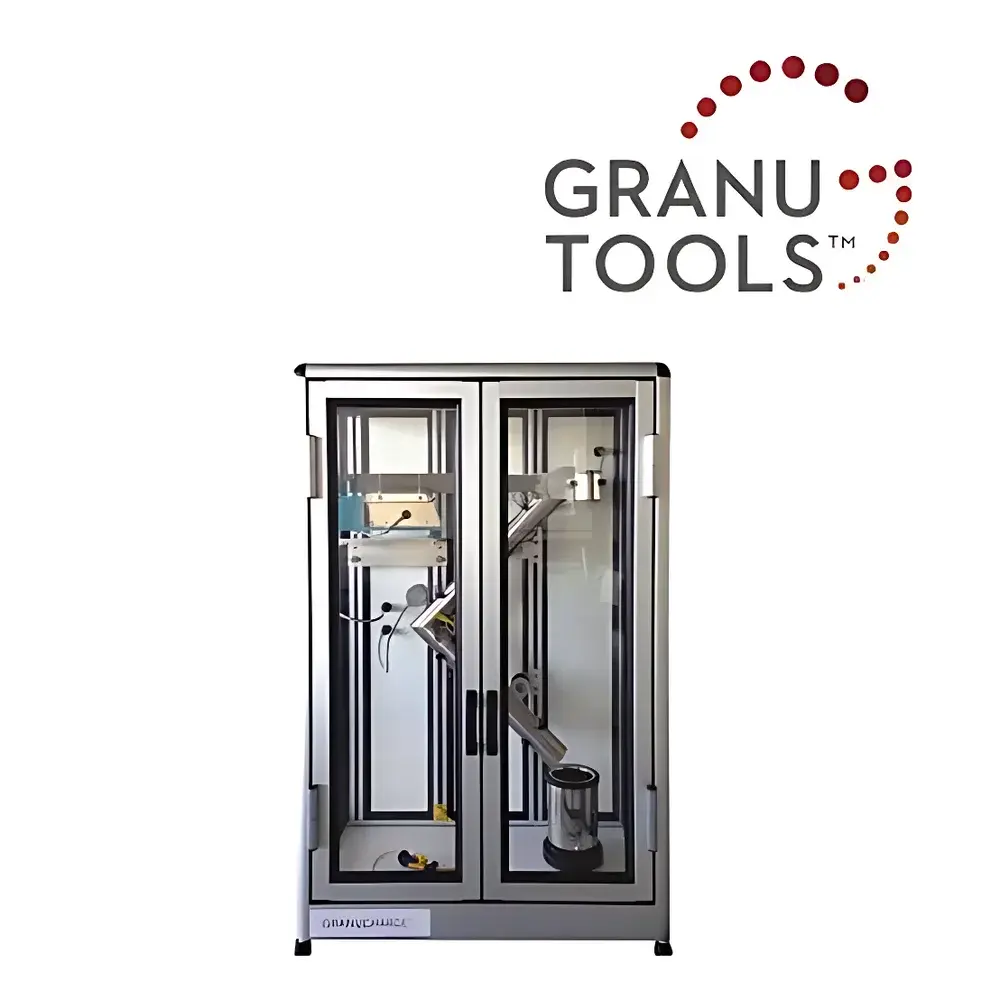
Granutools Granucharge Electrostatic Charge Analyzer
| Brand | Granutools |
|---|---|
| Origin | Belgium |
| Model | Granucharge |
| Measurement Principle | Triboelectric Charge Quantification via Faraday Cup and Electrometer |
| Sample Volume Range | 10 mL – 999,999,999 mL (practically unlimited with modular feed control) |
| Charge Resolution | ≤ 0.5 nC |
| Repeatability | ±4% RSD |
| Sample Contact Surface | Interchangeable V-tube liners (standard 316L stainless steel |
| Environmental Control | Integrated temperature & relative humidity monitoring (external chamber integration supported) |
| Compliance | Designed for GLP/GMP-aligned workflows |
| Software | Offline analysis license included |
Overview
The Granutools Granucharge Electrostatic Charge Analyzer is an engineered solution for quantifying triboelectric charge generation during powder flow—critical for understanding electrostatic hazards, process fouling, and material compatibility in pneumatic conveying, blending, filling, and additive manufacturing. Based on the fundamental principle of contact electrification (triboelectrification), the system measures net charge transfer between dry particulate solids and defined solid surfaces under controlled dynamic conditions. Powder flows through a vibrated V-shaped tube lined with a user-selectable material, then discharges into a grounded Faraday cup connected to a high-sensitivity electrometer. The resulting charge signal—recorded as charge vs. time—is directly proportional to the magnitude and polarity of surface charge acquired during interfacial contact. Unlike static charge meters or qualitative field probes, Granucharge delivers absolute, traceable, and time-resolved charge values (in nanocoulombs), enabling rigorous comparison across materials, processing conditions, and equipment geometries.
Key Features
- Modular, interchangeable V-tube liner system supporting rapid material screening—standard 316L stainless steel, with optional liners in borosilicate glass, HDPE, PVC, and aluminum for systematic tribological evaluation.
- High-fidelity charge measurement with ≤ 0.5 nC resolution and ±4% repeatability (RSD), validated against NIST-traceable calibration standards using the included verification kit.
- Vibration-controlled powder feeding ensures consistent mass flow rate and minimizes operator-induced variability—critical for reproducible tribocharging kinetics.
- Integrated environmental monitoring (temperature and relative humidity sensors) enables correlation of electrostatic behavior with ambient conditions, supporting ISO 8502-9 and ASTM D257 compliance protocols.
- Closed-system architecture meets ATEX and IEC 60079-0 safety requirements for handling combustible dusts; no open powder exposure during measurement.
- Modular mechanical design allows quick reconfiguration for different sample volumes (10 mL minimum) and flow regimes—eliminating downtime associated with hardware recalibration or cleaning between test series.
Sample Compatibility & Compliance
Granucharge accommodates free-flowing, cohesive, and semi-fluid powders—including metal alloys, polymers, pharmaceutical actives, ceramic precursors, and battery cathode materials—with particle size distributions ranging from submicron to >1 mm. Its non-destructive, bulk-scale measurement approach avoids artifacts introduced by single-particle techniques (e.g., electrostatic force microscopy). The system conforms to internationally recognized frameworks for powder characterization: it supports documentation practices aligned with ISO/IEC 17025 for testing laboratories, provides raw data export in CSV and HDF5 formats for third-party statistical validation, and—when operated with the optional GLP-compliant software module—enables electronic signatures, version-controlled SOPs, and full audit trails satisfying FDA 21 CFR Part 11 and EU Annex 11 requirements.
Software & Data Management
The Granucharge acquisition software runs on Windows-based platforms and records time-synchronized charge, temperature, and humidity data at 100 Hz sampling frequency. Each measurement session automatically generates a timestamped metadata file containing instrument configuration, liner material ID, vibration amplitude/frequency, and environmental logs. Offline analysis software (licensed separately per workstation) permits advanced curve fitting (e.g., exponential decay modeling of charge dissipation), comparative overlay of multiple charge-time profiles, and batch statistical reporting (mean charge density, peak charge rate, charge half-life). Data exports are compatible with JMP, MATLAB, and Python-based analytical pipelines. All datasets are stored in a structured directory hierarchy compliant with FAIR (Findable, Accessible, Interoperable, Reusable) principles.
Applications
- Optimizing pneumatic vacuum transfer systems by identifying pipe wall materials that minimize charge accumulation—reducing particle adhesion, line blockages, and explosion risks per NFPA 77 guidelines.
- Qualifying recycled metal or polymer powders for laser powder bed fusion (LPBF) processes, where residual surface charge influences layer uniformity and defect formation.
- Supporting formulation development in dry powder inhalers (DPIs), where electrostatic interactions govern dose uniformity and aerosolization efficiency (aligned with USP and Ph. Eur. 2.9.36).
- Investigating tribocharging mechanisms in high-shear mixers and hoppers to refine DEM (Discrete Element Method) simulations with empirically derived charge-transfer coefficients.
- Screening antistatic additives (e.g., carbon black, conductive polymers) by quantifying their effect on charge decay kinetics under controlled humidity gradients.
FAQ
What physical principle does Granucharge rely on?
It quantifies triboelectric charge transfer via Faraday cup electrometry during controlled powder flow over a defined surface—based on contact electrification physics, not capacitance or field sensing.
Can Granucharge measure charge decay over time?
Yes—time-resolved charge acquisition (up to 100 Hz) enables direct observation of charge build-up, saturation, and post-flow dissipation dynamics.
Is calibration traceable to national standards?
The included verification kit contains certified reference charges traceable to NIST SRM 2800; full calibration procedures are documented in the ISO/IEC 17025-compliant manual.
Does it support hazardous area operation?
The base unit is rated for Zone 2/Class I Div 2 environments; optional ATEX-certified vibration actuators and sealed Faraday cup variants are available upon request.
How is data integrity ensured for regulated industries?
With the GLP software module, all actions (user login, parameter changes, report generation) are logged with digital signatures, immutable timestamps, and tamper-evident hashing—fully compliant with 21 CFR Part 11 Subpart B.



