
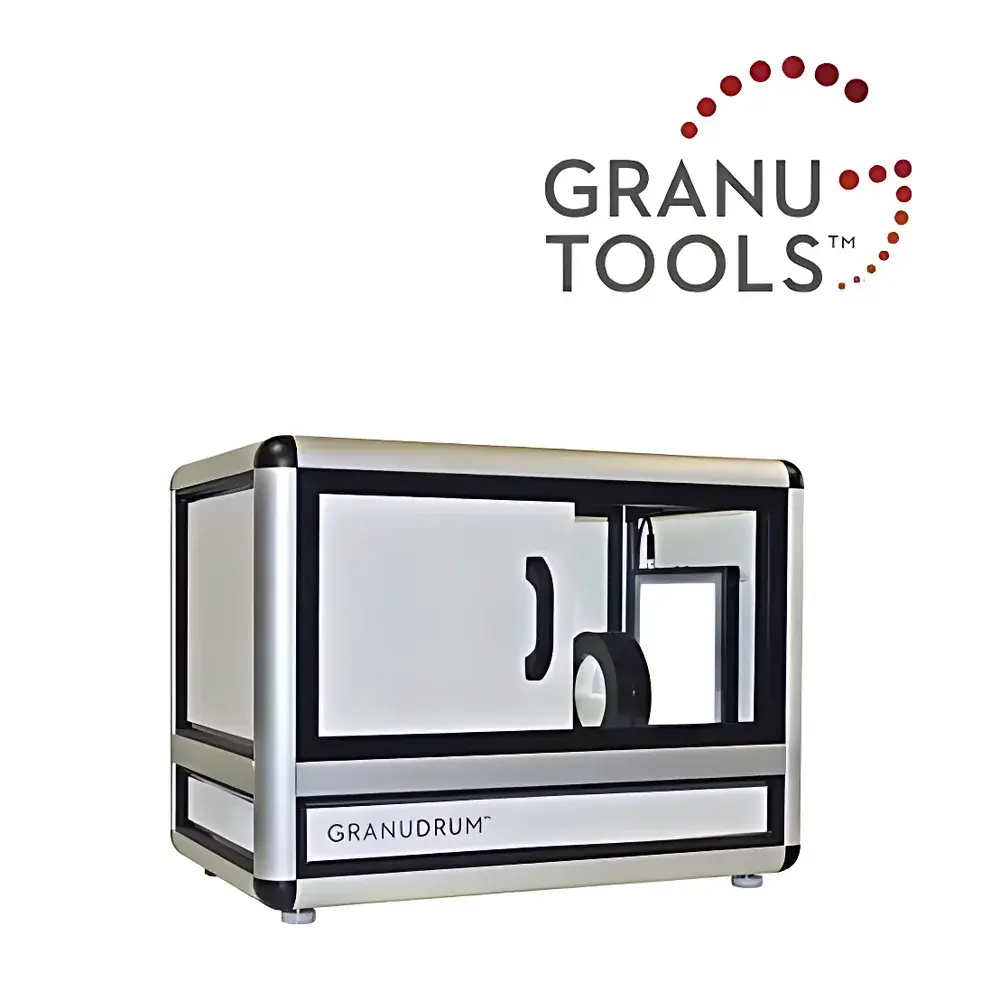
Granutools Granudrum Powder Shear Performance Analyzer
| Brand | Granutools |
|---|---|
| Origin | Belgium |
| Model | Granudrum |
| Sample Capacity | 50 mL (max), 10 mL (min) |
| Measurable Parameter | Dynamic Cohesion Index & Flow Angle |
| Rotation Speed Range | 2–60 rpm |
| Measurement Principle | Rotating Drum Imaging with CCD-Based Interface Analysis |
| Compliance | Designed for GLP/GMP-aligned workflows, supports audit-trail-capable data export |
Overview
The Granutools Granudrum Powder Shear Performance Analyzer is an automated, image-based instrument engineered for the quantitative characterization of powder flow behavior under dynamic shear conditions. It operates on the rotating drum principle—a well-established method grounded in granular physics—where a partially filled cylindrical cell rotates horizontally about its central axis. As rotation speed increases incrementally from 2 to 60 rpm, a high-resolution CCD camera captures sequential images of the powder–air interface within the transparent-walled drum. From these images, two fundamental rheological descriptors are extracted: the flow angle (also referred to as the dynamic angle of repose) and the dynamic cohesion index. The flow angle reflects the equilibrium inclination of the free surface at steady-state rotation and correlates inversely with flowability; lower values indicate reduced interparticle resistance to motion. In contrast, the dynamic cohesion index quantifies interface fluctuation amplitude—directly linked to cohesive forces such as van der Waals attraction, electrostatic interactions, and capillary bridging—making it a sensitive metric for distinguishing between free-flowing, slightly cohesive, and highly agglomerated powders. Unlike static hopper or shear cell methods, Granudrum evaluates powder response across a continuous range of low-to-moderate shear rates (equivalent to linear velocities of ~4–290 mm/s), capturing transient phenomena including thixotropy—the time-dependent evolution of cohesion during rotation.
Key Features
- Automated, repeatable measurement protocol compliant with ASTM D6393 and ISO 4497 standards for powder flow assessment
- Dual-parameter output: flow angle (±0.3° repeatability) and dynamic cohesion index (coefficient of variation < 1.8% for dense materials, < 4.2% for low-density powders)
- Modular drum design with chemically resistant internal coating, enabling compatibility with reactive, hygroscopic, or abrasive powders
- Seamless integration into controlled environments: drums can be pre-conditioned inside gloveboxes (inert gas, humidity-controlled, or temperature-regulated atmospheres) prior to measurement
- High-speed CCD imaging synchronized with precise motor control ensures consistent frame acquisition across all rotational speeds
- Optional high-temperature drum variant rated up to 200 °C, supported by NIST-traceable calibration kit
- Multiple drum volumes available (10, 20, 30, 40, and 50 mL) to accommodate limited-sample applications in pharmaceutical development and precious-metal powder analysis
Sample Compatibility & Compliance
The Granudrum accommodates dry, free-flowing, and moderately cohesive powders across a broad density and particle size spectrum—from submicron pharmaceutical actives to 100 µm metal powders used in additive manufacturing. Its non-invasive, container-based methodology eliminates wall friction artifacts common in shear cell testers. All measurements adhere to principles outlined in USP “Powder Flow”, EP 2.9.36 “Flow Properties of Powders”, and FDA guidance on powder characterization for solid dosage forms. Data integrity is ensured through timestamped image archiving, operator ID logging, and export-ready CSV/Excel outputs compatible with 21 CFR Part 11–compliant LIMS environments. Standard operating procedures (SOPs) are fully customizable and version-controlled within the software interface.
Software & Data Management
The proprietary GranuSoft™ platform provides real-time visualization of interface dynamics, automatic calculation of flow angle and cohesion index per speed step, and statistical reporting of mean, standard deviation, and trend curves. Raw image sequences, metadata, and processed parameters are stored in a structured SQLite database with optional network backup. Offline analysis licensing permits concurrent operation: one workstation controls acquisition while another performs retrospective image reprocessing or comparative cohort analysis. Batch reporting tools generate PDF or HTML summary reports—including annotated interface overlays and parameter correlation heatmaps—with configurable templates for internal QA review or regulatory submission.
Applications
- Additive manufacturing: Quantification of spreadability and layer uniformity prediction for metal and polymer powders; optimization of recoater blade speed and bed density
- Pharmaceutical manufacturing: Assessment of blend uniformity, die-filling consistency, and capsule fill weight variability in high-shear granulation and direct compression processes
- Powder handling systems: Prediction of pneumatic conveying stability, hopper discharge patterns, and silo arching propensity
- Materials R&D: Thixotropic profiling of nanostructured powders, humidity-induced cohesion changes, and surface-modifier efficacy evaluation
- Quality control laboratories: Rapid release testing of incoming raw materials against flow-specification thresholds defined in internal material specifications
FAQ
How does Granudrum differ from traditional shear cell testers?
Granudrum measures dynamic flow response under centrifugal shear without wall confinement, avoiding boundary effects inherent in vane or annular shear cells. It delivers two orthogonal metrics—flow angle (friction-dominated) and cohesion index (adhesion-dominated)—in a single experiment.
Can Granudrum assess moisture-sensitive powders?
Yes. The drum can be loaded, sealed, and equilibrated inside a nitrogen-purged glovebox prior to insertion into the instrument, preserving ambient conditions throughout measurement.
Is calibration traceable to international standards?
Rotation speed is calibrated via optical encoder feedback; angular position accuracy is verified using certified angular reference targets. Optional thermal calibration kits include NIST-traceable thermistors for high-temperature configurations.
What sample preparation is required?
Minimal: powders are gently poured into the drum to achieve 50% volume fill level. No tapping, compaction, or conditioning steps are needed—ensuring measurement reflects as-received state.
Does Granudrum support multi-user environments with audit trails?
Yes. GranuSoft™ logs user login, parameter changes, report generation events, and image deletion actions with timestamps and IP addresses—fully compliant with ALCOA+ data integrity principles.



