
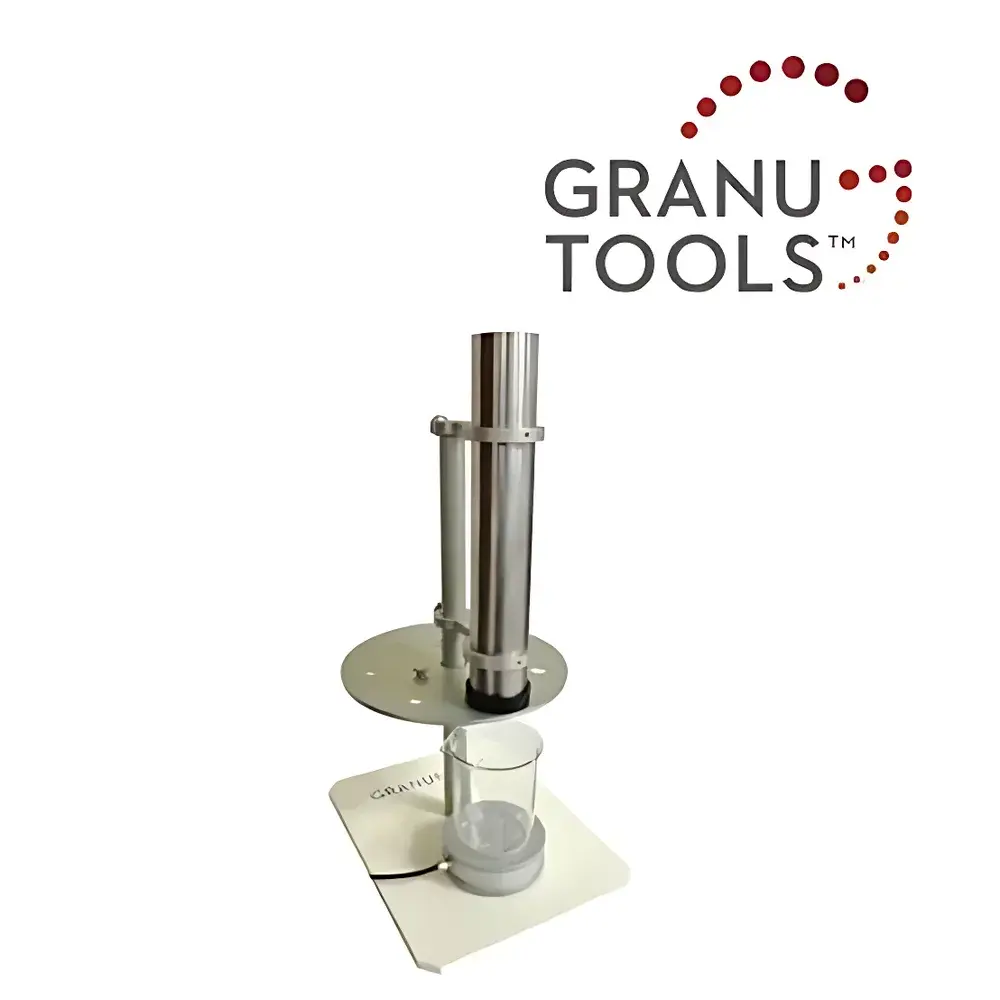
Granutools Granuflow Powder Flowability Analyzer
| Brand | Granutools |
|---|---|
| Origin | Belgium |
| Model | Granuflow |
| Sample Capacity | 500 mL (max), 50 mL (min) |
| Measurable Parameters | Flow Rate Index, Beverloo Curve |
| Orifice Array | 7 calibrated circular orifices (1–38 mm diameter) |
| Measurement Principle | Gravimetric mass-flow vs. time slope analysis |
| Compliance | ASTM B213, ISO 4490, USP <1174> |
| Reproducibility | ±2% RSD |
| Measurement Duration | <5 min per test |
| Data Output | Cb (Beverloo flow index), Dmin (minimum orifice diameter), mass flow rate (g/s) |
Overview
The Granutools Granuflow Powder Flowability Analyzer is a gravimetric, orifice-based instrument engineered for quantitative assessment of powder flow behavior under gravity-driven discharge conditions. Unlike classical funnel methods—such as the Hall Flowmeter (ASTM B213, ISO 4490) or pharmacopeial “orifice flow” tests (USP )—the Granuflow implements a systematic, multi-orifice approach grounded in the Beverloo correlation. This empirical model describes the relationship between mass flow rate (ṁ) and orifice diameter (D) as ṁ ∝ (D − k·dp)2.5, where dp is the characteristic particle size and k is a material-dependent constant. By measuring mass flow across seven precisely machined stainless-steel orifices (1–38 mm), the Granuflow generates a full Beverloo curve, enabling robust extraction of two fundamental parameters: the flow index Cb (indicative of interparticle cohesion and flow resistance) and the minimum stable orifice diameter Dmin—a critical design parameter for hopper and feeder geometry.
Key Features
- Stainless-steel (SS 316L) sample reservoir with 500 mL capacity and modular design supporting interchangeable vessel configurations (e.g., conical, cylindrical) to accommodate diverse bulk density and compressibility profiles.
- Rotating orifice plate with seven fixed-diameter circular apertures (1, 3, 6, 10, 16, 25, and 38 mm), manually indexed without disassembly—ensuring mechanical stability and eliminating cross-contamination between measurements.
- Integrated high-resolution analytical balance (0.001 g resolution) synchronized with real-time data acquisition; mass vs. time profiles are recorded at 10 Hz sampling rate for accurate slope derivation of steady-state flow.
- Automated calculation of Cb and Dmin via non-linear regression against the Beverloo equation, with goodness-of-fit metrics (R², residual analysis) reported for each test.
- Reproducibility of ±2% relative standard deviation (RSD) across repeated measurements—achieved through hardware-level vibration damping, temperature-stabilized electronics, and operator-independent protocol execution.
- Compliance-ready architecture: audit trail logging, user access levels, and timestamped raw data export support GLP/GMP-aligned workflows and FDA 21 CFR Part 11 readiness when paired with validated software configurations.
Sample Compatibility & Compliance
The Granuflow accommodates free-flowing to marginally cohesive powders across pharmaceutical, chemical, food, and metallurgical sectors. Minimum sample requirement is 50 mL—enabling rapid screening of limited or high-value formulations. It supports both dry and slightly conditioned (e.g., 25–40% RH) samples, though hygroscopic or electrostatically charged materials may require optional anti-static accessories. Regulatory alignment includes direct traceability to ASTM B213 (metal powders), ISO 4490 (metallic powders), and USP (powder flow characterization for solid dosage forms). The instrument’s physical design adheres to IEC 61000-6-3 (EMC) and IEC 61010-1 (safety), with CE marking valid for EU market deployment.
Software & Data Management
The proprietary GranuFlow Control Suite provides intuitive test sequencing, real-time curve visualization, and automated Beverloo fitting. All raw mass/time datasets are stored in .csv and .xlsx formats with embedded metadata (operator ID, date/time, environmental conditions, calibration status). Version-controlled software updates include enhanced outlier detection, comparative cohort analysis tools, and customizable report templates compliant with internal SOPs or external regulatory submissions. Audit trails record every parameter change, file export, and user login event—supporting full traceability for quality assurance teams during process validation or regulatory inspections.
Applications
- Galenic development: Classification of excipients and APIs according to flow category (e.g., “excellent”, “poor”) based on Cb thresholds established in literature (e.g., Carr’s flow index equivalents).
- Hopper design validation: Empirical determination of Dmin informs critical hopper outlet sizing to prevent arching or ratholing in silo and feeder systems.
- In-process quality control: On-line batch release testing prior to granulation or capsule filling—detecting flow degradation due to moisture uptake, milling over-processing, or blend segregation.
- Formulation troubleshooting: Correlating Cb shifts with lubricant concentration, particle size distribution changes, or surface modification treatments.
- Material equivalency studies: Objective comparison of generic vs. innovator powders using statistically comparable Beverloo-derived metrics—not just single-point flow time.
FAQ
How does Granuflow differ from traditional Hall Flowmeters?
The Hall Flowmeter measures only one flow time through a fixed orifice (typically 2.5 mm), yielding a single empirical value with no mechanistic interpretation. Granuflow acquires seven independent flow rates across a geometrically spaced orifice series, enabling derivation of Cb and Dmin—parameters directly linked to powder rheology and process design.
Is calibration required before each test?
No routine recalibration is needed between tests. The system performs automatic zero-tracking and tare compensation before each measurement cycle. Annual verification with certified weights and orifice gauge blocks is recommended per ISO/IEC 17025 guidelines.
Can Granuflow handle cohesive or fine powders (e.g., nanosilica or milled lactose)?
Yes—optional accessories include ultrasonic-assisted orifice activation and low-frequency vibratory plates to mitigate bridging. These modules maintain Beverloo correlation validity while extending dynamic range to powders with Hausner ratios >1.6.
What data output formats are supported?
Raw time-series (.csv), fitted parameter tables (.xlsx), and PDF reports with embedded plots and statistical summaries. All files include digital signatures and hash verification for integrity assurance.
Is remote monitoring or integration with LIMS possible?
Yes—the instrument supports TCP/IP communication via Ethernet, enabling direct LIMS connectivity using ASTM E1384 or HL7-compliant middleware. API documentation is provided under NDA for custom integration projects.



