
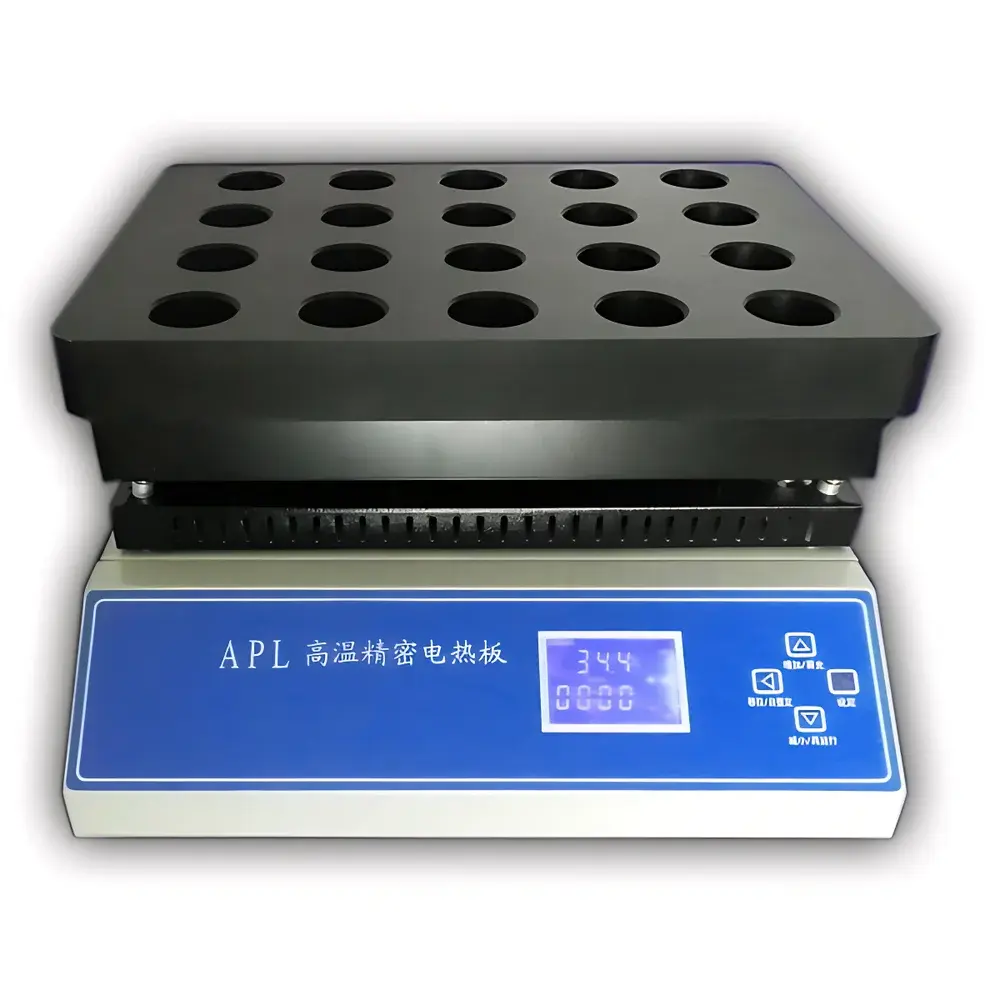
Graphite Block Digestion System APL ED20G
| Brand | APL |
|---|---|
| Origin | Sichuan, China |
| Manufacturer Type | Direct Manufacturer |
| Equipment Type | Graphite Block Digestion System |
| Model | ED20G |
| Heating Method | Uniform Surrounding Graphite Heating |
| Temperature Range | Ambient to 200 °C |
| Temperature Accuracy | ±1 °C (±0.2 °C with PID control loop) |
| Max Power | 3.6 kW |
| Number of Digestion Positions | 20 |
| Compliance | EPA Method-Compatible |
| Software Interface | RS-232/USB Digital Serial Port for PC Integration and LIMS Connectivity |
| Sample Uniformity | ±1.5 °C across all 20 positions (ambient–210 °C) |
Overview
The APL ED20G Graphite Block Digestion System is an electrically heated, programmable sample preparation instrument engineered for reproducible, high-throughput acid digestion of solid and semi-solid matrices in environmental, food, clinical, and regulatory laboratories. It operates on the principle of conductive heating via a monolithic high-purity graphite block, which provides superior thermal mass, uniform heat distribution, and chemical inertness under aggressive acidic conditions (e.g., HNO₃, HCl, HF, H₂O₂). Unlike conventional hot plates or ceramic-heated blocks, the ED20G employs a fully enclosed, one-piece graphite heating module with integrated temperature sensors at multiple spatial locations—ensuring closed-loop feedback control and minimizing radial and axial thermal gradients. This architecture enables consistent reaction kinetics across all 20 digestion vessels, supporting method-compliant batch processing per U.S. EPA Methods 3050B, 3051A, 3052, and ASTM D5511/D5512 for trace metal analysis by ICP-OES or ICP-MS.
Key Features
- Monolithic high-purity graphite heating block with proprietary PTFE–ceramic composite coating—resistant to fuming acids, high-temperature oxidation, and mechanical abrasion over extended service life.
- PID-based digital temperature controller with programmable ramp-hold profiles, adjustable heating rate (0.1–10 °C/min), dual-stage over-temperature protection, and audible/visual alarm triggers.
- Surrounding heating geometry ensures ≥95% thermal efficiency—reducing energy consumption by up to 75% compared to open-coil or ceramic plate systems while achieving full setpoint attainment within ≤8 minutes (from ambient to 200 °C).
- 20-position digestion platform with precision-machined wells accommodating standard 50 mL Teflon®-lined or quartz digestion tubes; inter-well temperature uniformity maintained at ±1.5 °C across full operating range (ambient to 210 °C).
- Corrosion-resistant front-panel controls and sealed membrane switches rated for continuous operation in Class C laboratory environments (per IEC 60529 IP54); housing constructed from reinforced polymer with stainless steel reinforcement.
- Digital serial interface (RS-232 and USB) compliant with Modbus RTU protocol—enabling bidirectional communication with host PCs, automated data logging of real-time temperature curves, and integration into validated LIMS or ELN platforms.
Sample Compatibility & Compliance
The ED20G supports digestion of diverse sample types including soils, sediments, biological tissues, plant materials, polymers, and food composites. Its graphite construction and coated surface are compatible with concentrated nitric, hydrochloric, hydrofluoric, and perchloric acids—provided appropriate fume hood ventilation and safety protocols are observed. The system meets functional requirements of U.S. EPA SW-846 Methods 3050B (acid digestion of sediments and soils), 3051A (microwave-assisted alternative reference), and 3052 (high-pressure microwave digestion validation benchmarks). While not certified as 21 CFR Part 11–compliant out-of-the-box, its digital logging capability supports audit-trail generation when deployed with validated third-party software adhering to ALCOA+ principles (Attributable, Legible, Contemporaneous, Original, Accurate) under GLP/GMP frameworks.
Software & Data Management
The ED20G includes native firmware supporting time-stamped temperature recording at user-defined intervals (1–60 sec resolution) and export of CSV-formatted datasets via USB memory or direct PC link. Optional APL DigControl™ software (v3.2+) provides graphical real-time monitoring, multi-sequence method storage (up to 99 programs), automatic pass/fail flagging against pre-set tolerance windows, and PDF report generation with digital signature fields. All logged data include instrument ID, operator ID (via login prompt), method version, start/end timestamps, and deviation alerts—facilitating traceability during internal audits or regulatory inspections.
Applications
- Preparation of environmental samples (soil, sludge, airborne particulates) for total recoverable metals analysis by ICP-OES/ICP-MS.
- Routine digestion of food and feed samples prior to Cd, Pb, As, and Hg quantification per ISO 17294-2 and EU Commission Regulation (EU) No 836/2011.
- Pharmaceutical excipient and active ingredient digestion for elemental impurities testing aligned with ICH Q3D guidelines.
- Geological sample dissolution for rare earth element (REE) fingerprinting and isotopic ratio studies.
- Validation of digestion efficiency through parallel spiked recovery experiments and CRM (Certified Reference Material) analysis (e.g., NIST SRM 2710a, GBW 07401).
FAQ
Is the ED20G suitable for HF-based digestions?
Yes—the graphite block and PTFE–ceramic coating are chemically resistant to hydrofluoric acid concentrations up to 40% w/w at temperatures ≤200 °C. Always use HF-rated digestion vessels and operate within a certified fume hood.
Can the system be calibrated and verified according to ISO/IEC 17025 requirements?
Yes—built-in sensor offsets can be adjusted using NIST-traceable reference thermometers (e.g., Fluke 1523 with dry-block calibrator). APL provides calibration certificates and uncertainty budgets upon request.
What maintenance is required to sustain long-term temperature uniformity?
Annual inspection of graphite block integrity and coating adhesion is recommended. Clean only with deionized water and non-abrasive lint-free cloths; avoid organic solvents or metal scrapers.
Does the ED20G support remote start/stop via Ethernet or Wi-Fi?
No—only RS-232 and USB interfaces are natively supported. Ethernet or Wi-Fi connectivity requires external industrial protocol gateways (e.g., Moxa EDS-G205A) configured for Modbus TCP bridging.
How is temperature accuracy verified across all 20 positions?
APL recommends quarterly verification using a 20-channel thermocouple scanner (e.g., Omega OM-DAQPRO-5300) with NIST-traceable probes inserted into empty digestion tubes placed in each well.



